
A windshield display is a reflection trick, like Pepper's ghost
Supplier and patent documentation show the shared mechanism, without confirming production dates or eyebox figures.
- First source published
- February 8, 2011
- Site publication
- September 18, 2026
What the supplier's own documentation states, as retrieved
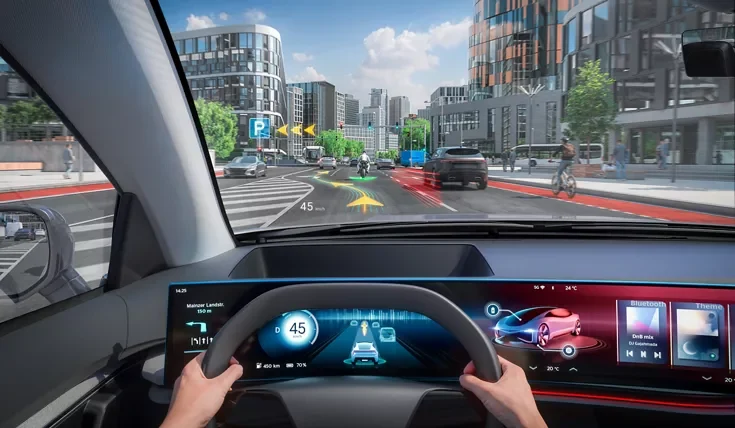
Continental's automotive division now presents its head-up display work under the Aumovio name; continental-automotive.com currently redirects to aumovio.com, and it is that page which carries the current documentation. It describes a 'mirrorless AR HUD' offering 'a wide virtual depth range, largely independent of windshield geometry', and a separate 'scenic view' system that 'reflects important information for the driver with an exceptionally high light intensity onto a specially coated, black-printed area along the lower edge of the windshield'. The page does not state which production vehicles carry either system or when they were first fitted, so this review does not assert a deployment date beyond what the document itself confirms: the technology exists in the supplier's current lineup as described.
A reflected virtual image, the same trick behind a stage illusion
Both a windshield head-up display and a Pepper's ghost projection form a virtual image by reflecting light off an angled, partially reflective surface, so a viewer sees an image that appears to float in space beyond the physical surface doing the reflecting. A patent granted in 2011 for a theatrical Pepper's ghost projection system describes exactly this: a virtual image 'appearing to be located behind the screen' through projection reflected off a tensioned, angled foil. A windshield performs the equivalent role for a driver, with the glass standing in for the foil and the instrument cluster or a dedicated projector standing in for the theatrical projector. The families differ in scale, brightness and purpose, not in the underlying optical principle.
Why the comparison has limits
The patent describes a stage effect built around a large-format foil viewed by an audience from a fixed auditorium, not a single-driver optical system with a defined eyebox, the small volume of space within which a driver's eyes must sit for the reflected image to align correctly. Aumovio's description of 'a wide virtual depth range, largely independent of windshield geometry' is the supplier's claim about solving exactly that constraint, but the page retrieved for this review does not give eyebox dimensions or a virtual image distance in figures, so those specific numbers cannot be stated here as documented facts.
Questions to bring to a demo
- What is the eyebox size, and does it account for different driver heights and seating positions?
- At what fixed distance does the virtual image appear, and does that distance change with windshield rake or curvature?
- Is the claimed wide virtual depth range documented with figures, or only described qualitatively?
A windshield head-up display and a theatrical ghost effect are close cousins because both rely on reflection to place an image where no physical screen exists. The automotive version adds constraints, a single viewer, a moving vehicle, ambient daylight, that the stage version does not have to solve, and a supplier's page describing the result in qualitative terms is not the same as a published eyebox specification.
Sources & reading trail
Manufacturer documentation (Continental's automotive business, now Aumovio) describing a mirrorless AR HUD and a windshield-reflection scenic-view HUD, without production-vehicle dates or eyebox figures.
Source published: Not established · Retrieved: 16 September 2026
Describes, for theatrical projection, the same underlying optical principle of forming a virtual image via reflection off an angled partially reflective surface that a windshield HUD also depends on.
Source published: 8 February 2011 · Retrieved: 16 September 2026
Primary documents establish the record; the mechanism reading and the demo questions are Presence Atlas editorial analysis. This retrospective draft does not imply the site published on the event date.
Continue reading
- John Henry Pepper's own account explains the ghost's glass trick
- An angled sheet of glass fixes where a ghost can be seen
- Waveguide combiners are the window into see-through headsets
- Browse the complete the archive
Sources & reading trail
- AUMOVIO — Head-up displays
Retrieved: September 16, 2026 - Projection apparatus and method for Pepper's ghost illusion (US7883212B2)
Source published: February 8, 2011 · Retrieved: September 16, 2026
The documents above establish the record. The reading and the questions are this publication’s editorial analysis, written after the fact.
Published September 18, 2026, not on the date of the event described.