
Waveguide combiners are the window into see-through headsets
A nanophotonics review frames field of view, brightness and colour uniformity as one linked design trade-off.
- First source published
- October 7, 2020
- Site publication
- September 18, 2026
What the review documents
"Waveguide combiners for mixed reality headsets: a nanophotonics design perspective," by Microsoft HoloLens researchers Bernard Kress and Ishan Chatterjee, appeared in the journal Nanophotonics on 7 October 2020 (the bibliographic record for the paper, cited because the publisher's own page could not be retrieved for this piece, gives the title, authors, date and abstract). The review frames the waveguide combiner — the transparent element in front of the eye — as "the direct window to both the digital content and the real world for the user's eyes," and argues that headset design turns on two linked demands: comfort (wearable, visual, vestibular and social) and immersion. That framing is the review's central claim: optical choices are not made in isolation from how a headset feels to wear.
What creates the image, in plain terms
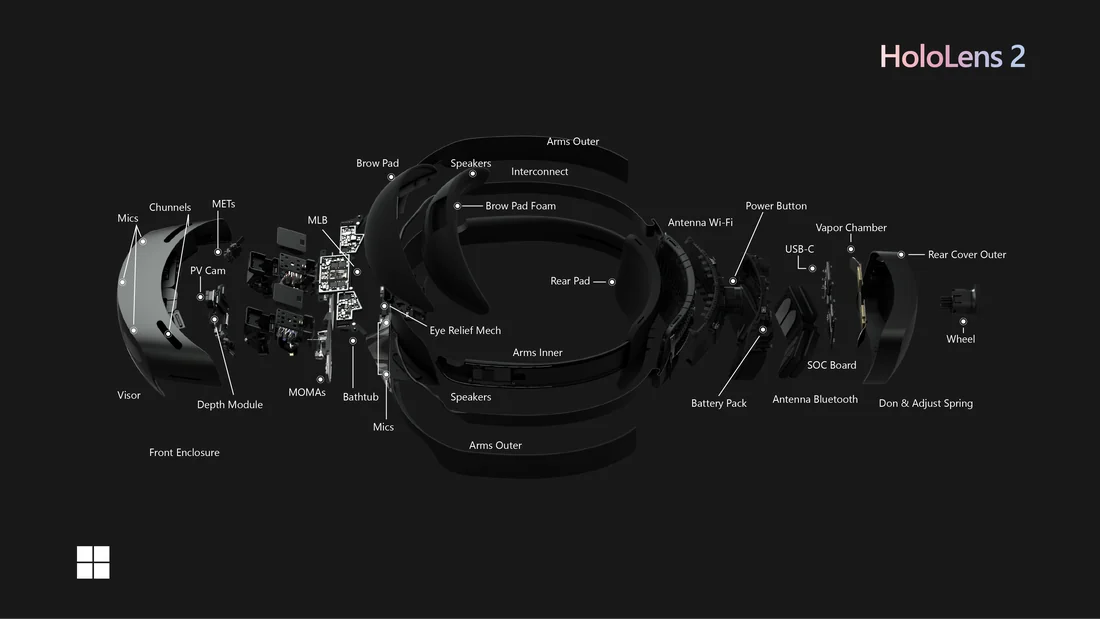
A waveguide combiner takes light from a small projector at the temple, injects it into a thin sheet of glass or plastic, and guides it by total internal reflection until a second grating or mirror array steers it back out toward the eye — the same "see-through holographic lenses (waveguides)" that Microsoft's own HoloLens 2 specification names as its display optic. Diffractive designs use etched or holographic gratings to couple light in and out; reflective designs use angled semi-mirrors instead. Either way, the wearer needs a fairly precise eye position behind the waveguide's exit area for the image to appear correctly, and ambient light competes directly with the projected image because the combiner is transparent by design. A 2024 prototype at glasses scale, Meta's Orion glasses, was described by its maker as having "the largest field of view in the smallest AR glasses form to date" — a claim that only makes sense against this trade-off.
What the trade-off actually constrains
Widening the field of view in a waveguide means guiding light across a wider range of angles, which is harder to do efficiently and evenly; that is why field of view, brightness and colour uniformity behave as one coupled problem rather than separate specifications a vendor can improve independently. A headset can claim a wide field of view or high brightness, but the review's framing implies a maker is choosing where the compromise falls, not eliminating it. None of the sources opened for this piece give independent efficiency or colour-uniformity measurements for a specific shipping headset; they establish the mechanism and the design logic, not a tested result, and the general optics above are presented as editorial synthesis rather than a direct quotation.
Questions to bring to a demo
- Does brightness or colour visibly shift between the centre and the edge of the field of view?
- How does the image change if the headset shifts on the wearer's face, moving the eye relative to the waveguide's exit area?
- How much does bright ambient light wash out the image compared with a dim room?
The word 'holographic' attached to more than one product built on this mechanism, but the combiner itself is a waveguide, not a wavefront reconstruction; the review names the comfort-and-immersion trade-off every such design is actually negotiating.
Sources & reading trail
Bibliographic record giving the review's title, authors, journal, date and abstract describing the comfort-and-immersion framework for waveguide combiner design.
Source published: 7 October 2020 · Retrieved: 16 September 2026
Documents a shipping waveguide combiner, naming the display optic as 'see-through holographic lenses (waveguides).'
Source published: Not established · Retrieved: 16 September 2026
Gives a glasses-scale example of the same field-of-view trade-off, claiming the largest field of view in the smallest AR glasses form to date.
Source published: 25 September 2024 · Retrieved: 16 September 2026
Primary documents establish the record; the mechanism reading and the demo questions are Presence Atlas editorial analysis. This retrospective draft does not imply the site published on the event date.
Continue reading
- Microsoft called HoloLens holographic before it shipped
- Meta showed AR glasses it does not plan to sell yet
- HoloLens stopped being made at the end of 2024
- Browse the complete the archive
Sources & reading trail
- Waveguide combiners for mixed reality headsets: a nanophotonics design perspective
Source published: October 7, 2020 · Retrieved: September 16, 2026 - HoloLens 2 hardware
Retrieved: September 16, 2026 - Introducing Orion, Our First True Augmented Reality Glasses
Source published: September 25, 2024 · Retrieved: September 16, 2026
The documents above establish the record. The reading and the questions are this publication’s editorial analysis, written after the fact.
Published September 18, 2026, not on the date of the event described.