
An angled sheet of glass fixes where a ghost can be seen
A 2011 illusion patent and Pepper's own 1890 account show why the reflected image floats at one depth and vanishes from some seats.
- First source published
- January 21, 1865
- Site publication
- September 18, 2026
A geometry documented twice, 121 years apart
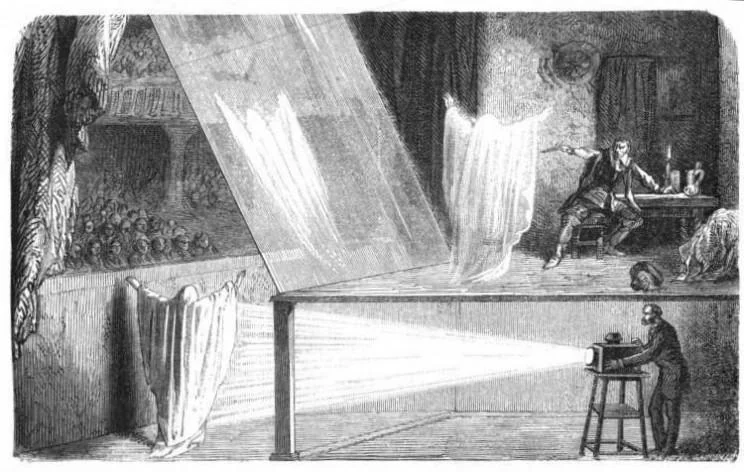
The Pepper's ghost illusion depends on one piece of geometry: an angled glass or foil sheet between audience and stage, reflecting a brightly lit, hidden performer so the image appears to float among objects on the visible stage. John Henry Pepper's own 1890 account, The True History of the Ghost, describes the arrangement directly: the glass is 'set at such an inclination as to bring the reflected image to the level of the visible or ordinary stage', while the performer occupies 'a second stage at a lower level... hidden from the audience'. A modern illusion patent, US Patent 7,883,212, granted in 2011, describes the same geometry updated for projection: a screen 'inclined at approximately 45 degrees to the plane of emission of light from the projector'.
What creates the image, and why brightness matters so much
The mechanism is straightforward reflection, not any form of hologram: light from the hidden subject, or a projector in the modern version, bounces off the angled transparent surface toward the audience at an angle equal to its angle of incidence. Because glass and foil are only partially reflective, the hidden subject must be lit far more strongly than the visible stage; Pepper's text notes the hidden stage was 'strongly illuminated by artificial light' with 'means for instantaneously extinguishing or masking the light' to end the effect. The 2011 patent quantifies the modern equivalent as needing 'a bright projector (8,000 lumens+)' to overcome ambient light and avoid a washed-out, 'milky hue' reflection. In both cases the ghost's apparent depth is fixed by the physical distance between the glass and the hidden subject or screen; it does not respond to where the audience sits.
The dead zones a producer has to plan around
Because the reflection only reaches the audience along specific angles, Pepper's account states the effect 'will be visible from all parts of the house except those extreme positions which cannot command a view through the glass', and adds that the original calibration required 'persons in the different parts of the house to say when the image is shewn to them correctly'. That is a documented, empirically tuned dead zone, not a footnote. An 1865 illustration of the stage arrangement, published in Le Monde Illustré, shows the same angled-glass layout explained to the public within a few years of its debut, useful here only as provenance, not technical specification. The 2011 patent's variable-incline mounting exists to correct keystone distortion from the projection angle, the modern version of the same seating-dependent problem.

Questions to bring to a demo
- From which seats does the reflected image disappear or distort?
- How is the hidden performer, object or projector's beam kept invisible to the audience?
- What ambient light level was the rig calibrated for, and does the venue match it?
Two accounts a century apart describe the same fixed-angle reflection and seating limits. Anyone billing this as a hologram is describing the wrong mechanism; it is a controlled reflection, and its geometry is exactly why it only works from where it was built to be seen.
Sources & reading trail
Specifies the geometry: a partially transparent screen inclined at approximately 45 degrees to the projector's beam, a bright projector (8,000 lumens or more) to overcome ambient light, and keystone correction from tilting the reflective board.
Source published: 8 February 2011 · Retrieved: 16 September 2026
Pepper's own account specifies the mechanism: glass angled to bring the reflection to stage level, a hidden lower stage strongly illuminated, and dead zones for seats that cannot see through the glass to the reflected area.
Source published: Not established · Retrieved: 16 September 2026
Documents an 1865 published illustration of the stage arrangement (Le Monde Illustré, 21 January 1865), useful as provenance for how the layout was depicted at the time, not as a technical specification.
Source published: 21 January 1865 · Retrieved: 16 September 2026
Primary documents establish the record; the mechanism reading and the demo questions are Presence Atlas editorial analysis. This retrospective draft does not imply the site published on the event date.
Continue reading
- John Henry Pepper's own account explains the ghost's glass trick
- A tensioned foil scaled Pepper's ghost to concert-size stages
- Pepper's own 1890 memoir explains the ghost illusion's staging
- Browse the complete the archive
Sources & reading trail
- Projection Apparatus and Method for Pepper's Ghost Illusion (US Patent 7,883,212 B2)
Source published: February 8, 2011 · Retrieved: September 16, 2026 - The True History of the Ghost: And All About Metempsychosis
Retrieved: September 16, 2026 - Peppers Ghost.jpg (Wikimedia Commons file record)
Source published: January 21, 1865 · Retrieved: September 16, 2026
The documents above establish the record. The reading and the questions are this publication’s editorial analysis, written after the fact.
Published September 18, 2026, not on the date of the event described.