
Pepper's own 1890 memoir explains the ghost illusion's staging
Pepper's 1890 book records the double-stage glass technique, the Dircks dispute over credit, and why Victorian audiences were fooled.
- Site publication
- September 18, 2026
A showman's memoir, not a manual
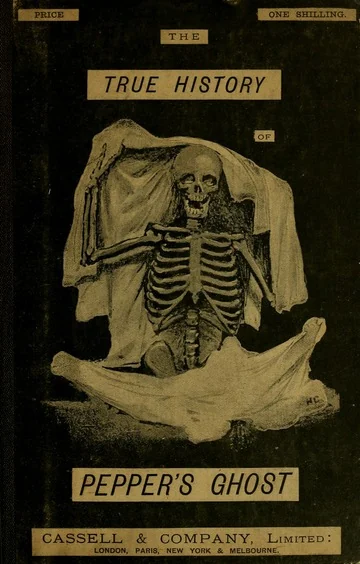
In 1890, showman John Henry Pepper published The True History of the Ghost, a 76-page account of the illusion that carries his name. The book is not an engineering manual; it is a retrospective defence of Pepper's own role, written nearly three decades after the effect debuted at London's Royal Polytechnic Institution. Pepper describes a private view just before Christmas 1862, a rapid move to the Polytechnic's large theatre by Easter 1863 as crowds grew, and a visit from the Prince and Princess of Wales at the end of May 1863. He records that the illusion ran for fifteen months and helped raise twelve thousand pounds, figures that appear only in his own telling and should be read as a promoter's account of his own success, not an audited record.
The glass, the angle, and the dark stage behind it
Pepper's description of the mechanism is specific. A large sheet of glass stood on the ordinary stage, inclined so spectators looked through it toward the players while also catching a reflection of a second, hidden stage below and in front, strongly illuminated by artificial light and instantly darkened to make a phantom vanish. The ghost performer stood on that hidden stage, leaning against a support angled to match the glass, dressed in black velvet so no stray reflection of the hidden stage reached the audience. Scenery concealed the glass's frame. None of this works from an arbitrary seat: the illusion depends on a fixed viewing zone in front of the raked glass, a darkened auditorium relative to the lit hidden stage, and precise control of when that second stage is lit or blacked out.
A contested credit, told by the winner
The book's most pointed passages concern Henry Dircks, whose earlier model Pepper says the Crystal Palace and other venues had already declined. Pepper writes that he improved and simplified the illusion far beyond what Dircks had shown him, enough to be staged in an ordinary theatre, and quotes a patent hearing in which a law officer reportedly declined to patent Dircks's original idea until persuaded by Pepper's own double-stage improvement. The Science Museum Group's biography record for Pepper differs in emphasis, stating the illusion was first demonstrated by Henry Dircks before Pepper's name became attached to it. Neither document is neutral: one is the interested party's memoir, the other a museum's summary judgement. Together they establish that credit was disputed at the time and remains a matter of framing, not settled fact.
- Whose account of who invented an illusion is being told, and who is left out of it?
- Does a modern staging still depend on a fixed sightline and a darkened auditorium, or has projection replaced the glass entirely?
- What contemporaneous record, other than the promoter's own book, describes audience reaction?
Pepper's memoir is valuable because it is partisan: it shows how a showman wanted his invention remembered, down to the shillings taken and the royal visitors received. That makes it a primary source for staging mechanics and for the politics of credit, but not for independent verification of either.
Sources & reading trail
Pepper's own account of the double-stage glass technique, the 1862-63 Royal Polytechnic run, and his dispute with Henry Dircks over credit.
Source published: Not established · Retrieved: 16 September 2026
Museum biographical record crediting Henry Dircks with first demonstrating the illusion, a different emphasis from Pepper's own account.
Source published: Not established · Retrieved: 16 September 2026
Primary documents establish the record; the mechanism reading and the demo questions are Presence Atlas editorial analysis. This retrospective draft does not imply the site published on the event date.
Continue reading
- John Henry Pepper's own account explains the ghost's glass trick
- An angled sheet of glass fixes where a ghost can be seen
- A tensioned foil scaled Pepper's ghost to concert-size stages
- Browse the complete the archive
Sources & reading trail
- The True History of the Ghost
Retrieved: September 16, 2026 - John Henry Pepper (Science Museum Group Collection)
Retrieved: September 16, 2026
The documents above establish the record. The reading and the questions are this publication’s editorial analysis, written after the fact.
Published September 18, 2026, not on the date of the event described.