
Two flat drawings taught Wheatstone how depth is seen
Museum records of Wheatstone's mirror stereoscope and a secondary sketch of his life fix 1838 as the year binocular fusion was demonstrated as a display trick.
- Site publication
- September 18, 2026
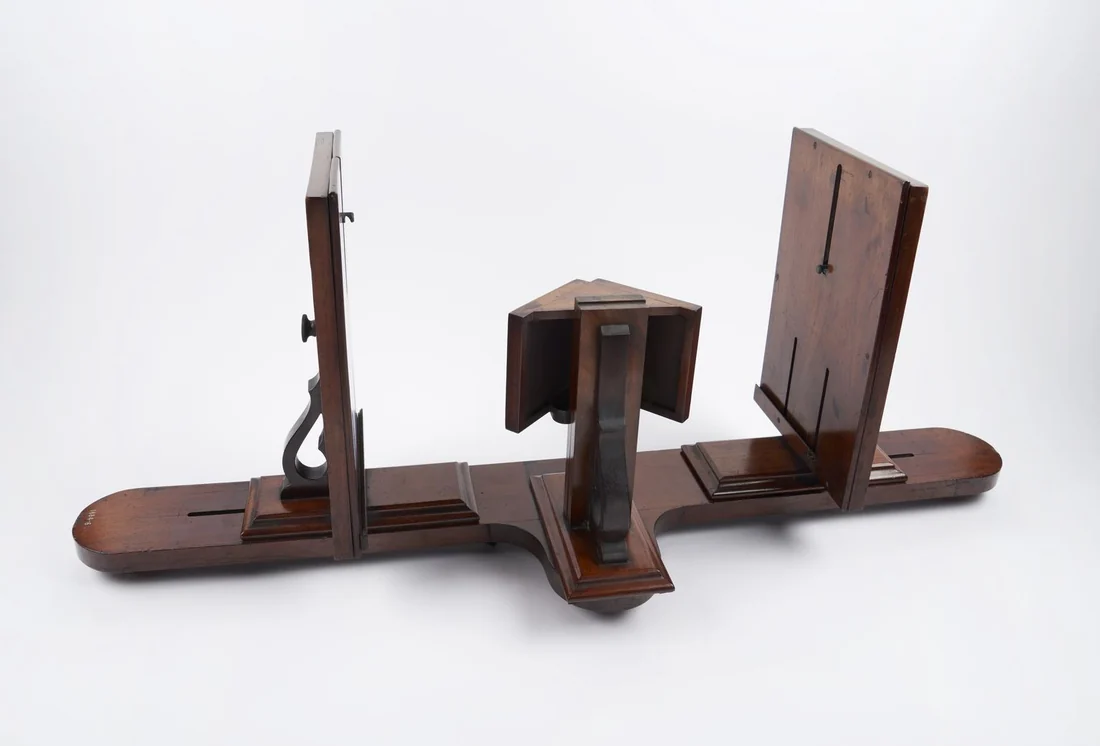
A mirror box that split two drawings between two eyes
Two Science Museum Group objects anchor this record: a mahogany reflecting stereoscope originally used by Sir Charles Wheatstone, catalogued to 1845-1855, and a set of seven original stereograms drawn for it. Neither record carries the date of Wheatstone's founding paper. A secondary account, a sketch of Wheatstone reprinted on Wikisource from an 1876 issue of Popular Science Monthly, states that he published two papers on vision in the Philosophical Transactions in 1838, one explaining the principles of the stereoscope, and adds that the work was the fruit of profound study of the physiology of vision rather than a chance find. This entry treats 1838 as the year of record and does not assert a specific day, since the paper itself could not be opened directly for this draft.
Two flat pictures, fused into one solid one
The mechanism is binocular parallax used on purpose. A stereoscope shows each eye a separate flat drawing, made from two slightly different horizontal viewpoints spaced like a pair of human eyes. In Wheatstone's reflecting design, two mirrors angled apart in a shallow V return one drawing to the left eye and the other to the right; the visual system fuses the pair into a single scene with an impression of depth that neither drawing carries alone. Viewing conditions matter: eyes must sit close to the mirror hinge and look straight ahead, both drawings need even lighting, and only one head fits the correct position at a time. Nothing about a lens, a laser or a screen is required; the illusion lives in how the brain combines two offset views, which is exactly why the trick still works from plain cardboard.
What a surviving instrument does and does not prove
An object in a case confirms that Wheatstone built and used this apparatus; it does not, alone, establish what his paper argued or how it was received. The 1876 sketch used here is a secondary, retrospective source, treated as a third reference rather than as proof of the paper's own wording. The stereograms, numbered 5 to 39 of what was evidently a larger set, are themselves undated by the museum's own catalogue and cannot fix the paper to a particular month. A claim that Wheatstone read his paper to the Royal Society on a specific day in June 1838 goes beyond what these opened records show, and this draft does not repeat it as fact.
- Does the display still rely on nothing more than two offset flat images, or has it added focus cues the 1838 apparatus never needed?
- Can every visitor find the one head position the geometry demands, or does the rig assume a single fixed viewer?
- What happens to the fused image if the two views are mismatched in brightness, scale or colour?
Later stereoscopes multiplied lenses and printed cards; today's headsets multiply pixels and refresh rate. The founding trick recorded here has not changed: give each eye its own flat view and let binocular vision supply the depth, with all the positional fussiness that arrangement still demands.
Sources & reading trail
Museum record of a mirror stereoscope owned and used by Wheatstone, dated by the museum to 1845-1855, confirming the physical reflecting apparatus.
Source published: Not established · Retrieved: 16 September 2026
Museum record of Wheatstone's own numbered stereogram drawings made for the reflecting stereoscope.
Source published: Not established · Retrieved: 16 September 2026
Secondary account (third source) stating Wheatstone published two 1838 Philosophical Transactions papers on vision, one explaining the stereoscope's principles.
Source published: 1 January 1876 · Retrieved: 16 September 2026
Primary documents establish the record; the mechanism reading and the demo questions are Presence Atlas editorial analysis. This retrospective draft does not imply the site published on the event date.
Continue reading
- A patent and a 1938 viewer confirm View-Master's fixed reel
- A 2008 study measured fatigue from a stereo display conflict
- A barrier or a lens decides which pixels reach which eye
- Browse the complete the archive
Sources & reading trail
- Reflecting stereoscope originally used by Sir Charles Wheatstone
Retrieved: September 16, 2026 - Seven original stereograms by Charles Wheatstone, 1845-1855
Retrieved: September 16, 2026 - Popular Science Monthly, Volume 8, January 1876: Sketch of Sir Charles Wheatstone
Source published: January 1, 1876 · Retrieved: September 16, 2026
The documents above establish the record. The reading and the questions are this publication’s editorial analysis, written after the fact.
Published September 18, 2026, not on the date of the event described.