
A barrier or a lens decides which pixels reach which eye
Ives' 1903 parallax stereogram patent and later display surveys show how a fixed screen splits a stereo pair, and what that splitting costs.
- First source published
- April 14, 1903
- Site publication
- September 18, 2026
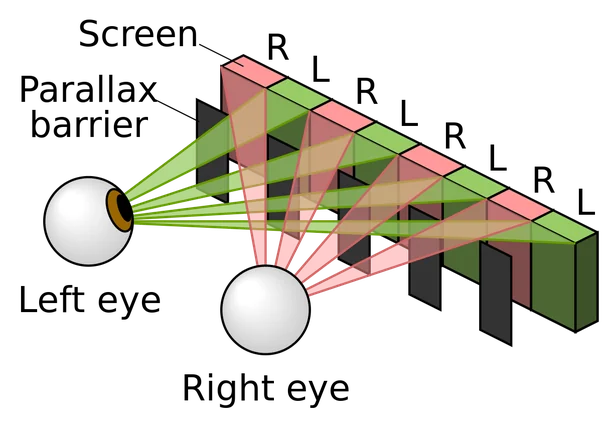
Two 1903-vintage ways to aim pixels at eyes
A parallax barrier and a lenticular sheet solve the same problem: making a flat panel show two, or more, different images to two eyes without glasses. Frederic Ives patented the underlying idea in 1903, in what his parallax stereogram patent describes as a 'line-screen' laid over a composite photograph at a 'definite separation' calculated 'by reason of the parallax of vision with two eyes'. The barrier is opaque lines with clear gaps; a lenticular sheet replaces the opaque lines with tiny cylindrical lenses that bend light instead of blocking it. Both send interleaved columns of left-eye and right-eye pixels out at different angles from the same physical screen.
What creates the image, and where you have to stand
The barrier works by simple occlusion: from one eye's position, strips of black line hide every other column of pixels, leaving only the left-eye set visible; move to the other eye's position and the geometry reverses. Ives' patent is explicit that the screen and the image must be aligned so 'the elements of the right-eye picture' are visible only to the right eye and the left-eye elements only to the left. A lenticular lens does the same job optically, refracting each column toward a narrow angular zone rather than blocking the rest of the light. That distinction carries a direct brightness cost: a barrier throws away roughly half the panel's light to its blocking strips, while a lens redirects nearly all of it, at the price of harder-to-manufacture optics. Both approaches work only from specific head positions, called viewing zones or sweet spots; step outside one and the eyes swap images or see a doubled, mixed picture.
What the survey literature actually establishes
Two later display surveys, cited here as evidence rather than as barrier-specific manuals, place parallax barrier and lenticular systems inside a broader family. The 2011 IEEE Transactions on Broadcasting review by Holliman, Dodgson, Favalora and Pockett updates a display taxonomy that separates two-view stereo pairs from 'horizontal parallax multiview' systems, the category barrier and lenticular displays fall into once more than two views are interleaved. An earlier 2007 3DTV display survey groups them among 'multiple image displays', distinct from holography and volumetric displays. Neither paper's full text was opened here; what is confirmed is their scope and categorisation, not every numeric claim a vendor might quote from them. This is an editorial synthesis of a well-documented optical trade-off, not a reproduction of either paper's complete findings.
Questions to bring to a demo
- How many discrete views does the panel interleave, and how does that divide the native pixel count?
- How wide is the working viewing zone at the intended seating distance, and what happens at its edge?
- Is the panel a barrier, dimmer but cheaper to make, or a lenticular sheet, brighter but harder to align?
Neither mechanism has changed in principle since 1903; only fabrication precision and the number of interleaved views have. The trade-off Ives described, pixels sacrificed or light redirected for spatial separation, is still the one to check before trusting a spec sheet.
Sources & reading trail
Describes the original parallax barrier mechanism: a line-screen positioned at a calculated separation from a composite photograph so each eye sees only its own set of lines.
Source published: 14 April 1903 · Retrieved: 16 September 2026
Confirms the survey's taxonomy separates two-view displays from horizontal-parallax multiview systems, the category that includes parallax-barrier and lenticular displays.
Source published: 1 June 2011 · Retrieved: 16 September 2026
Establishes the broader classification of multiple-image displays that parallax barrier and lenticular sheets belong to, distinct from holography and volumetric displays.
Source published: 1 November 2007 · Retrieved: 16 September 2026
Primary documents establish the record; the mechanism reading and the demo questions are Presence Atlas editorial analysis. This retrospective draft does not imply the site published on the event date.
Continue reading
- Ives patented a slotted screen that split a photo per eye
- A quilt of rendered views feeds a lenticular light field
- Browse the complete the archive
Sources & reading trail
- Parallax Stereogram and Process of Making Same (US Patent 725,567)
Source published: April 14, 1903 · Retrieved: September 16, 2026 - Three-Dimensional Displays: A Review and Applications Analysis
Source published: June 1, 2011 · Retrieved: September 16, 2026 - A Survey of 3DTV Displays: Techniques and Technologies
Source published: November 1, 2007 · Retrieved: September 16, 2026
The documents above establish the record. The reading and the questions are this publication’s editorial analysis, written after the fact.
Published September 18, 2026, not on the date of the event described.