
A quilt of rendered views feeds a lenticular light field
Looking Glass documentation specifies the view grid, ordering and shearing a lenticular display needs from rendered content.
- Site publication
- September 18, 2026
What the documentation specifies
Looking Glass Factory's quilt documentation describes a quilt as "an image standard" the company uses for both still and moving 3D content, built as a single tiled image containing many individually rendered views of the same scene. View counts are model-specific: the documentation states the Looking Glass Portrait uses "8 columns and 6 rows," 48 views in total, while the larger 65-inch display uses "8 columns and 9 rows," 72 views. Ordering matters and is specified precisely: "the bottom-left tile of the quilt (view 0) is the leftmost view of the scene, and the top-right tile is the rightmost." A quilt can, per the documentation, be compressed to under a megabyte, which is why it doubles as a practical screenshot and interchange format, not only a rendering intermediate.
The mechanism underneath the format
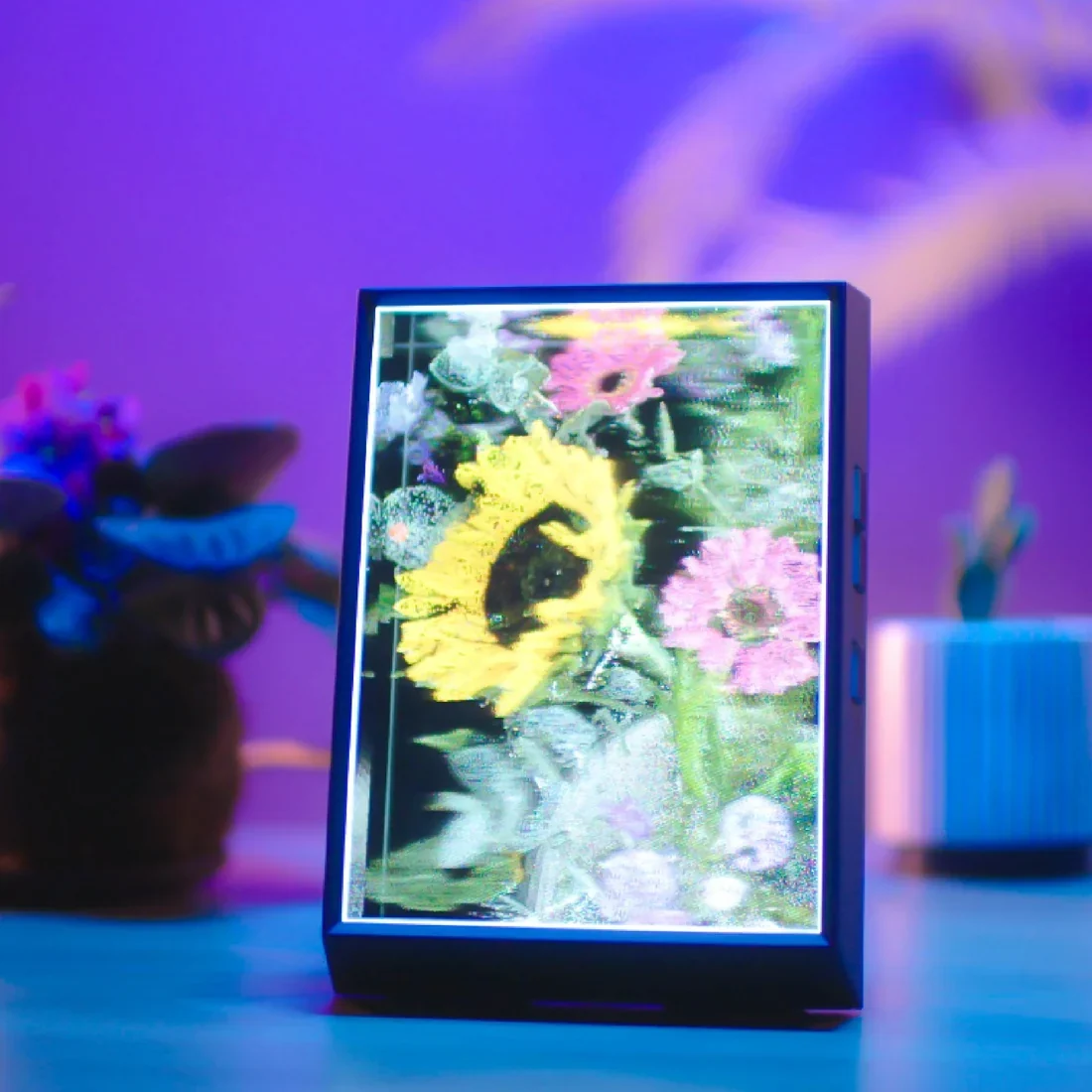
The company's own product description states that its light-field displays project dozens of perspectives simultaneously, between 45 and 100 distinct viewpoints depending on the model, at 60 frames per second, viewable within what it calls a 53-degree cone, so several people at different positions each see a distinct, correctly angled view without glasses. A quilt is exactly the packaging format for those simultaneous views: instead of receiving one ordinary video frame, the display receives one tiled image per frame containing every view the lenticular lens sheet needs to steer to its angle. The company describes this family of products as "holographic," including a Hololuminescent line layering a fixed 3D holographic volume behind a flat panel; on this evidence, that is promotional language for a lenticular, directional-view system, not wavefront reconstruction, and the distinction matters because the two mechanisms fail differently in a real room.
What producing a quilt actually costs
The documentation flags a specific and easy-to-miss rendering error: generating a quilt from a naive multi-camera rig, without correctly shearing each view's projection, produces an artefact the documentation calls "toe-in," which degrades the 3D effect. Handling this correctly is a rendering-pipeline requirement, not a display-side fix. More fundamental is the multiplication in cost: a quilt for the 65-inch display asks a renderer to produce 72 correctly sheared views of every frame, not one, a very different budget from rendering a single camera angle. The documentation's product overview notes that quilts can also be produced from Gaussian-splat or NeRF scene reconstructions rather than a live camera rig, which changes where that rendering cost is paid but does not remove it.
Questions to bring to a demo
- How many views does the quilt contain for this specific display model, and does the source material actually cover that view count natively?
- Was view shearing applied correctly, or is the parallax subtly wrong in a way the documentation describes as toe-in?
- Is the content pre-rendered and static, or generated live, and does the frame rate hold at the full view count?
The quilt format is a precise, documented answer to a genuine production problem: how to hand a lenticular display exactly the simultaneous views it needs. It is not evidence, on its own terms, of holography in the wavefront sense, whatever the surrounding marketing calls it.
Sources & reading trail
Defines the quilt format, per-model view counts and ordering, and the view-shearing requirement that avoids toe-in artefacts.
Source published: Not established · Retrieved: 16 September 2026
States the display's simultaneous view count, frame rate and viewing cone, and describes the product line as holographic.
Source published: Not established · Retrieved: 16 September 2026
Distinguishes the Hololuminescent and Light Field Display product lines and notes quilts can be produced from Gaussian splats or NeRFs.
Source published: Not established · Retrieved: 16 September 2026
Primary documents establish the record; the mechanism reading and the demo questions are Presence Atlas editorial analysis. This retrospective draft does not imply the site published on the event date.
Continue reading
- A desktop light-field display trades resolution for angle
- A barrier or a lens decides which pixels reach which eye
- A light field is a claim about how many rays you capture
- Browse the complete the archive
Sources & reading trail
- Quilts
Retrieved: September 16, 2026 - Looking Glass Factory
Retrieved: September 16, 2026 - Looking Glass Factory Documentation
Retrieved: September 16, 2026
The documents above establish the record. The reading and the questions are this publication’s editorial analysis, written after the fact.
Published September 18, 2026, not on the date of the event described.