
A patent and a 1938 viewer confirm View-Master's fixed reel
Gruber's stereoscopic-viewer patent and a Science Museum 1938 example show why a fixed-viewpoint reel avoids the alignment problems bigger displays face.
- Historical event
- January 20, 1939
- First source published
- January 20, 1939
- Site publication
- September 18, 2026
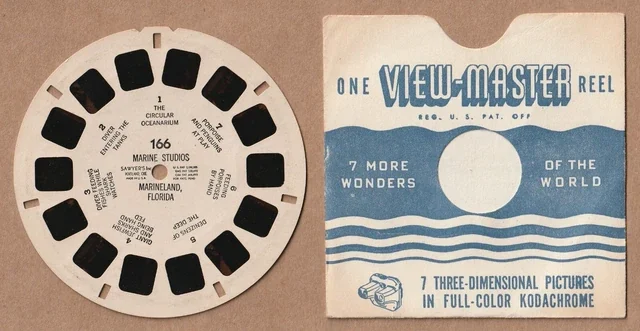
A patent filed in January 1939, a viewer in a museum case
William B. Gruber filed for a 'Stereoscopic viewing device' on 20 January 1939; US patent 2,189,285 was granted on 6 February 1940. A separate Science Museum Group record catalogues a View-Master viewer manufactured by Sawyer's of Portland, Oregon, dated by the museum to 1938, complete in its original box with 32 reels. Read together, the two records place the design's manufacture at or before its own patent filing, a normal sequence for a consumer product refined ahead of the paperwork rather than evidence of an error in either record.
Seven fixed pairs, no adjustment required
The patent describes a perforated disc, or reel, holding fourteen small transparency windows, arranged so that successive pairs of stereoscopic views are disposed in opposite windows in alternating succession. A spring-loaded lever advances the reel two positions at a time, presenting one stereo pair to a pair of fixed viewing lenses, then the next, through seven views before returning to the start. Because both the transparencies and the viewer's optics are fixed at the factory, the two images are always correctly matched in scale, alignment and brightness; the viewer only has to hold the device to their eyes and press the lever, with none of the mirror-angle or head-position adjustment a Wheatstone-style reflecting stereoscope demands.
What fixing the geometry trades away
That reliability comes from removing choice: a single, non-adjustable interpupillary spacing and a fixed image distance mean the device cannot be tuned to an individual viewer the way an adjustable stereoscope can, and only one person can look through it at a time. Neither opened record documents how the seven-view limit or the disc's small transparency size affected image sharpness in practice, so this draft does not claim a resolution or brightness figure for the original device.
- Does a fixed-viewpoint stereo device accommodate a range of interpupillary distances, or only one?
- What happens to comfort and fusion if a viewer's eyes do not match the device's built-in spacing?
- Is the mechanism genuinely maintenance-free, or does misalignment creep in as the reel and lenses wear?
Fixing the whole optical path at manufacture, rather than leaving it adjustable, is the quiet trade at the centre of this patent: less flexibility, but a stereo pair that cannot be shown out of alignment.
Sources & reading trail
The patent's filing date, grant date, and description of the fourteen-window reel and transport mechanism.
Source published: 20 January 1939 · Retrieved: 16 September 2026
Museum record of a complete 1938 Sawyer's View-Master viewer with 32 reels, corroborating early manufacture of the device the patent describes.
Source published: Not established · Retrieved: 16 September 2026
Primary documents establish the record; the mechanism reading and the demo questions are Presence Atlas editorial analysis. This retrospective draft does not imply the site published on the event date.
Continue reading
- Two flat drawings taught Wheatstone how depth is seen
- Stereo depth has a comfort zone, and it narrows up close
- A headset must be built to fit a range of eyes
- Browse the complete the archive
Sources & reading trail
- US2189285A - Stereoscopic viewing device
Source published: January 20, 1939 · Retrieved: September 16, 2026 - View-Master stereoscopic viewer, manufactured by Sawyer's (Science Museum Group)
Retrieved: September 16, 2026
The documents above establish the record. The reading and the questions are this publication’s editorial analysis, written after the fact.
Published September 18, 2026, not on the date of the event described.