
Webex Hologram took years to move from pitch to hardware
Cisco's own posts trace Webex Hologram from an October 2021 announcement to a 12-camera light-field rig shipped to beta customers.
- Historical event
- October 1, 2021
- First source published
- September 16, 2022
- Site publication
- September 18, 2026
An announcement, then a slow path to hardware
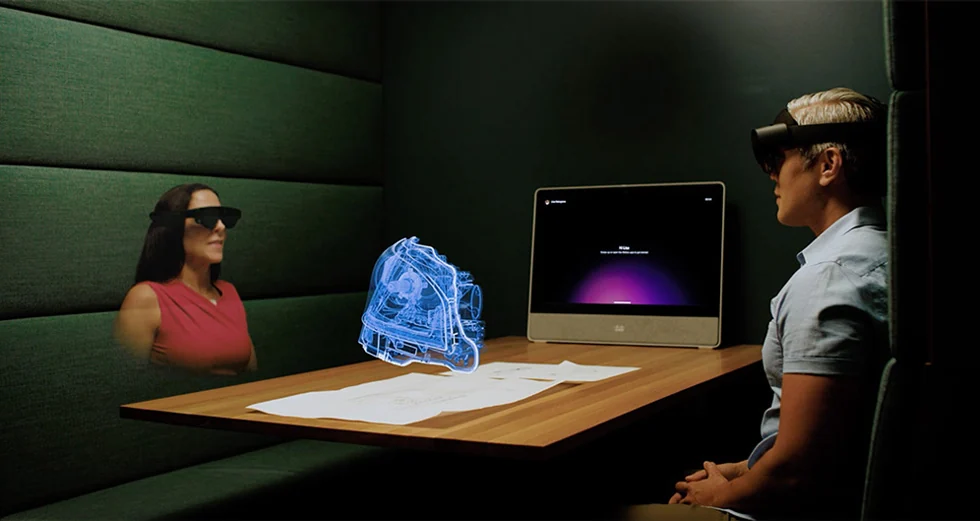
Cisco's Webex engineering blog states that the company announced Webex Hologram in October 2021, describing a tool meant to show remote colleagues as lifelike three-dimensional figures to a headset wearer rather than as flat video. A later post on Webex Hologram 1.0 records that a wall-mounted capture device had just shipped out to beta customers as of that writing, built around a 12-camera array with processing assisted by Nvidia hardware, more than two years after the original announcement. That gap between announcement and shipped hardware is itself part of the record: this was proposed well before it reached even a beta customer's wall.
Light-field capture, not a polygon model
The mechanism is explained in Cisco's engineering post on what is behind the innovation: an array of twelve cameras captures a subject's image in three-dimensional form as a light field, an approach chosen over texture-mapped polygons or depth-camera point clouds because those methods jag on fine detail such as hair and produce dark artefacts around edges, while a light field preserves reflections on skin and refraction through objects. The receiving side is a colleague wearing an AR or VR headset, on which the captured figure appears volumetrically rather than as a screen inset. Because the source is a fixed multi-camera rig rather than a single depth sensor, the subject needs to stay within the array's capture volume for the illusion to hold.
Devices, status and what remains undocumented
The target headsets named in Cisco's earlier posts are Magic Leap 2 and Microsoft HoloLens 2; a 2024 post about the product winning an award at the Augmented World Expo widens that list to a mobile app compatible with Vision Pro, Meta Quest and HoloLens more broadly, suggesting the receiving side broadened faster than the capture hardware did. None of the posts state a public price, a general-availability date beyond beta customers, or bandwidth and latency figures for the light-field stream, and Cisco's own materials do not claim the system has been independently tested outside company demonstrations.
- Is the capture device installed and calibrated in the specific room where this demo will run, or is this a travelling unit?
- Which headset will the receiving side actually wear, and is that headset on the currently supported list?
- Has this deployment moved beyond the beta-customer stage Cisco's own post describes, or is it still at that stage?
A light-field capture rig and a headset display are two separate pieces of infrastructure, each with its own constraints, and Cisco's own account of a multi-year gap between announcement and shipped hardware is a reminder that a compelling capture mechanism is not the same as a deployed product.
Sources & reading trail
States Webex Hologram was announced in October 2021 and frames the product's design philosophy.
Source published: 16 September 2022 · Retrieved: 16 September 2026
Describes the light-field capture mechanism, the 12-camera array, and why light fields were chosen over polygon or point-cloud methods.
Source published: 9 November 2022 · Retrieved: 16 September 2026
Describes Webex Hologram 1.0 shipping to beta customers with a wall-mounted 12-camera capture device and Magic Leap 2 / HoloLens 2 support.
Source published: 17 November 2023 · Retrieved: 16 September 2026
Primary documents establish the record; the mechanism reading and the demo questions are Presence Atlas editorial analysis. This retrospective draft does not imply the site published on the event date.
Continue reading
- A light-field booth carried Google's Starline calls
- HoloLens stopped being made at the end of 2024
- A modular panel's own patents specify a 120-degree zone
- Browse the complete the archive
Sources & reading trail
- Humans are complicated. Webex Hologram embraces that.
Source published: September 16, 2022 · Retrieved: September 16, 2026 - Behind the Innovation of Webex Hologram
Source published: November 9, 2022 · Retrieved: September 16, 2026 - 5 things to know about Webex Hologram 1.0
Source published: November 17, 2023 · Retrieved: September 16, 2026
The documents above establish the record. The reading and the questions are this publication’s editorial analysis, written after the fact.
Published September 18, 2026, not on the date of the event described.