
A light-field booth carried Google's Starline calls
A SIGGRAPH Asia paper and two company posts describe a head-tracked 3D display, and what changed as it became Google Beam.
- Historical event
- May 18, 2021
- First source published
- May 18, 2021
- Site publication
- September 18, 2026
A window that behaves like a person is there
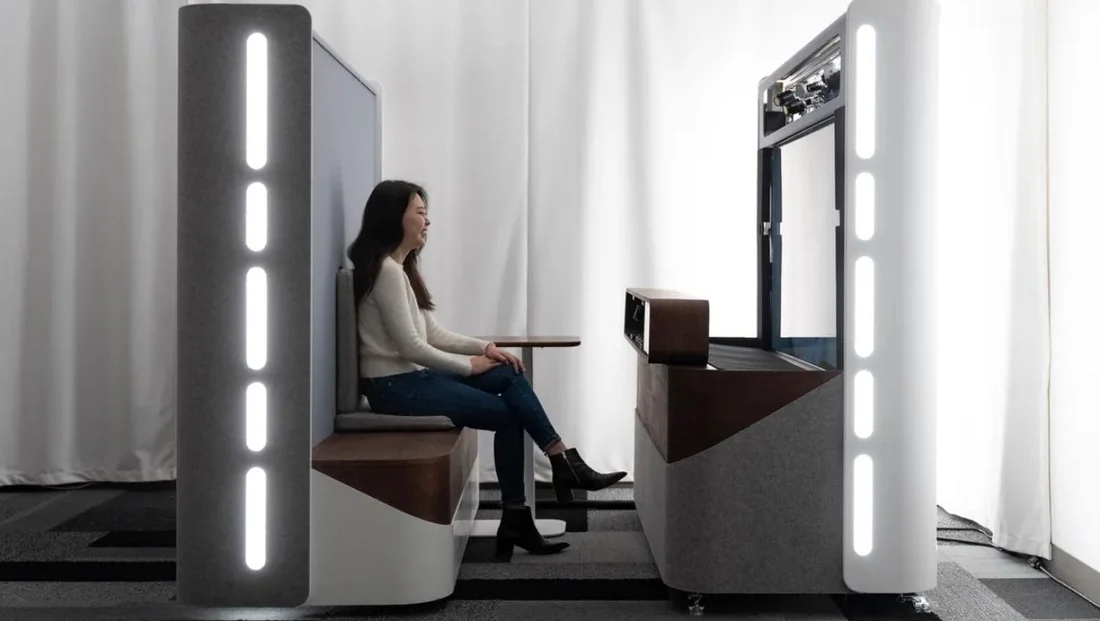
On 18 May 2021 Google described Project Starline as a research system that shows a remote person life-size and in three dimensions through what it called a breakthrough light field display, without glasses or a headset. The peer-reviewed account followed later that year: a paper published in ACM Transactions on Graphics for SIGGRAPH Asia 2021 describes a head-tracked autostereoscopic display fed by a multi-view capture rig that fuses several camera views into one reconstructed geometry, compresses colour and depth together, and reproduces stereopsis, motion parallax, eye contact and spatialised audio in real time. The company's later product, Google Beam, states plainly that it builds on Project Starline's breakthrough 3D video technology.
What the mechanism actually needs
Autostereoscopic means no glasses, but it does not mean no constraints. A head-tracked display of this kind builds its three-dimensional effect around where the system calculates the viewer's eyes to be, which is why the paper specifies head tracking as part of the pipeline rather than an optional add-on. That implies a viewing position: sit where the tracking expects and the volume and parallax read correctly; move well outside it and the effect degrades in a way a flat video call never could. The 2021 announcement was explicit that this ran on custom-built hardware and highly specialised equipment installed in a handful of Google's own offices, and that the company's stated goal was to make the approach more affordable and accessible later, itself an admission that affordability was not yet solved.
What changed on the way to a product
Google Beam is the commercialised description of the same lineage, now built with HP as the first Google Beam device for enterprise, according to Google's own product page. That page repeats the life-size, headset-free claim and adds that the system is powered by Google's latest breakthroughs in artificial intelligence, a claim which, unlike the 2021 paper's described capture and compression pipeline, is not accompanied here by a published technical account of what the newer component replaces or improves. The distinction matters for comparison: the SIGGRAPH Asia paper is peer-reviewed engineering evidence with a described method and named authors; the Beam page is a vendor's current description of a shipping system, retrieved 16 September 2026, and should be read as such rather than as independently verified performance data.
Questions to bring to a demo
- Is the display autostereoscopic with head tracking, or does it rely on glasses, and what is the tracked viewing zone.
- How many simultaneous viewers can the display serve before the effect breaks down for anyone outside the tracked position.
- What in the shipping product is new engineering, and what is inherited unchanged from the 2021 research system.
Between 2021 and Beam, the label moved from a research demonstration to an enterprise product, but the paper remains the fullest public account of what actually reconstructs the image, and it should be read alongside, not replaced by, the newer marketing language.
Sources & reading trail
Announces Project Starline and describes the light-field display, glasses-free viewing, and its limited office deployment.
Source published: 18 May 2021 · Retrieved: 16 September 2026
Peer-reviewed description of the head-tracked autostereoscopic display, multi-view capture, compression and real-time reconstruction pipeline.
Source published: Not established · Retrieved: 16 September 2026
Living product page describing Google Beam as built on Starline's technology, its HP hardware partner, and current vendor claims.
Source published: Not established · Retrieved: 16 September 2026
Primary documents establish the record; the mechanism reading and the demo questions are Presence Atlas editorial analysis. This retrospective draft does not imply the site published on the event date.
Continue reading
- Holoportation turned a body into a live 3D stream
- Cisco's 2006 filings describe a room, not just a screen
- A light field is a claim about how many rays you capture
- Browse the complete the archive
Sources & reading trail
- Project Starline: Feel like you're there, together
Source published: May 18, 2021 · Retrieved: September 16, 2026 - Project Starline: A high-fidelity telepresence system
Retrieved: September 16, 2026 - Meet the future of video communication
Retrieved: September 16, 2026
The documents above establish the record. The reading and the questions are this publication’s editorial analysis, written after the fact.
Published September 18, 2026, not on the date of the event described.