
Holoportation turned a body into a live 3D stream
A 2016 paper and Microsoft's ongoing project page describe real-time 3D capture for a HoloLens viewer, with one bandwidth caveat.
- Historical event
- March 1, 2016
- Site publication
- September 18, 2026
What the 2016 paper put on record
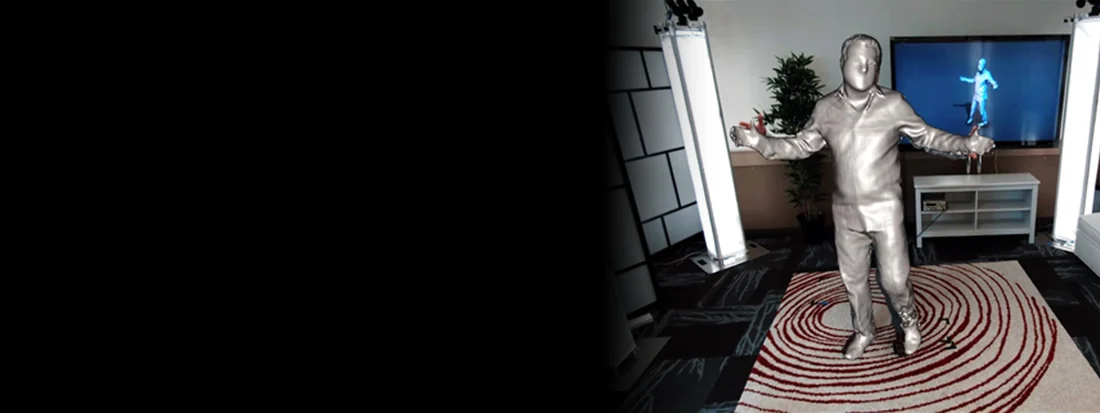
In March 2016, researchers at Microsoft published Holoportation: Virtual 3D Teleportation in Real-Time, presented that year at the ACM Symposium on User Interface Software and Technology. The abstract states plainly what the system does: high-quality 3D models of people are reconstructed, compressed and transmitted anywhere in the world in real time, then viewed through a mixed-reality headset such as HoloLens so a remote person appears to occupy the viewer's own space. That is the claim worth holding onto: this is a capture-and-transmission pipeline married to a see-through headset display, not a projector, a panel or a laser system.
What creates the image, and what it needs
Microsoft's continuing project page, Holoportation, describes the capture side as an array of depth-and-colour sensors, now built around Azure Kinect units, arranged to cover a person from multiple angles so no side of them is a flat cutout. That multi-camera coverage is what a single webcam cannot supply: it is the difference between a flat image with a depth guess and an actual reconstructed surface a viewer can walk around. On the display side, the viewer needs a mixed-reality headset capable of registering the model in their own room, not a screen; a person without one cannot see the effect at all, a constraint any comparison with ordinary video calling has to state up front.
The bandwidth question, and what is and is not documented
The same project page reports that when the system was adapted for use inside a moving vehicle, the team achieved a ninety-seven per cent reduction in bandwidth requirements while holding quality, and lists a telemedicine collaboration with surgeons in Glasgow and integration into Microsoft Mesh as later applications. Those are separate, later deployments rather than details of the original 2016 demonstration, and the page does not restate what the 2016 system's own bandwidth cost was, so the two figures should not be read as a single before-and-after claim. The published abstract likewise does not state a camera count or a specific data rate, so this entry does not invent one.
Questions to bring to a demo
- How many capture cameras cover the volume, and what happens to the reconstruction at its edges.
- Does viewing require a headset for every participant, or can some join by flat video.
- What data rate does a live session actually sustain outside a research network.
Holoportation is best read as an early, well-documented answer to one narrow question: can a body be reconstructed and streamed in real time for a headset viewer. It is not, on this record, evidence about cost, comfort or bandwidth at ordinary broadband scale.
Sources & reading trail
States the paper's venue, authors and abstract describing real-time reconstruction, compression and transmission for HoloLens viewing.
Source published: Not established · Retrieved: 16 September 2026
Living project page describing the Azure Kinect capture array, HoloLens viewing, and a later ninety-seven per cent bandwidth reduction in a vehicle deployment.
Source published: Not established · Retrieved: 16 September 2026
Primary documents establish the record; the mechanism reading and the demo questions are Presence Atlas editorial analysis. This retrospective draft does not imply the site published on the event date.
Continue reading
- A light-field booth carried Google's Starline calls
- Microsoft Mesh promised photoreal selves, shipped avatars
- Depthkit turns depth cameras into playable volumetric video
- Browse the complete the archive
Sources & reading trail
- Holoportation: Virtual 3D Teleportation in Real-Time
Retrieved: September 16, 2026 - Holoportation
Retrieved: September 16, 2026
The documents above establish the record. The reading and the questions are this publication’s editorial analysis, written after the fact.
Published September 18, 2026, not on the date of the event described.