
Microsoft Mesh promised photoreal selves, shipped avatars
The 2021 Mesh announcement and today's Teams documentation show an avatar platform, distinct from telepresence proper.
- Historical event
- March 2, 2021
- First source published
- March 2, 2021
- Site publication
- September 18, 2026
What the March 2021 announcement promised
On 2 March 2021 Microsoft announced Microsoft Mesh, describing it as an Azure-based mixed-reality platform for shared holographic experiences across HoloLens 2, a range of virtual reality headsets, smartphones, tablets and PCs. Technical Fellow Alex Kipman is quoted saying people would be able to feel like they are in the same place as someone sharing content. The announcement placed Mesh explicitly in the lineage of Microsoft's own Holoportation research, and its stated roadmap went further than avatars: it described a future in which participants could project themselves as their most lifelike, photorealistic selves, a capture-based aim closer to Holoportation than to a cartoon avatar.
What creates the shared-space effect today
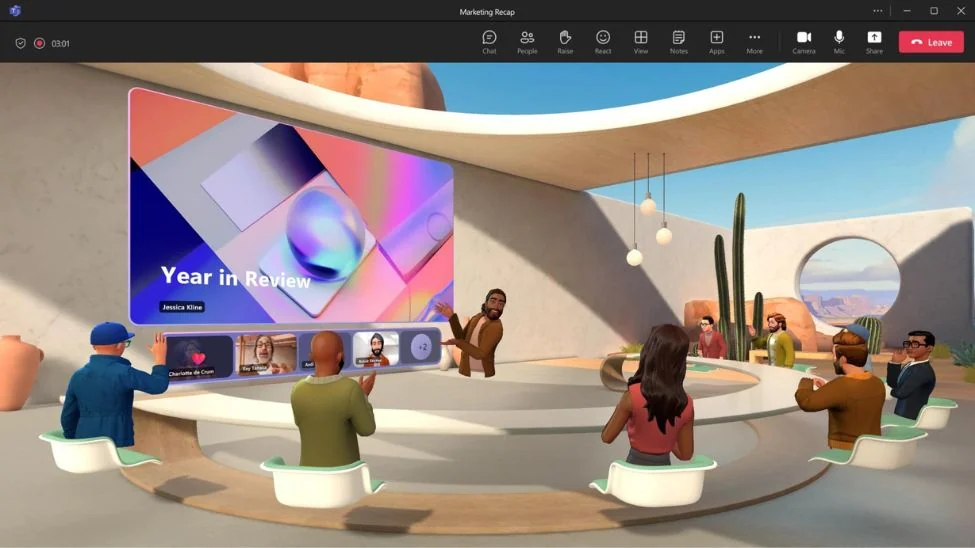
Microsoft's current support documentation for immersive spaces, Get started with immersive events in Microsoft Teams, retrieved 16 September 2026, describes a narrower mechanism than that roadmap: attendees join as avatars that can be personalised in the Teams Avatars app, positioned in a three-dimensional scene so that directionality and distance let separate small-group conversations happen in the same virtual room, viewed on the Teams app for PC and Mac or a Teams Immersive app on Meta Quest 3. That is an avatar-driven positioning and spatial-audio system, not a system that captures a participant's actual face and body live. The gap between the two documents is the point: the 2021 language reached for photorealistic capture, and the shipped feature is a customisable figure placed in a shared scene.
Why an avatar meeting is not telepresence
This distinction matters for a field guide that treats presence claims carefully. A telepresence system, in the sense used elsewhere in this archive, generally captures a real, current image of a person, whether by matched-room video, light-field display or volumetric capture, and reproduces it live. An avatar-based platform substitutes a pre-built or customised model, driven by tracked motion or a microphone, for that live image. Both can support a sense of co-presence and directional conversation, but only one of them lets a viewer see what the other person actually looks like at that moment, and Mesh's shipped avatar system is the latter category, whatever its 2021 announcement aspired to.
Questions to bring to a demo
- Does the platform show a live capture of the participant's face, or a driven avatar model.
- Which devices are required to see the shared three-dimensional space, and what does a participant on a flat screen see instead.
- How much of the 2021 photorealistic-capture roadmap has actually shipped, as of the date the claim is made.
Mesh is a legitimate example of shared spatial computing, but its own history is a caution against reading a platform announcement as a description of what ships. The avatar meetings available today are one specific, more modest thing, and this archive treats them as such rather than as telepresence by another name.
Sources & reading trail
Announces Microsoft Mesh, its supported devices, and a roadmap toward photorealistic holoportation-based avatars.
Source published: 2 March 2021 · Retrieved: 16 September 2026
Living documentation describing the shipped Mesh/immersive-events feature as customisable avatars positioned in a three-dimensional scene.
Source published: Not established · Retrieved: 16 September 2026
Primary documents establish the record; the mechanism reading and the demo questions are Presence Atlas editorial analysis. This retrospective draft does not imply the site published on the event date.
Continue reading
- Horizon Workrooms tracked hands, not faces, in a shared room
- A Teams avatar is a styled photo, not a live capture
- Holoportation turned a body into a live 3D stream
- Browse the complete the archive
Sources & reading trail
- "You can actually feel like you're in the same place": Microsoft Mesh powers shared experiences in mixed reality
Source published: March 2, 2021 · Retrieved: September 16, 2026 - Get started with immersive events in Microsoft Teams
Retrieved: September 16, 2026
The documents above establish the record. The reading and the questions are this publication’s editorial analysis, written after the fact.
Published September 18, 2026, not on the date of the event described.