
A Teams avatar is a styled photo, not a live capture
Microsoft's support pages describe a Teams avatar built once from a photo, not a live-tracked likeness, with no legs yet supported.
- Site publication
- September 18, 2026
What Microsoft's documentation records
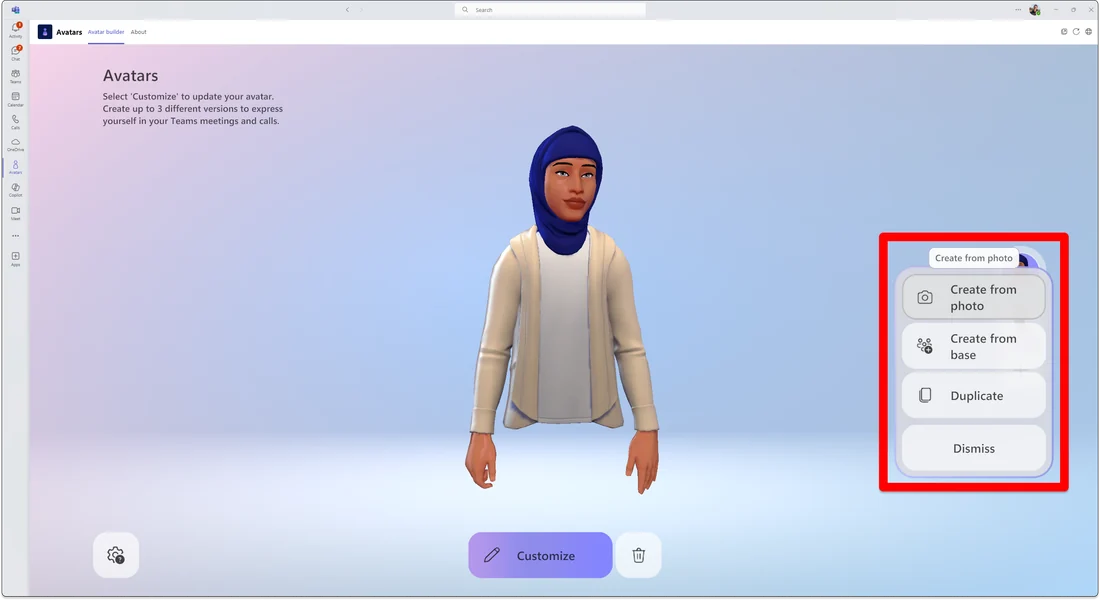
Microsoft's support pages on joining a meeting as an avatar and on customising a Teams avatar, as retrieved on 16 September 2026, describe a Mesh-based avatar feature available on the Teams desktop app for Windows and Mac, with view-only access on mobile. A user can save up to three avatars, each generated from a submitted photo that Microsoft's system analyses for facial points, then styled through sliders for skin tone, facial features, hair, makeup, body shape and clothing. A separate article on immersive events describes a related but distinct capability: 3D virtual venues for webinars and town halls, reachable from Teams on PC and Mac and, via a dedicated app, on a Meta Quest 3 headset. None of the three pages states a specific general-availability date or version number for either capability.
What an avatar actually represents
A Teams avatar is a puppet, not a capture. The documentation states that the system analyses a submitted photograph once, to recommend a matching style, and says plainly that the photo is not retained or used for any other purpose; there is no ongoing camera feed driving facial expression or body motion. The avatar can carry reactions and gestures a user selects, but it does not livestream the wearer's actual face. The pages also flag an acknowledged limitation in the product itself: avatars currently have no legs, which Microsoft's own documentation calls a surprisingly complex engineering challenge rather than a deliberate design choice. This is presence as a stylised, selected identity, useful for keeping a camera off while still signalling attention, and quite different from the volumetric or light-field capture systems elsewhere in this category that reproduce a person's actual appearance in real time.
Constraints on what is documented
Because none of these support pages carries a publication date, this entry can only describe Mesh avatars and immersive events as Microsoft's help centre presents them on 16 September 2026, not as they were announced or first shipped; readers should treat any externally reported January 2024 general-availability date as unverified against Microsoft's own current documentation opened here. The desktop-only requirement for hosting or fully controlling either feature also means a meeting mixing desktop, mobile and headset participants will have uneven capability across attendees, a constraint the pages state directly rather than leave implicit.
- Which participants in this meeting can host or fully control avatars and immersive spaces, and which are limited to viewing?
- Is the avatar meant to represent presence while the camera is off, or is a video tile also expected from the same person?
- Does an immersive event here require the Meta Quest 3 companion app, and has that app been tested on the specific headset in the room?
An avatar is a chosen likeness, assembled once from a photograph and never updated by a live feed; that is a materially different claim to presence than a system built to transmit a face as it moves.
Sources & reading trail
Describes what a Teams avatar does, platform availability, participant limits, and the stated absence of leg representation.
Source published: Not established · Retrieved: 16 September 2026
Describes how avatars are built once from a submitted photo and customised, with no camera-based live tracking described.
Source published: Not established · Retrieved: 16 September 2026
Describes the related immersive-events capability, including Meta Quest 3 support via a dedicated app.
Source published: Not established · Retrieved: 16 September 2026
Primary documents establish the record; the mechanism reading and the demo questions are Presence Atlas editorial analysis. This retrospective draft does not imply the site published on the event date.
Continue reading
- Microsoft Mesh promised photoreal selves, shipped avatars
- Horizon Workrooms tracked hands, not faces, in a shared room
- Codec Avatars render a scanned face, not a live scene
- Browse the complete the archive
Sources & reading trail
- Join a meeting as an avatar in Microsoft Teams
Retrieved: September 16, 2026 - Customize your avatar in Microsoft Teams
Retrieved: September 16, 2026 - Get started with immersive events in Microsoft Teams
Retrieved: September 16, 2026
The documents above establish the record. The reading and the questions are this publication’s editorial analysis, written after the fact.
Published September 18, 2026, not on the date of the event described.