
Horizon Workrooms tracked hands, not faces, in a shared room
Meta's 2021 announcement describes Horizon Workrooms as a hand-tracked shared VR room for up to 16 people, not a face-capture system.
- Historical event
- August 19, 2021
- First source published
- August 19, 2021
- Site publication
- September 18, 2026
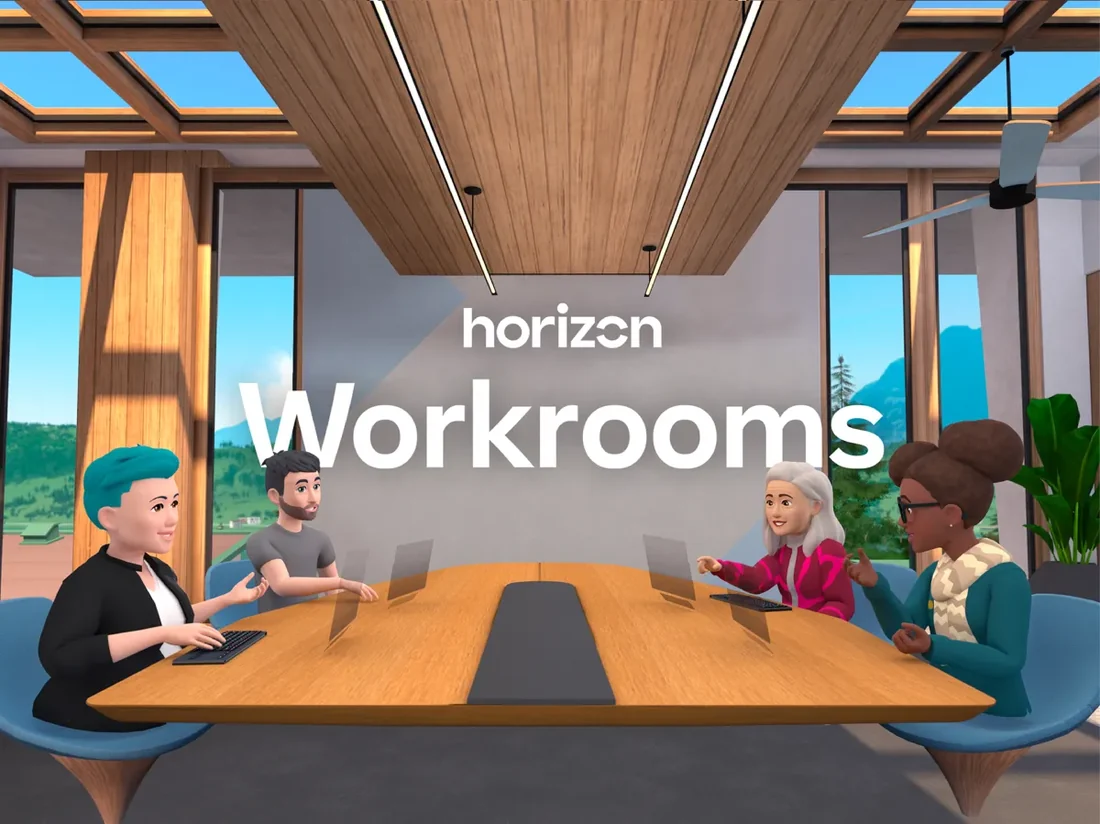
An open beta for headset-based meetings
Meta, then Facebook, opened Horizon Workrooms in free open beta on 19 August 2021, for the Oculus Quest 2 headset. The announcement, still mirrored on Meta's own site, describes a virtual meeting room that up to 16 people could enter in VR at once, with up to 50 total participants when video-calling attendees are included. Hand tracking was the primary input, letting a user's real hands appear in the virtual room without controllers; a companion desktop app could stream a physical keyboard and desk into the headset view via passthrough, and an infinite virtual whiteboard supported shared sketching. Non-VR participants joined by ordinary video call and could see, but not directly manipulate, the shared space.
Presence built from tracked geometry, not capture
Workrooms represents each person as an Oculus Avatar, a stylised 3D character driven by headset and hand tracking, spatial audio positioned by where the avatar sits, and voice. This is a materially different mechanism from a video composite: every VR participant shares one tracked 3D room, so avatars keep consistent relative positions and each viewer's headset renders the correct parallax for their own head movement. The trade-off is that the face on screen is an avatar, not the wearer's actual features, and only what hand tracking and controller input capture, principally hand position and gesture, reaches other participants; expression, gaze and the rest of the body are not transmitted.
What the announcement establishes and what it leaves open
The announcement is explicit about scope: a Facebook account was required for VR access via a distinct Workrooms account, hand tracking needed to be enabled, and availability was limited to countries where Quest 2 itself shipped. It states that screen sharing was opt-in and that Workrooms conversations would not feed Facebook's advertising systems. It does not describe how the system behaves under poor network conditions, nor does it certify that hand tracking works reliably in every lighting environment; those are operational questions a demo, not an announcement, would need to answer. The open-beta framing also means the described state was explicitly provisional at launch, not a finished product specification.
- Is hand tracking or a physical controller expected for this session, and has it been tested in the room's actual lighting?
- How many attendees will be in VR headsets versus joining by ordinary video call, and what can the video-call group actually see?
- Which Meta account and app version does the room require, and does it match what participants have installed?
A shared tracked room and a composited video call solve different problems under the same rough label of virtual meeting, and Workrooms' avatar-and-hand-tracking approach is closer to the former, with the fidelity trade-offs that implies.
Sources & reading trail
Original open-beta announcement describing features, device requirements, participant limits and account requirements.
Source published: 19 August 2021 · Retrieved: 16 September 2026
Meta's current mirror of the original announcement, confirming the same beta date and feature set are still presented as accurate.
Source published: Not established · Retrieved: 16 September 2026
Primary documents establish the record; the mechanism reading and the demo questions are Presence Atlas editorial analysis. This retrospective draft does not imply the site published on the event date.
Continue reading
- Microsoft Mesh promised photoreal selves, shipped avatars
- A Teams avatar is a styled photo, not a live capture
- A Kickstarter campaign restarted consumer virtual reality
- Browse the complete the archive
Sources & reading trail
- Introducing Horizon Workrooms: Remote Collaboration Reimagined
Source published: August 19, 2021 · Retrieved: September 16, 2026 - Introducing Horizon Workrooms: Remote Collaboration Reimagined
Retrieved: September 16, 2026
The documents above establish the record. The reading and the questions are this publication’s editorial analysis, written after the fact.
Published September 18, 2026, not on the date of the event described.