
A Kickstarter campaign restarted consumer virtual reality
Cheap panels and wide lenses funded a developer kit that made head tracking and latency the real engineering problem.
- Historical event
- August 1, 2012
- First source published
- November 28, 2012
- Site publication
- September 18, 2026
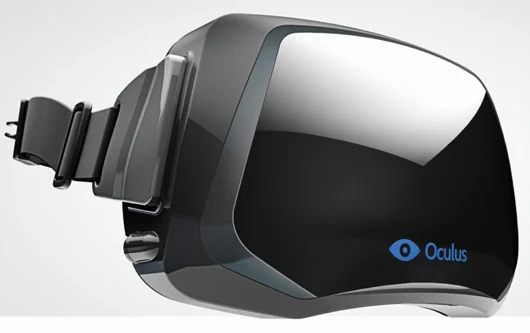
A funding goal, met in a day
Oculus opened its Kickstarter campaign on 1 August 2012, according to a contemporaneous account in TechCrunch's history of the company (used here as a secondary record because the campaign page itself could not be retrieved for this piece). The article states the funding target was "$250,000" and that "within 24 hours, they'd raised $670,000 from 2,750 people." Oculus's own follow-up post that November, addressed to backers, put the final total at "nearly $2.5 million dollars" from "almost 10,000 backers" — a company figure independent of the secondary account and broadly consistent with it.
What the developer kit actually was
The reward being funded was a developer kit, not a finished consumer product. Oculus's own November 2012 update specifies "a modern, 1280×800 7'' display" paired with wide-angle lenses held close to the eyes, and a custom motion sensor combining an accelerometer, gyroscope and magnetometer sampled at "up to 1000hz." The wide lenses were the point: earlier stereoscopic headsets used narrow optics that left VR feeling like looking through a window; Oculus's approach filled more of the wearer's peripheral vision, at the cost of a visible screen-door pattern between pixels held so close to the eye. High-rate head tracking existed to solve a harder problem than the lenses did: any lag between a head turn and the image updating breaks the illusion and can induce nausea, so tracking rate and rendering latency, not optical field of view alone, were the harder engineering constraint.
What the record does and does not establish
Facebook's 2014 acquisition announcement later described the shipped Rift as providing "an immersive, stereoscopic 3D view with an ultra-wide field of view and low latency head tracking," and reported "more than 75,000 orders for development kits" by that point — the company's own retrospective claim, not an independently measured comfort or latency figure. None of the documents opened for this piece give a numeric field-of-view figure for the DK1 lenses or a measured motion-to-photon latency; both are commonly quoted elsewhere but are absent from the primary sources here.
Questions to bring to a demo
- What is the measured motion-to-photon latency, and how was it tested rather than estimated?
- Does the lens design introduce visible distortion or colour fringing toward the edge of the field of view?
- Is head tracking self-contained in the headset, or does it depend on an external sensor and a clear line of sight to it?
The Kickstarter did not fund a finished headset; it funded a developer kit intended to expose exactly these unresolved engineering questions to the people who would have to solve them.
Sources & reading trail
Secondary account (used as a third, clearly labelled source) dating the Kickstarter launch to 1 August 2012, its $250,000 goal and early backer numbers.
Source published: 26 March 2014 · Retrieved: 16 September 2026
Oculus's own post-campaign update giving the DK1 specification, funding total near $2.5 million from almost 10,000 backers, and shipping schedule.
Source published: 28 November 2012 · Retrieved: 16 September 2026
Facebook's acquisition announcement describing the Rift as offering an 'ultra-wide field of view' and noting more than 75,000 developer kit orders.
Source published: Not established · Retrieved: 16 September 2026
Primary documents establish the record; the mechanism reading and the demo questions are Presence Atlas editorial analysis. This retrospective draft does not imply the site published on the event date.
Continue reading
- Microsoft called HoloLens holographic before it shipped
- Meta Quest 3 built mixed reality from cameras, not lenses
- The Simulator Sickness Questionnaire replaced ad hoc reports
- Browse the complete the archive
Sources & reading trail
- A Brief History Of Oculus
Source published: March 26, 2014 · Retrieved: September 16, 2026 - Update on Developer Kit Technology & Shipping Details
Source published: November 28, 2012 · Retrieved: September 16, 2026 - Facebook to Acquire Oculus
Retrieved: September 16, 2026
The documents above establish the record. The reading and the questions are this publication’s editorial analysis, written after the fact.
Published September 18, 2026, not on the date of the event described.