
Meta Quest 3 built mixed reality from cameras, not lenses
The announcement describes colour passthrough replacing see-through optics, with the layer's limits set out in developer documentation.
- Historical event
- June 1, 2023
- First source published
- June 1, 2023
- Site publication
- September 18, 2026
What the announcement claims
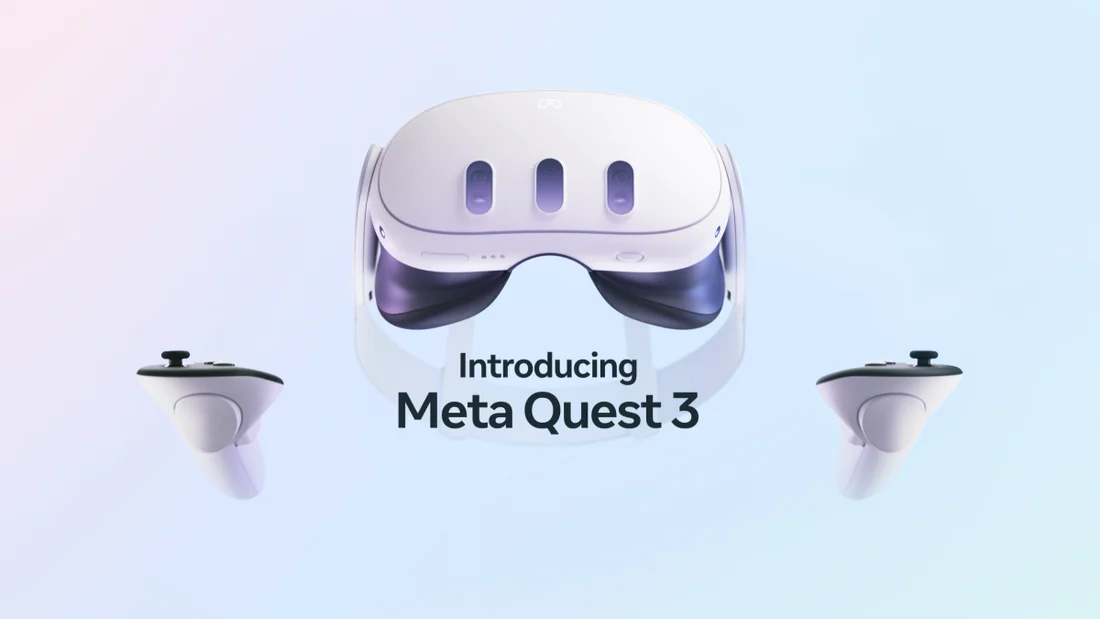
Meta announced Quest 3 on 1 June 2023, describing a headset built around "high-fidelity color Passthrough, innovative machine learning, and spatial understanding" that would let a wearer "interact with virtual content and the physical world simultaneously." The announcement also cites "our highest resolution display and pancake optics" and describes the headset as combining virtual and mixed reality in one device at a new price point, without publishing a specific passthrough camera resolution.
What creates the image
Quest 3 shows the room through a video feed built from outward-facing cameras, not through any transparent optical path. Meta's own developer documentation states plainly that "Passthrough is rendered by a dedicated service into a separate layer" and that "an app cannot access images or videos of a user's physical environment" directly — the operating system performs environment reconstruction, a three-dimensional approximation of the room, and composites that reconstruction with any virtual layer before display. A companion guide to styling that layer confirms developers can "colorize the passthrough feed, highlight edges, and perform image processing" — evidence that what a wearer sees is a processed reconstruction, not a raw camera image, let alone the room itself. Viewing conditions follow from that: the reconstruction depends on the cameras having a workable view of the space, and any mismatch between the reconstructed geometry and the real room can misplace where virtual objects appear to sit.
What the record does and does not establish
Neither document opened for this piece gives a measured passthrough latency, a colour-accuracy comparison with the real room, or a camera resolution figure — all commonly discussed elsewhere but absent from Meta's own materials here. The distinction from a waveguide headset is documented, not assumed: where a waveguide relays real light through glass, Quest 3's passthrough is entirely a software reconstruction, which is why Meta's own guides describe it as a layer that can be stylised or processed, rather than a fixed optical property of the hardware.
Questions to bring to a demo
- How much delay is there between a hand or object moving and the passthrough image updating to match?
- Does the reconstructed environment stay aligned with real furniture and walls as the wearer moves, or does it drift?
- What does the passthrough image do in low light or with reflective and transparent surfaces, which are hard for camera-based reconstruction?
Calling this "mixed reality" is accurate to what Meta built, but it is worth keeping distinct from a see-through waveguide headset: Quest 3 never lets light from the room reach the eye directly, only a reconstruction of it.
Sources & reading trail
Meta's own announcement describing colour passthrough, pancake optics and the headset's mixed-reality positioning.
Source published: 1 June 2023 · Retrieved: 16 September 2026
Current developer documentation stating apps cannot access raw camera images and describing passthrough as a compositor layer built from environment reconstruction.
Source published: Not established · Retrieved: 16 September 2026
Documents that the passthrough layer can be recoloured, edge-highlighted and image-processed, confirming it is a reconstruction rather than a raw feed.
Source published: Not established · Retrieved: 16 September 2026
Primary documents establish the record; the mechanism reading and the demo questions are Presence Atlas editorial analysis. This retrospective draft does not imply the site published on the event date.
Continue reading
- A Kickstarter campaign restarted consumer virtual reality
- Apple Vision Pro shows the world through cameras, not glass
- Horizon Workrooms tracked hands, not faces, in a shared room
- Browse the complete the archive
Sources & reading trail
- Meta Quest 3: Our Highest-Performing Standalone VR System Yet, Coming this Fall
Source published: June 1, 2023 · Retrieved: September 16, 2026 - Passthrough (Mobile)
Retrieved: September 16, 2026 - Passthrough (Unity)
Retrieved: September 16, 2026
The documents above establish the record. The reading and the questions are this publication’s editorial analysis, written after the fact.
Published September 18, 2026, not on the date of the event described.