
Apple Vision Pro shows the world through cameras, not glass
Apple's announcement describes passthrough video, eye tracking and an outward display standing in for see-through optics.
- Historical event
- June 5, 2023
- First source published
- June 5, 2023
- Site publication
- September 18, 2026
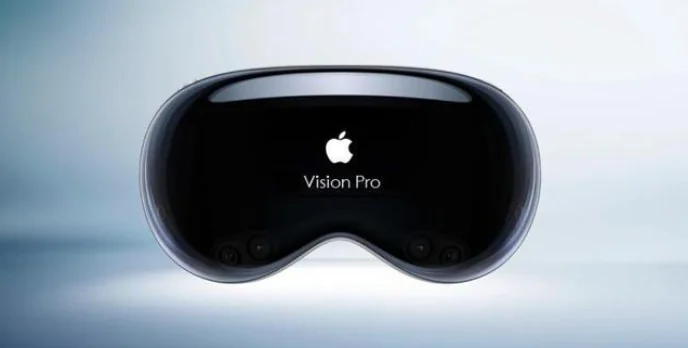
An announcement that avoided the word hologram
Apple unveiled Vision Pro on 5 June 2023, calling it a "spatial computer" rather than reaching for holography at all. The announcement describes a device that "seamlessly blends digital content with the physical world" through "a fully three-dimensional user interface controlled by...eyes, hands, and voice." That framing matters for this publication's terminology: Apple is not claiming wavefront reconstruction or even see-through optics. There is no transparent lens between the wearer's eyes and the room.
What creates the image
Vision Pro shows the wearer a video feed, not the room itself. Apple's own specification sheet lists micro-OLED panels with "23 million pixels" across two displays and a stereoscopic main camera pair at "18 mm, f/2.00 aperture," alongside six additional world-facing tracking cameras, a TrueDepth camera and a LiDAR scanner. Digital content is composited onto that camera feed in real time and displayed on the internal panels; nothing about the physical world reaches the eye directly. Eye tracking, described as working through "high-speed cameras and a ring of LEDs that project invisible light patterns," drives the interface. The outward-facing EyeSight display, covered in Apple's visionOS guide, projects a rendering of the wearer's eyes so bystanders see something resembling a face rather than an opaque shell — a display substituting for transparency in both directions.
What the announcement does and does not establish
Apple's own materials are the source for every claim here: the pixel counts, the camera specification and the EyeSight description are the company's statements about its own product, retrieved as they stand on 16 September 2026, and not an independent measurement of passthrough latency, colour accuracy or how convincing the EyeSight rendering looks to another person in the room. No field-of-view figure appears in the specification sheet this publication opened, which is itself notable: a headline optical number several competing headsets publish is absent from Apple's own listing. Presence, in Apple's language, is achieved entirely through cameras and compositing rather than any optical see-through path.
Questions to bring to a demo
- What is the measured delay between a head movement and the passthrough image updating, and is it noticeable indoors under normal light?
- How does the EyeSight display read to a bystander in typical room lighting, compared with the marketing renders?
- What happens to passthrough clarity in low light, given the camera aperture is fixed rather than adapting like a human pupil?
Vision Pro is a useful boundary case for this publication's vocabulary: it is presence built entirely from cameras, screens and software, with no claim to transparency or wavefront reconstruction anywhere in the chain.
Sources & reading trail
Apple's own description of passthrough cameras, EyeSight, eye tracking and the term 'spatial computing.'
Source published: 5 June 2023 · Retrieved: 16 September 2026
Lists the micro-OLED display pixel count and pitch and the main camera aperture used for passthrough.
Source published: Not established · Retrieved: 16 September 2026
Current user guide describing Vision Pro as blending digital content into physical space and documenting EyeSight and Environments.
Source published: Not established · Retrieved: 16 September 2026
Primary documents establish the record; the mechanism reading and the demo questions are Presence Atlas editorial analysis. This retrospective draft does not imply the site published on the event date.
Continue reading
- Meta Quest 3 built mixed reality from cameras, not lenses
- A scanned Persona stands in for a face a headset hides
- Codec Avatars render a scanned face, not a live scene
- Browse the complete the archive
Sources & reading trail
- Apple Vision Pro
Source published: June 5, 2023 · Retrieved: September 16, 2026 - Apple Vision Pro - Technical Specifications
Retrieved: September 16, 2026 - Apple Vision Pro User Guide - Welcome to visionOS
Retrieved: September 16, 2026
The documents above establish the record. The reading and the questions are this publication’s editorial analysis, written after the fact.
Published September 18, 2026, not on the date of the event described.