
Depthkit turns depth cameras into playable volumetric video
Depthkit's documentation specifies which depth cameras it supports and what a capture exports for a game engine to render.
- Site publication
- September 18, 2026
What the documentation specifies
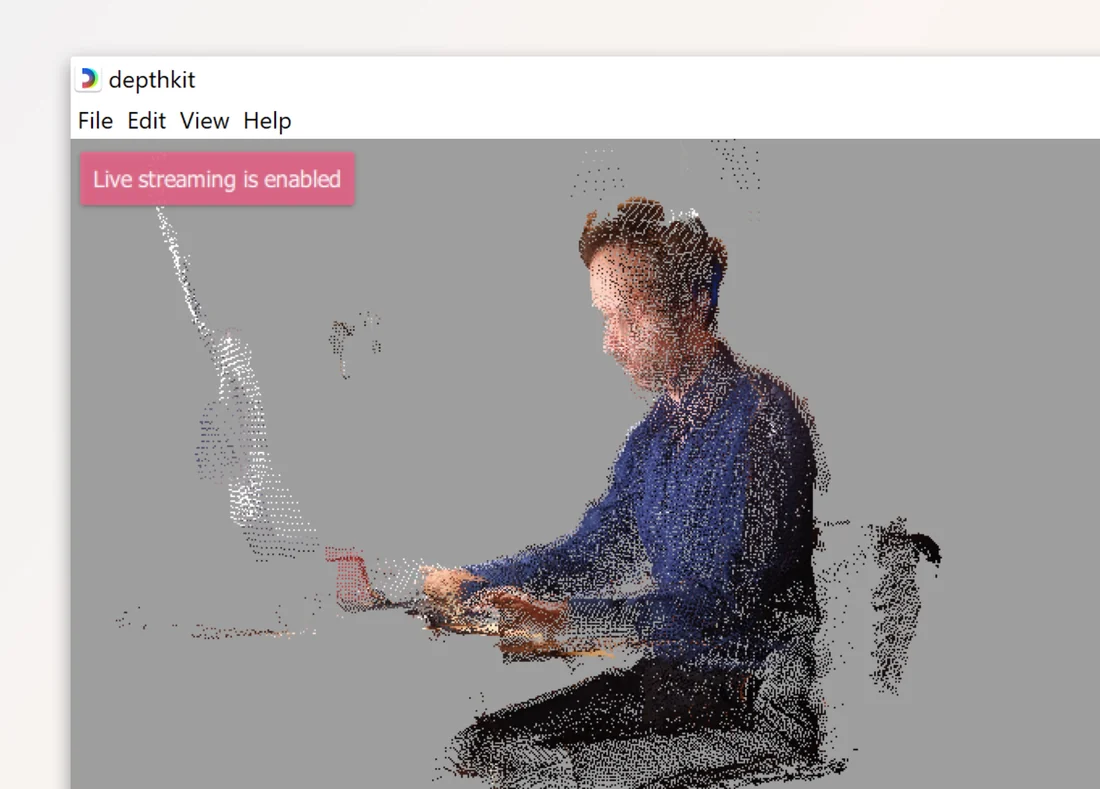
Depthkit is described in its own materials as software for filming and livestreaming volumetric video, meaning a scene is captured as moving three-dimensional geometry rather than a flat frame. The workflow documentation lists the supported sensors: the discontinued Azure Kinect DK for the multi-camera Studio product, the older Kinect v2 for the Core and Cinema tiers, and the Orbbec Femto Bolt as the currently recommended replacement now that Kinect hardware is out of production. Depthkit Studio can synchronise up to ten Azure Kinect units around a subject for a fuller, 360-degree reconstruction; a single sensor produces a one-sided capture, useful for a performer facing one camera but not a figure a viewer can walk around. This is a documentation record rather than a dated announcement: the description reflects the site and docs as retrieved on 16 September 2026.
The mechanism and what a display needs
Each sensor emits a colour image and a depth map, one distance value per pixel. Depthkit's software fuses these per frame into an animated mesh: a grid of vertices displaced by depth and textured with the colour image. That output is not a video file in the ordinary sense. The documentation describes two export paths: a combined per-pixel colour-and-depth video, compressed with standard codecs, and a geometry sequence for tools outside Unity. Either way, whatever displays the result, a monitor, a headset, or a light-field panel, needs a 3D engine that reads the exported format and rebuilds geometry every frame, not a passive video player. A viewer's sense of depth depends on that downstream renderer: a free camera gives motion parallax, while a fixed camera angle renders the capture as an ordinary flat video with the volumetric information unused.
What a small studio can realistically capture
The documentation's own framing is instructive about limits. Recommending the Femto Bolt for new buyers, after two prior sensor generations went out of production, shows how tightly this pipeline depends on commodity depth hardware Depthkit does not manufacture. A single-sensor rig, the entry point for a small studio, captures only surfaces visible to that one camera; anything behind the subject, or a second performer standing back to back with the first, is missing geometry, not just detail. Multi-sensor capture reduces but does not eliminate this: overlapping views must be calibrated, and the documentation flags reflective surfaces and uneven light as sources of noisy depth data. None of this is stated as a limitation; it has to be inferred from the hardware list and workflow.
Questions to bring to a demo
- Which depth sensor generation produced the footage, and is that hardware still available to buy?
- Is the capture single-sensor or multi-sensor, and does the intended display let a viewer move enough to expose the difference?
- Does the export path match the target display's renderer, or does it need a costly reformatting step first?
Volumetric video is a production format, not a display technology: Depthkit's documentation is explicit about sensors and exports and silent about what any screen or headset makes of the result. That gap is usually where a demo's credibility is decided.
Sources & reading trail
States Depthkit's purpose, supported depth sensors, and the capture-then-export workflow.
Source published: Not established · Retrieved: 16 September 2026
Specifies supported sensors (Femto Bolt, Azure Kinect DK, Kinect v2), multi-sensor capture, and the two export formats.
Source published: Not established · Retrieved: 16 September 2026
Primary documents establish the record; the mechanism reading and the demo questions are Presence Atlas editorial analysis. This retrospective draft does not imply the site published on the event date.
Continue reading
- Kinect put a depth camera in millions of living rooms
- A 106-camera rig captures people as 3D mesh files
- Holoportation turned a body into a live 3D stream
- Browse the complete the archive
Sources & reading trail
- Depthkit
Retrieved: September 16, 2026 - The Depthkit Workflow
Retrieved: September 16, 2026
The documents above establish the record. The reading and the questions are this publication’s editorial analysis, written after the fact.
Published September 18, 2026, not on the date of the event described.