
Together Mode cut out faces and seated them in one scene
Microsoft's 2020 announcement describes segmentation into a shared background, and today's documentation shows what survived.
- Historical event
- July 8, 2020
- First source published
- July 8, 2020
- Site publication
- September 18, 2026
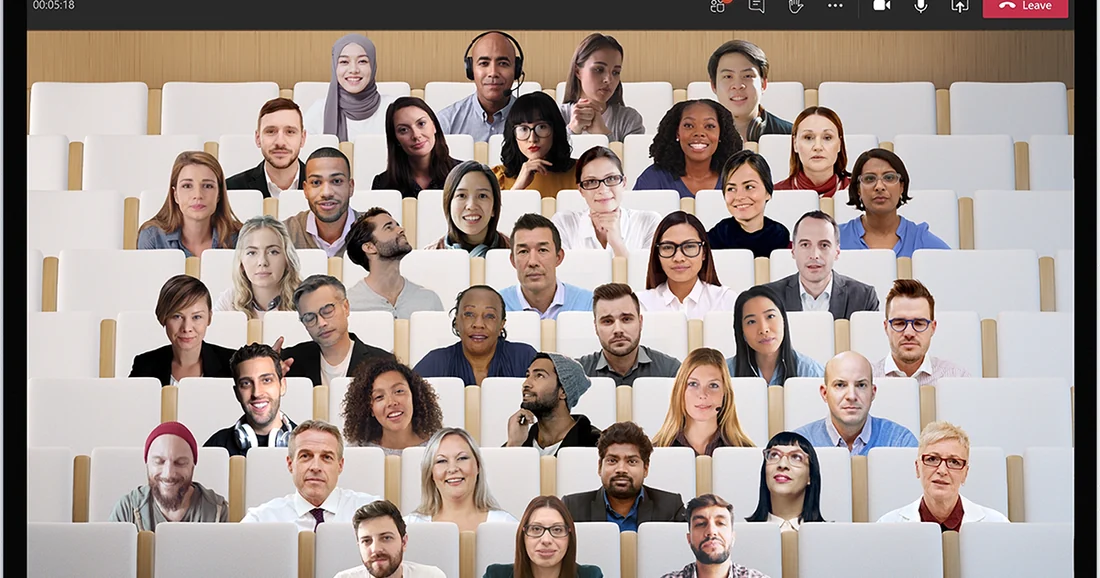
What the 2020 announcement describes
On 8 July 2020, Microsoft announced Together mode for Microsoft Teams, describing a feature that uses AI segmentation to cut each participant's video out of their own background and place them into a single shared virtual scene, an auditorium layout at launch, so that a meeting of several people reads as one room rather than a grid of separate windows. The post ties this directly to a stated problem: Microsoft said its research found people feel less connected since moving to remote work and experience more fatigue in video meetings than in person, and that seeing faces and body language together in one frame was meant to ease that.
What the segmentation does, and does not, capture
Cutting a person out of their video background is a two-dimensional image-processing technique: each participant is still filmed by an ordinary webcam from a fixed angle, and the software removes the background pixels and composites the resulting silhouette into a shared virtual backdrop, seated in a fixed arrangement of virtual seats. That is different in kind from a system that reconstructs a person's actual three-dimensional shape, the way a capture-studio rig or a light-field booth does; there is no depth information, no parallax if a viewer's own window resizes, and no gaze correction beyond what an ordinary webcam call already lacks. The 2020 announcement itself acknowledges a limit of a different kind, stating that Together mode is not intended for every meeting, suggesting best use in brainstorms and roundtables rather than presentations.
What today's documentation confirms and omits
Current Microsoft support documentation, retrieved 16 September 2026, still lists Together mode among the layouts a meeting can switch to, alongside Gallery and Large Gallery, confirming the feature remains available years after launch. Microsoft's separate current guide to customising a Teams meeting view does not mention Together mode at all in the sections checked for this entry, which this entry treats as a gap in that particular document rather than proof the feature has been withdrawn, since the view-only-attendee guide still names it directly and no source consulted here states a retirement.
Questions to bring to a demo
- Is the shared scene built from two-dimensional cutouts or from an actual three-dimensional reconstruction of each participant.
- Does the seating arrangement adapt to how many people join, or is it a fixed set of virtual seats.
- Which meeting types does the organiser judge unsuited to this layout, and why.
Together mode is a useful example of how modest a shared-virtual-room claim can be while still changing how a meeting feels: a background composite over ordinary webcam video, not a captured body in space. That is worth stating precisely against systems elsewhere in this archive that do reconstruct a person's actual three-dimensional form.
Sources & reading trail
Announces Together mode, describes the segmentation-into-shared-scene mechanism, and states the design rationale and a stated limitation.
Source published: 8 July 2020 · Retrieved: 16 September 2026
Confirms Together mode remains a current meeting layout option alongside Gallery and Large Gallery.
Source published: Not established · Retrieved: 16 September 2026
Primary documents establish the record; the mechanism reading and the demo questions are Presence Atlas editorial analysis. This retrospective draft does not imply the site published on the event date.
Continue reading
- Horizon Workrooms tracked hands, not faces, in a shared room
- Microsoft Mesh promised photoreal selves, shipped avatars
- Zoom's immersive view composites faces onto one backdrop
- Browse the complete the archive
Sources & reading trail
- Reimagining virtual collaboration for the future of work and learning
Source published: July 8, 2020 · Retrieved: September 16, 2026 - Join a meeting as a view-only attendee in Microsoft Teams
Retrieved: September 16, 2026
The documents above establish the record. The reading and the questions are this publication’s editorial analysis, written after the fact.
Published September 18, 2026, not on the date of the event described.