
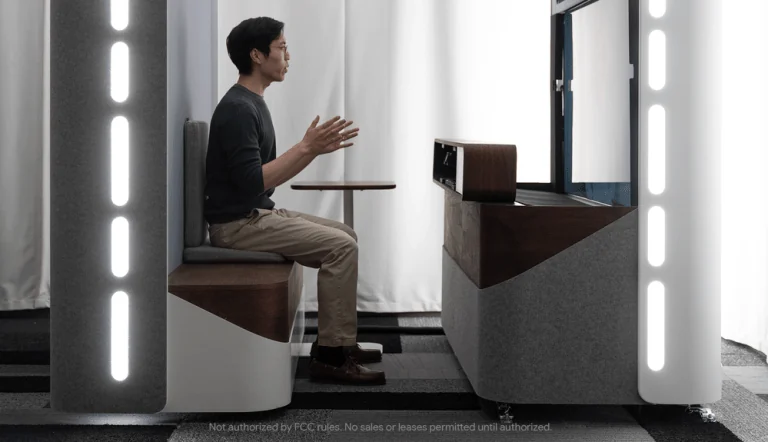
Google's Starline paper describes a booth, not a headset
Google's publication page places the Starline peer-reviewed paper in December 2021, describing a tracked light-field booth, not a headset.
- Historical event
- December 1, 2021
- First source published
- May 18, 2021
- Site publication
- September 18, 2026
What the record actually documents
Google's own publication listing for Project Starline: A high-fidelity telepresence system names the venue as ACM Transactions on Graphics, in the Proceedings of SIGGRAPH Asia, volume 40, issue 6, dated 2021, placing the peer-reviewed paper in December 2021 alongside that year's conference. This is worth stating plainly because a technical paper under this title is sometimes associated with 2023 in secondary summaries; Google's own listing, opened directly, places it in 2021, some months after the company's original product announcement of 18 May 2021, which describes internal use across Google's Bay Area, New York and Seattle offices and early demonstrations to healthcare and media partners.
An autostereoscopic light-field booth, not a headset
The paper's abstract, as Google presents it, describes a real-time bidirectional system built around a head-tracked autostereoscopic display: a lenticular screen that steers slightly different images to each eye without glasses, combined with multi-view three-dimensional capture, face tracking, spatial audio and compressed colour-and-depth video streamed over a network. Because the display tracks the viewer's head, correct stereo and motion parallax depend on sitting within the booth's tracked zone and largely facing the display; this is presence built from a specific hardware volume on each end of the call, not a general-purpose camera-and-screen setup. The May 2021 announcement adds that a proprietary light-field display renders a life-sized counterpart with working eye contact, a claim about apparent gaze direction rather than a claim about full free-viewpoint movement.
What the evidence supports and what it does not
Google's listing states the system was assessed as demonstrably better than ordinary two-dimensional video calling, based on participant ratings of presence and engagement, meeting recall, and observed nonverbal behaviour such as head nods. That is a company-run user study of its own product, described on the company's own publication page, not an independent replication, and the announcement itself frames the 2021 rollout as limited to internal offices and selected enterprise partners rather than general availability. Neither source states unit cost, room size requirements beyond the booth itself, or how many simultaneous participants a single unit supports.
- Is this specific booth the same generation of hardware the 2021 paper describes, or a later revision with different specifications?
- Was the cited user study run by the vendor, an independent lab, or some combination, and on what sample size?
- What happens to image and audio quality if a participant leans out of the display's tracked viewing zone?
A head-tracked light-field booth and a video call solve the same nominal problem, being face to face at a distance, through very different means, and the paper's contribution is specifically to the booth: capture, compression and a display that tracks one viewer's eyes, not a claim about telepresence in general.
Sources & reading trail
Google's own publication page naming the ACM Transactions on Graphics / SIGGRAPH Asia 2021 venue, authors, technical components and the user-study claim.
Source published: Not established · Retrieved: 16 September 2026
Google's original product announcement describing internal testing and the light-field display's eye-contact claim.
Source published: 18 May 2021 · Retrieved: 16 September 2026
Primary documents establish the record; the mechanism reading and the demo questions are Presence Atlas editorial analysis. This retrospective draft does not imply the site published on the event date.
Continue reading
- A light-field booth carried Google's Starline calls
- Webex Hologram took years to move from pitch to hardware
- A modular panel's own patents specify a 120-degree zone
- Browse the complete the archive
Sources & reading trail
- Project Starline: A high-fidelity telepresence system
Retrieved: September 16, 2026 - Project Starline: Feel like you're there, together
Source published: May 18, 2021 · Retrieved: September 16, 2026
The documents above establish the record. The reading and the questions are this publication’s editorial analysis, written after the fact.
Published September 18, 2026, not on the date of the event described.