
Broadcast flash-safety guidance also applies to LED walls
ITU-R BT.1702 and independent flash testing show photosensitive-seizure risk is tested, not eyeballed.
- Site publication
- September 18, 2026
A broadcast safety standard, still being revised
The current ITU-R record, as retrieved on 16 September 2026, describes BT.1702 as guidance 'for the reduction of photosensitive epileptic seizures caused by television'. The record shows the recommendation was first issued in 2005 and has since been revised at least three times, most recently approved in November 2023. The document itself, opened as a PDF from the ITU, is organised around several technical appendices: one giving production guidance on flashing images, one on luminance measurement technique, one on filtering methods that can reduce flash risk in post-production, and one on viewing-environment factors. That structure is the useful fact here, independent of the exact numeric thresholds inside it, which sit in appendix text this review could not fully extract: BT.1702 is a measurement and production framework, not a single flash-rate number.
Why an LED wall or projection show is not exempt
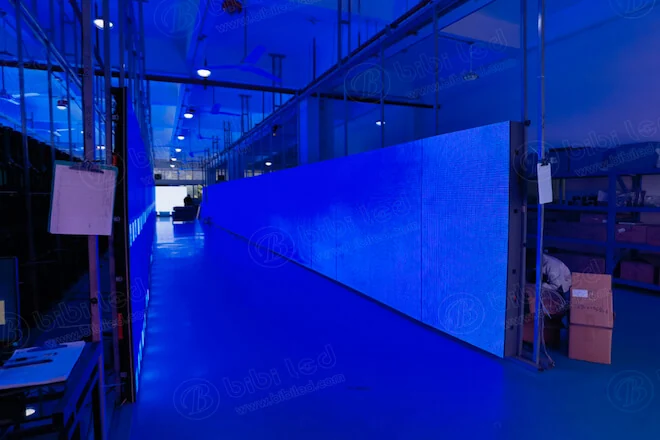
BT.1702 was written for television, but the hazard it addresses, rapid high-contrast flashing and certain repeating patterns, is optical, not medium-specific. A stage LED wall or a projected show can reproduce the same luminance transitions the recommendation was built to catch, at a scale and brightness a domestic screen cannot match. A venue commissioning original content, rather than broadcasting pre-cleared television material, has to decide for itself whether to apply an equivalent check, because the ordinary broadcast compliance chain that catches this for television does not automatically extend to a live show.
How a venue actually tests content
One commercial testing service, as retrieved, offers to analyse a finished video file against 'Ofcom/ITU' criteria by default, with a Japanese broadcast alternative also offered, and to issue a compliance result. That confirms, independent of the ITU text itself, that these thresholds are applied as an automated pass or fail test on finished video rather than a rule a producer applies by eye. It also shows the test is normally run on a finished file, which matters for a live show where content may be generated or remixed in real time and cannot be pre-screened the same way.
Questions to bring to a demo
- Has this specific content been run through a flash-and-pattern test, or only viewed by eye?
- If content is generative or live-remixed, what limits the flash rate at run time rather than only in pre-cleared clips?
- Which version of the guidance, and which national code, is the test calibrated against?
None of this tells a venue whether one specific cue is safe; only a proper test against the current document can do that. What the record does establish is that 'it looked fine to me' is not the standard the broadcast industry itself relies on, and there is no reason a large-format display should hold itself to a lower bar than a television screen.
Sources & reading trail
ITU record confirming the recommendation's subject, its first issue in 2005 and revision history to a November 2023 approval, and the appendix structure of the document itself.
Source published: Not established · Retrieved: 16 September 2026
Living commercial-service page confirming that Ofcom/ITU flash-and-pattern criteria are applied as an automated test against finished video files.
Source published: Not established · Retrieved: 16 September 2026
Primary documents establish the record; the mechanism reading and the demo questions are Presence Atlas editorial analysis. This retrospective draft does not imply the site published on the event date.
Continue reading
- Pixel pitch, not marketing, sets an LED wall's viewing zone
- A published standard puts a number on projection contrast
- The 2014 laser safety standard classifies hazard by output power
- Browse the complete the archive
Sources & reading trail
- Recommendation ITU-R BT.1702: Guidance for the reduction of photosensitive epileptic seizures caused by television
Retrieved: September 16, 2026 - Harding Test — online PSE compliance testing service
Retrieved: September 16, 2026
The documents above establish the record. The reading and the questions are this publication’s editorial analysis, written after the fact.
Published September 18, 2026, not on the date of the event described.