
Pixel pitch, not marketing, sets an LED wall's viewing zone
Manufacturer and AVIXA documentation ties minimum viewing distance to pixel pitch and viewing task, not one universal formula.
- Site publication
- September 18, 2026
What manufacturer documentation actually states
Planar's current product pages, as retrieved on 16 September 2026, list its DirectLight Ultra Series in 0.7mm and 0.9mm microLED pixel pitches alongside a 1.2mm standard-LED option, and its DirectLight Pro Series in 0.9mm, 1.2mm, 1.5mm and 1.8mm pitches, organised into indoor, outdoor, all-in-one and rental-and-staging categories. Samsung's equivalent LED business pages similarly separate a microLED flagship line from outdoor signage models with their own pitches. Neither page states a single formula converting pitch to viewing distance; both instead point to a separate interactive calculator tool rather than a fixed number, which is itself informative: the manufacturers treat the pitch-to-distance relationship as something calculated for a specific room, not quoted as a constant.
Why finer pitch belongs closer to the eye
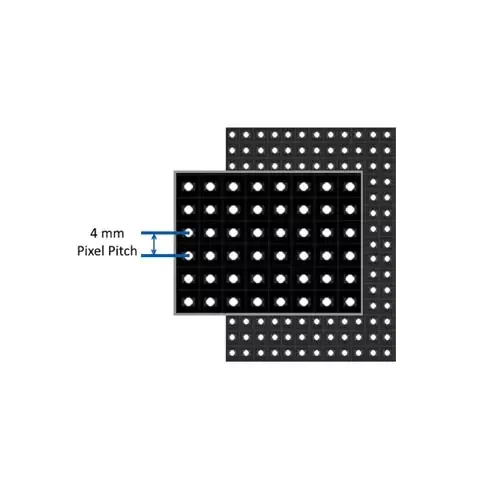
Pixel pitch is the centre-to-centre spacing between adjacent LEDs, and it sets the point at which the eye stops resolving individual pixels and starts seeing a continuous image. Move too close to a coarse-pitch wall and the picture resolves into visible dots and gaps rather than an image; stand far enough back from a fine-pitch wall and the extra resolution is wasted, since the eye can no longer use it. That logic sits behind pairing microLED and sub-millimetre pitches with near-viewing lobby and broadcast applications, and coarser pitches with stage and outdoor walls viewed from many metres back, exactly the split both manufacturers build into their own product categorisation.
Why a formal standard exists alongside the calculators
The AVIXA standards catalogue lists Display Image Size for 2D Content (DISCAS, ANSI/AVIXA V202.01) as a published standard for 'establishing display size and viewing positions for new or existing spaces from drawings or on-site', with its own online calculator for conformance. That a professional AV standards body maintains a separate, vendor-neutral method is itself evidence that a single manufacturer's rule of thumb should not be treated as an industry-wide constant: DISCAS exists because viewing task, not pixel pitch alone, determines an acceptable position, and a stage wall meant for immersive backdrop viewing is judged by different criteria than a wall meant for reading text at a lobby desk.
Questions to bring to a demo
- What is the pixel pitch of the specific panel being demonstrated, and is it the panel proposed for the final install?
- Has the intended viewing distance been checked against a calculator or standard, not just against how it looked in the showroom?
- Is this wall being sold for close reading, ambient backdrop, or both, and does one pitch actually serve both tasks?
A stage wall and a lobby wall are different products because they answer different questions about how close a person will stand. Neither manufacturer's page states a portable formula that fits every room, and that omission is the point: the actual number belongs to a calculator, a standard, or a site visit, not to a spec sheet read in isolation.
Sources & reading trail
Manufacturer documentation listing distinct pixel pitches (0.7-1.8mm) across separate DirectLight product lines split by indoor, outdoor and rental/staging application.
Source published: Not established · Retrieved: 16 September 2026
Identifies DISCAS (ANSI/AVIXA V202.01) as the published, vendor-neutral standard for establishing display size and viewing position for a space.
Source published: Not established · Retrieved: 16 September 2026
Manufacturer documentation listing distinct LED product families (microLED, outdoor signage) confirming pixel pitch is chosen per application rather than as one universal spec.
Source published: Not established · Retrieved: 16 September 2026
Primary documents establish the record; the mechanism reading and the demo questions are Presence Atlas editorial analysis. This retrospective draft does not imply the site published on the event date.
Continue reading
- Broadcast flash-safety guidance also applies to LED walls
- A published standard puts a number on projection contrast
- An angled sheet of glass fixes where a ghost can be seen
- Browse the complete the archive
Sources & reading trail
- Planar — LED display products
Retrieved: September 16, 2026 - AVIXA Standards
Retrieved: September 16, 2026 - Samsung Business — LED Displays
Retrieved: September 16, 2026
The documents above establish the record. The reading and the questions are this publication’s editorial analysis, written after the fact.
Published September 18, 2026, not on the date of the event described.