
The Mandalorian's LED volume replaced backdrops with pixels
ILM's documentation describes camera-tracked Unreal Engine renders on an LED wall, debuted on the series in November 2019.
- Historical event
- November 1, 2019
- Site publication
- September 18, 2026
What the production record documents
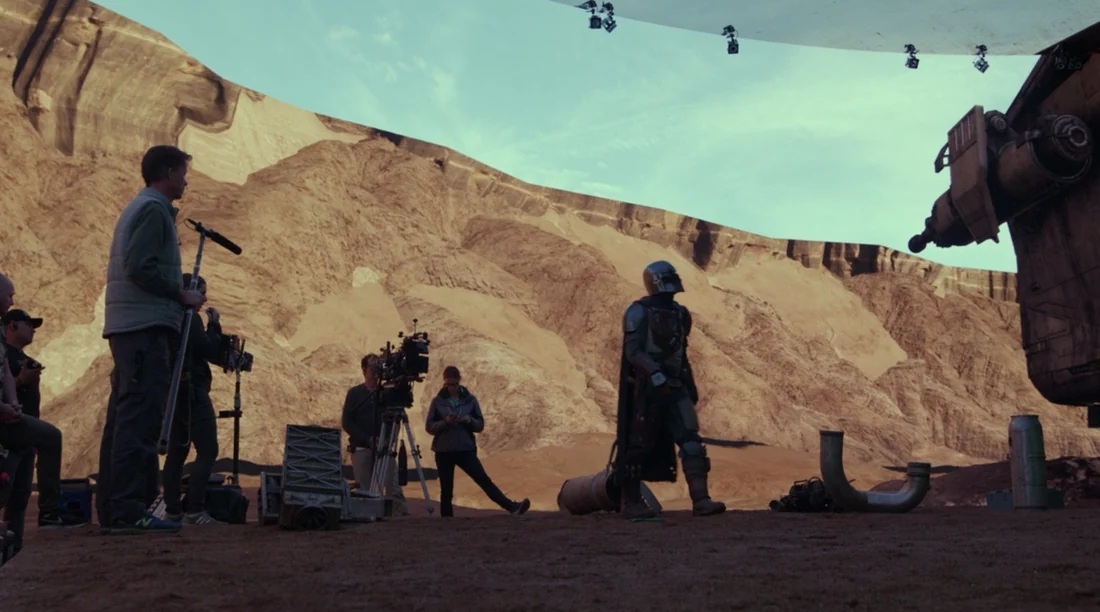
Industrial Light & Magic's own account of work on The Mandalorian states that, "after preliminary testing in 2018, the first ILM StageCraft LED Volume was constructed at scale on a soundstage at Manhattan Beach Studios," built with partners including Golem Creations, Epic Games, Fuse Technical Group and Profile Studios. The series debuted on Disney+ in November 2019, and ILM records that season one still required "over 4000 traditional visual effects shots created in post in addition to the real-time effects achieved in the StageCraft Volume," a detail worth keeping, since it shows the volume supplemented rather than replaced conventional visual effects work. Separately, Epic's account of the same production states that Unreal Engine "was running on four synchronized PCs to drive the pixels on the LED walls in real time," rendering more than 60 environments.
The mechanism: a background that knows where the camera is
A StageCraft-style volume is a room lined with LED panels displaying a rendered environment, with actors and physical set pieces placed inside it. The mechanism separating this from a static photographic backdrop is camera tracking: the physical film camera's position and lens data feed the render engine continuously, and the engine redraws the background from the correct perspective for that exact camera position, in real time. Move the camera, and the parallax on the LED wall shifts to match, the same way a real background would appear to shift from a moving viewpoint. Epic's account attributes a further, practical benefit to this setup: it can "capture a significant amount of complex VFX shots with accurate lighting and reflections in-camera," because the LED panels themselves become a physical light source illuminating the actors and any reflective surfaces on set, rather than lighting being added afterwards in post-production.
The constraint the technique inherits from stagecraft
The correct-perspective trick only works for the camera being tracked. A volume renders one background, from one point of view, at any instant; a second camera on set, or a live audience member standing beside the stage, would see the same LED panels from the wrong angle and the illusion would not hold. This is the same single-viewpoint limitation that has applied to rear-projection and other in-camera backdrop techniques for decades; StageCraft's innovation is making the backdrop interactive and camera-reactive, not eliminating the constraint that only the recording lens gets the corrected image. Neither ILM's nor Epic's documentation claims otherwise; both describe a filmmaking tool built around one tracked camera, not a display meant to be viewed live from arbitrary seats.
Questions to bring to a demo
- Is the background rendered specifically for the recording camera's tracked position, or is it a fixed, non-reactive video loop?
- How many of the finished shots still needed traditional post-production visual effects on top of the volume footage?
- What was built as a real, physical set piece versus displayed only as rendered background on the panels?
The LED volume's documented achievement is turning a backdrop into a camera-reactive render; it remains a single-viewpoint illusion borrowed from a much older stagecraft principle, applied with a modern engine.
Sources & reading trail
Dates preliminary testing to 2018 and the series debut to November 2019, and states season one still required 4000 additional traditional VFX shots.
Source published: Not established · Retrieved: 16 September 2026
Describes StageCraft as a production-proven LED volume methodology offering flexibility to filmmakers.
Source published: Not established · Retrieved: 16 September 2026
States Unreal Engine drove the LED walls in real time from four synchronised PCs, enabling accurate in-camera lighting and reflections.
Source published: Not established · Retrieved: 16 September 2026
Primary documents establish the record; the mechanism reading and the demo questions are Presence Atlas editorial analysis. This retrospective draft does not imply the site published on the event date.
Continue reading
- MetaHuman Creator ships digital humans as reusable rigs
- An angled sheet of glass fixes where a ghost can be seen
- Gauze becomes a screen only when the light behind it changes
- Browse the complete the archive
Sources & reading trail
- The Mandalorian — ILM Visual Effects
Retrieved: September 16, 2026 - StageCraft
Retrieved: September 16, 2026 - Forging New Paths for Filmmakers on The Mandalorian
Retrieved: September 16, 2026
The documents above establish the record. The reading and the questions are this publication’s editorial analysis, written after the fact.
Published September 18, 2026, not on the date of the event described.