
Gauze becomes a screen only when the light behind it changes
Manufacturer documentation for stage gauze and projection textiles shows lighting, not the fabric alone, decides what an audience sees.
- Site publication
- September 18, 2026
What manufacturer documentation actually lists
Gerriets, a stage-textile manufacturer, separates its transparent textiles from its projection textiles as distinct product categories, retrieved 16 September 2026: sheer muslin and gauze on one side, purpose-woven projection fabrics such as Ripstop and 8 Point Sharkstooth Isolde on the other, alongside rigid rear-projection sheet materials such as RigiFlex. The company's own projection-textiles page is candid that no one material suits every job, stating that PVC projection films are not always the best choice and that for some applications its projection textiles are much better suited. That is a manufacturer admitting a limit on its own product line, which is worth more than most specification claims.
A lighting relationship, not a fixed property of the fabric
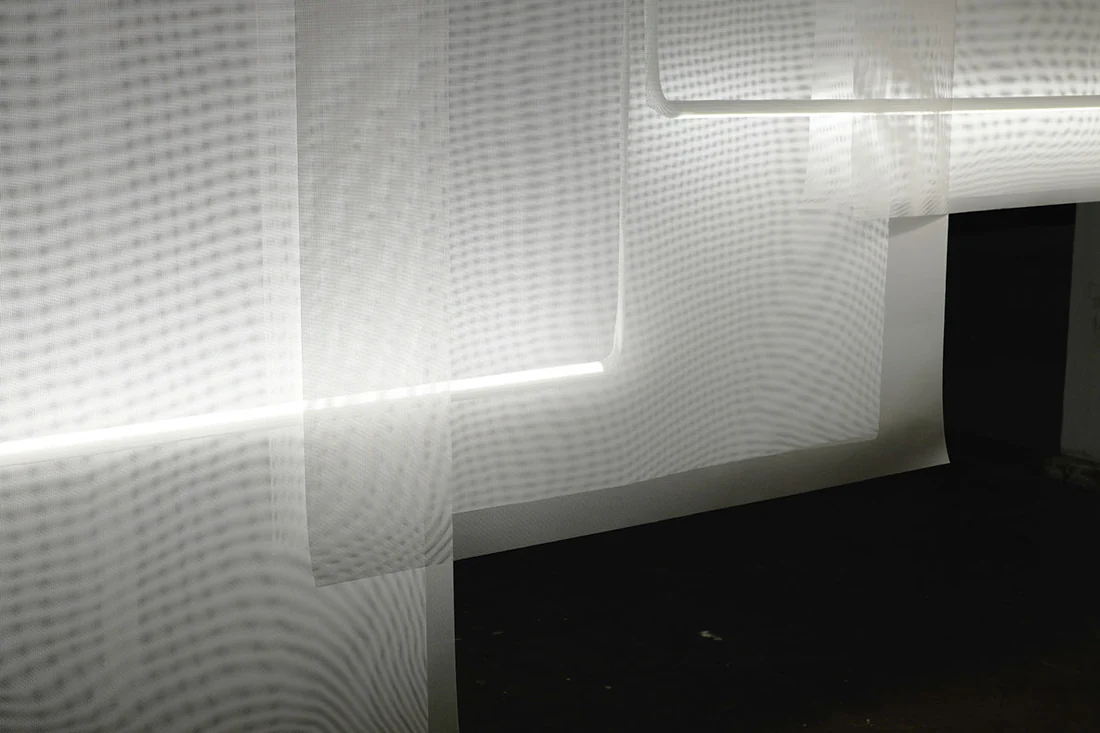
Gauze and scrim work by an optical relationship rather than a fixed transparency: light striking the front of the loosely woven fabric scatters back toward the audience, so a scene or projected image lit from the front reads as solid; light from behind passes through the weave largely unimpeded, revealing whatever sits behind it. The same physical fabric can look opaque or nearly invisible within the same performance, purely by changing which side is lit and by how much. Gerriets does not publish transparency or gain figures for its gauze products specifically, but its RigiFlex rear-projection sheet, a related, more rigid product from the same catalogue, gives concrete numbers for the same family of technique: a gain of 0.3, a viewing angle of 70 degrees or more in both directions, ambient-light performance rated only fair, 12 percent reflectivity, and a colour-critical viewing angle beyond 35 degrees. Those figures illustrate, even for a different specific material, why a projected or front-lit floating image on a fine mesh degrades quickly outside a fairly narrow cone and under anything but controlled ambient light.
What the documentation does not settle
None of the pages examined here give a transparency percentage, weave density, or gain figure for the gauze and scrim fabrics themselves, only for the adjacent rigid RigiFlex product. Nor do they quantify how atmospheric haze, sometimes added deliberately so a projector's beam is visible in the air above the gauze, interacts with the fabric's own scattering behaviour, or how far off-axis a seat can be before the reveal effect collapses. Those are venue-specific lighting-design decisions, made in the room, not facts a manufacturer's catalogue page states in advance.
- Is the floating image on gauze a projection, a reflection, or simply a front-lit performer behind a scrim that has gone transparent?
- What happens to the effect from a seat well off the venue's centre line?
- Does added haze make the trick more convincing, or does it give away the projector's beam path?
Gauze and scrim are among the oldest and cheapest tools in this archive, and the manufacturer's own documentation is correspondingly modest: it describes fabric weaves and finishes, not optical performance. The rest, gain, sightlines, and how convincingly a room reads the trick, is lighting design, decided anew at every venue.
Sources & reading trail
Manufacturer documentation, retrieved 16 September 2026, listing gauze and sheer fabric products used for reveal effects.
Source published: Not established · Retrieved: 16 September 2026
Manufacturer documentation stating that no single projection fabric suits every application.
Source published: Not established · Retrieved: 16 September 2026
Specification sheet giving gain, viewing-angle and ambient-light figures for a related rear-projection screen material.
Source published: Not established · Retrieved: 16 September 2026
Primary documents establish the record; the mechanism reading and the demo questions are Presence Atlas editorial analysis. This retrospective draft does not imply the site published on the event date.
Continue reading
- A patent for scattering light off fog describes no solid screen
- An angled sheet of glass fixes where a ghost can be seen
- Haze is a regulated fluid before it is a beam effect
- Browse the complete the archive
Sources & reading trail
- Transparent Textiles (Gerriets)
Retrieved: September 16, 2026 - Projection Textiles (Gerriets)
Retrieved: September 16, 2026 - RigiFlex (Gerriets)
Retrieved: September 16, 2026
The documents above establish the record. The reading and the questions are this publication’s editorial analysis, written after the fact.
Published September 18, 2026, not on the date of the event described.