
A patent for scattering light off fog describes no solid screen
The 2004 US patent explains a laminar fog sheet that forms a flat, two-sided image with no physical screen at all.
- Historical event
- November 20, 2003
- First source published
- November 16, 2004
- Site publication
- September 18, 2026
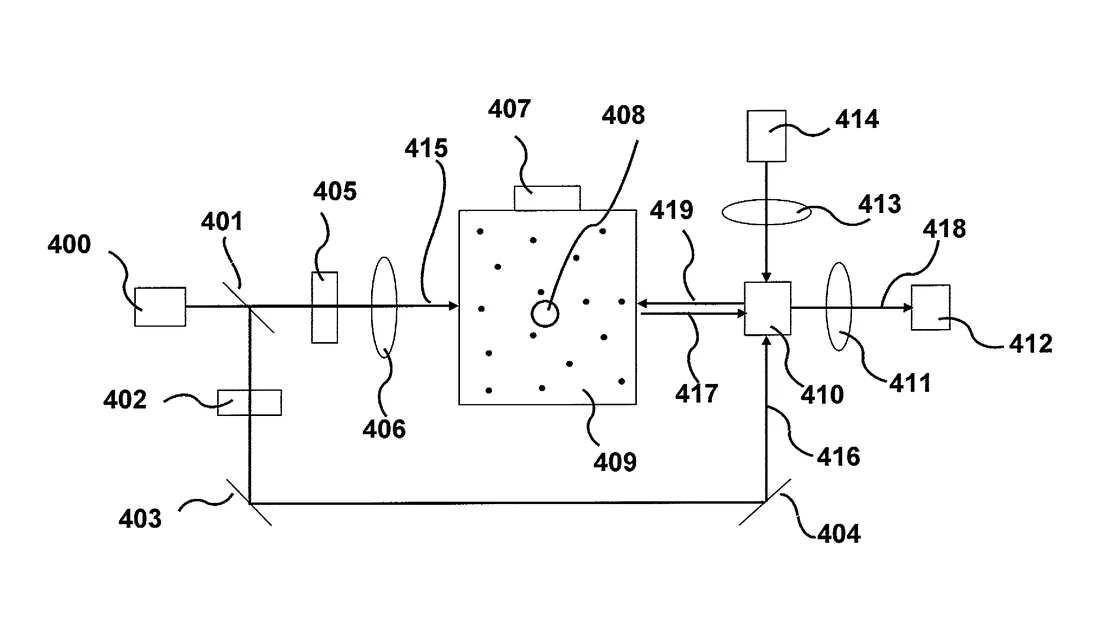
What the patent actually claims
US patent 6,819,487, Method and apparatus for forming a projection screen or a projection volume, was filed on 20 November 2003 by inventors Karri Palovuori and Ismo Rakkolainen and published on 16 November 2004. Its claims describe supplying light scattering or reflecting scattering centres, droplets of fog, into a substantially laminar transfer flow of air, discharged from nozzles of variable forms or a perforated or split tube, and kept toward the centre of that flow, away from the direct vicinity of the interfaces, so the resulting sheet keeps a stable, flat shape rather than dispersing into ordinary fog.
Scattering light, not reflecting it off a surface
This is a materially different mechanism from every foil- or glass-based illusion in this archive. There is no solid screen: a projector projects light, which scatters from the scattering centres in an elastic or non-elastic manner, forming the desired image directly within the moving layer of fog. The patent notes that non-elastic scattering produces images of arbitrary shape that can in principle be observed from any possible angle, because the actual images are transparent. The picture has no physical backing, so a viewer can, within limits, walk around or even through the space where it appears, and light passes through the sheet rather than bouncing off an angled surface the way it does in a Pepper's ghost rig. This is why the resulting image reads as flat and slightly soft rather than sharply defined: brightness and edge sharpness depend on droplet density and airflow stability, not on a screen's reflective coating.
A company that now sells air, not just images
The manufacturer's own site, fogscreen.com, retrieved 16 September 2026, still lists the original display products, FogScreen eZ and FogScreen eMotion, under an AudioVisual category, but its main technical specifications now sit under a Health category of air-purification devices built from the same fine-droplet expertise, documented with figures such as clean-air delivery rate and HEPA H13 filtration. The display product's own page, by contrast, gives only dimensions, power draw and water use, with no published gain, brightness or viewing-angle figures for the projected image itself. Neither the current commercial pages nor the original patent address how ambient light, air currents, or humidity affect image visibility in a real room; those are practical constraints a visitor would need to observe directly, not facts either document currently states.
- How does the image on a fog screen hold up next to a window, an open door, or a strong air-conditioning vent?
- Is the picture equally legible from both sides, and does either side see it mirror-reversed?
- If the manufacturer now emphasises air purification, does that suggest where the technology has found steadier commercial demand?
Read as a document, the patent is refreshingly precise about what it does not claim: a screen at all. That absence is the whole trick, and also the reason a fog display is more fragile, and more genuinely mid-air, than any reflection-based illusion in this archive.
Sources & reading trail
Patent describing the laminar fog-flow mechanism and light-scattering optical principle, with no solid screen.
Source published: 16 November 2004 · Retrieved: 16 September 2026
Manufacturer's current site, retrieved 16 September 2026, showing the display product listed alongside a newer air-purification product line built on the same droplet technology.
Source published: Not established · Retrieved: 16 September 2026
Current product page giving physical specifications but no optical performance figures for the display.
Source published: Not established · Retrieved: 16 September 2026
Primary documents establish the record; the mechanism reading and the demo questions are Presence Atlas editorial analysis. This retrospective draft does not imply the site published on the event date.
Continue reading
- Gauze becomes a screen only when the light behind it changes
- An angled sheet of glass fixes where a ghost can be seen
- Haze is a regulated fluid before it is a beam effect
- Browse the complete the archive
Sources & reading trail
- Method and apparatus for forming a projection screen or a projection volume (US 6,819,487)
Source published: November 16, 2004 · Retrieved: September 16, 2026 - FogScreen (company site)
Retrieved: September 16, 2026 - FogScreen eZ product page
Retrieved: September 16, 2026
The documents above establish the record. The reading and the questions are this publication’s editorial analysis, written after the fact.
Published September 18, 2026, not on the date of the event described.