
MetaHuman Creator ships digital humans as reusable rigs
Epic's documentation describes MetaHuman as a framework producing rigged photoreal humans driven by phone-captured performance.
- Site publication
- September 18, 2026
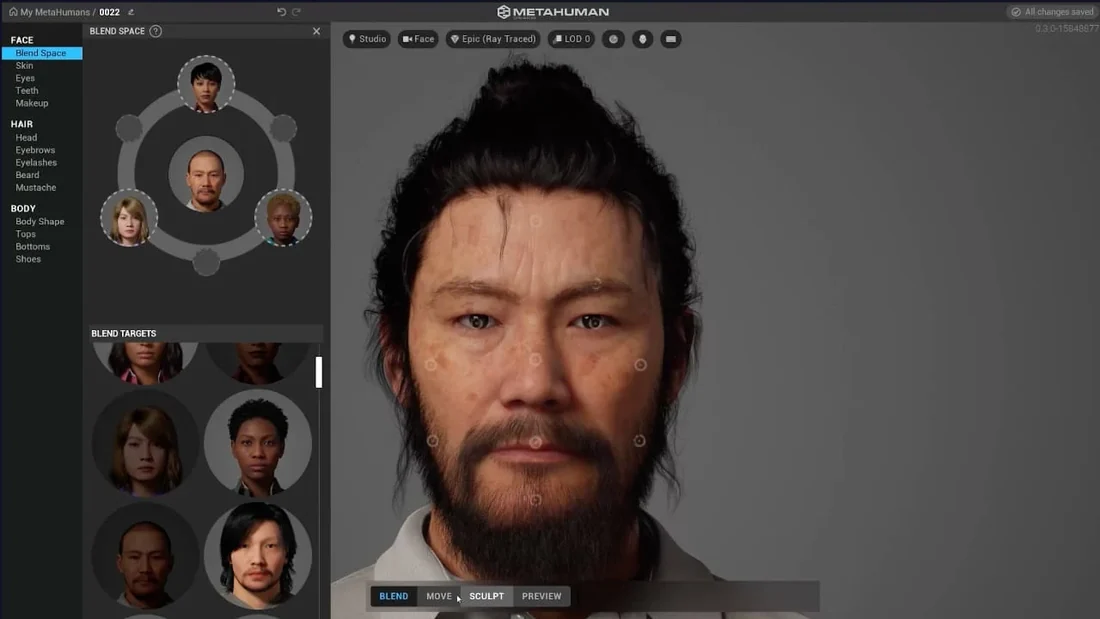
What the documentation says MetaHuman is
Epic Games' own MetaHuman documentation describes the system as "a complete framework that gives any creator the power to create, animate and use fully rigged, photorealistic digital humans in a variety of projects powered by Unreal Engine 5." That sentence is doing real work: MetaHuman is a framework, not a single tool, and the output is explicitly a rig rather than a finished animation or a fixed model. The documentation lists MetaHuman Creator for assembling a character's face and body, MetaHuman Crowds for populating scenes with many characters at once, and bridges to Autodesk Maya, SideFX Houdini and Unreal Editor for Fortnite. This description reflects the documentation as retrieved on 16 September 2026, since Epic revises the toolset continuously rather than issuing one dated release.
How a rig becomes a performance
The performance side of the pipeline is what makes MetaHuman relevant to virtual presence rather than static character art. Epic's MetaHuman page describes MetaHuman Capture recording an actor's face through the Live Link Face application on a phone, and MetaHuman Animator turning that footage into animation that, in Epic's words, "captures every nuance of an actor's performance." Inside Unreal Engine, the rig is edited through Control Rig and IK Rig rather than a proprietary format specific to MetaHuman. The distinction that matters for a spatial display is where the geometry and animation live: a MetaHuman is a skeleton and a set of facial controls, not a video. Whatever renders it, a games console, an LED volume, or a headset, needs Unreal Engine, or an export through Maya or Houdini, to turn the rig into pixels; it cannot simply play the character back like a captured clip.
What is documented and what is not
The documentation is precise about the pipeline and notably quiet about terms of use. Epic's MetaHuman page states that "core MetaHuman libraries" are becoming available as open source under an MIT licence, a change to how the underlying components can be reused, though the retrieved page does not itemise which libraries this covers or what remains proprietary. That distinction, open components versus a complete, freely reusable character, needs checking against the licence text itself rather than a summary page, and this record should not be read as a full account of MetaHuman's licensing terms. Separately, nothing in the documentation describes what a MetaHuman looks like on an LED volume or through a headset display; the framework's job stops at the rig, and rendered fidelity is a separate question the documentation does not address.
Questions to bring to a demo
- Is the character shown a stock MetaHuman preset, a custom Creator build, or a scan converted through Mesh to MetaHuman?
- Was the performance driven live through Capture and Animator, or hand-keyed afterwards?
- Which licence, Unreal Engine's standard terms or the newer open-source libraries, actually covers the specific assets on display?
MetaHuman standardises the rig, not the rendering. A photoreal face in a demo says more about Unreal Engine's real-time renderer and the display driving it than about MetaHuman itself, and the documentation supports that reading directly.
Sources & reading trail
Defines MetaHuman as a framework for creating, animating and using rigged photoreal digital humans, and lists Creator, Capture, Animator and third-party bridges.
Source published: Not established · Retrieved: 16 September 2026
Describes MetaHuman Capture and Animator driving facial performance, and notes core MetaHuman libraries becoming available under an MIT open-source licence.
Source published: Not established · Retrieved: 16 September 2026
Primary documents establish the record; the mechanism reading and the demo questions are Presence Atlas editorial analysis. This retrospective draft does not imply the site published on the event date.
Continue reading
- Codec Avatars render a scanned face, not a live scene
- A 106-camera rig captures people as 3D mesh files
- The Mandalorian's LED volume replaced backdrops with pixels
- Browse the complete the archive
Sources & reading trail
- MetaHuman Documentation
Retrieved: September 16, 2026 - MetaHuman
Retrieved: September 16, 2026
The documents above establish the record. The reading and the questions are this publication’s editorial analysis, written after the fact.
Published September 18, 2026, not on the date of the event described.