
A spinning LED blade draws a flat image that looks solid
HYPERVSN's own pages describe a rotating-blade display; the resulting image is flat, not volumetric.
- Site publication
- September 18, 2026
What the record documents
HYPERVSN is the trading name of Kino-mo Ltd, a company its own history page states was 'founded in 2011 by Kiryl Chykeyuk and his friend Art Stavenka', with the same page dating the product's 'commercial launch' to the CES trade show in 2017. This entry treats those as company-stated facts rather than independently confirmed dates, and covers the display as a mechanism rather than as a single dated event, since no announcement document was opened for this record beyond the company's own current pages, retrieved 16 September 2026.
What creates the image
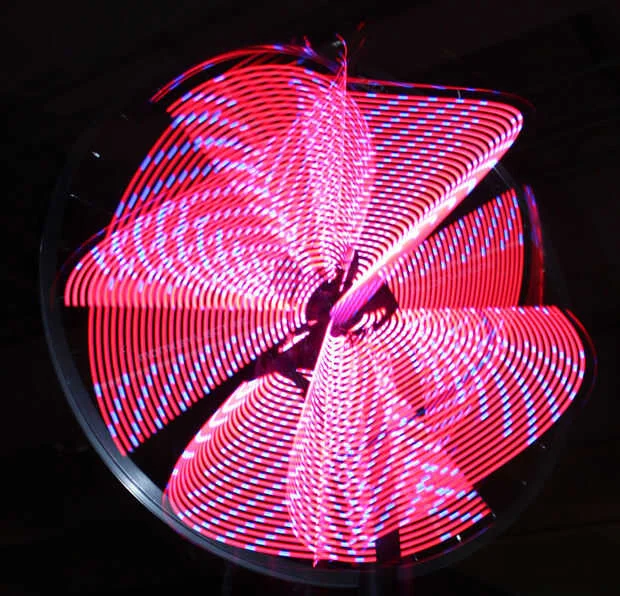
The device is, mechanically, a fan: HYPERVSN's own technology page states the product is 'the four-ray LED-based display' that 'rotates faster than the eye can see, leaving only the...content floating in midair'. Four thin blades, each carrying a line of LEDs, spin around a central hub. As each blade sweeps past a given point in space, its LEDs flash the correct colour for that instant, timed so precisely to the rotation that a full circle's worth of flashes builds up, frame by frame, into what looks like a continuously lit picture hanging in the air. This is the same persistence-of-vision principle behind a spinning sparkler trail or an old zoetrope, executed with LEDs and a motor controller instead of paper slots. The company's product page separately describes the same unit as 'a four-ray rotor display that shows 3D content which appears to float in midair'.
Why the picture is flat, not volumetric
Despite the vendor's repeated use of the word 'holographic', nothing in the pages reviewed here describes the display producing an image with genuine depth or parallax; the blades sweep out a single flat disc in space, and every LED flash belongs to that one plane, the way a spinning propeller traces a flat circle rather than a sphere. A viewer walking around the unit sees the same flat picture from the back as from the front, mirrored, rather than a different view revealing hidden depth - the defining difference between this category and the light-field and volumetric mechanisms covered elsewhere on this site. None of the pages reviewed for this entry state a rotation speed in revolutions per minute, a viewing-angle limit, or any guard, clearance or installation safety specification for the spinning blades themselves; those are vendor gaps this entry notes rather than fills.
Questions to bring to a demo
- What physical guard, clearance or enclosure does the installation guidance actually specify around the spinning blades?
- Is the image identical from the front and back of the disc, as the flat-plane mechanism implies?
- What happens to visible brightness or flicker at the edge of the swept disc compared with its centre?
The word 'holographic' in the product's own marketing is a claim about how the image feels to look at, not a claim this record can verify against the disclosed mechanism, which is a bright, fast, genuinely clever, and entirely flat rotating display.
Sources & reading trail
Describes the product as 'a four-ray rotor display that shows 3D content which appears to float in midair'.
Source published: Not established · Retrieved: 16 September 2026
States the display 'rotates faster than the eye can see', the persistence-of-vision mechanism behind the floating image.
Source published: Not established · Retrieved: 16 September 2026
States the company (Kino-mo Ltd, trading as HYPERVSN) was founded in 2011 and names a 2017 CES commercial launch.
Source published: Not established · Retrieved: 16 September 2026
Primary documents establish the record; the mechanism reading and the demo questions are Presence Atlas editorial analysis. This retrospective draft does not imply the site published on the event date.
Continue reading
- A hologram fan's real hazard is the invisible blade
- John Henry Pepper's own account explains the ghost's glass trick
- Pixel pitch, not marketing, sets an LED wall's viewing zone
- Browse the complete the archive
Sources & reading trail
- HYPERVSN | 3D Holographic Experiences
Retrieved: September 16, 2026 - How HYPERVSN Works — 3D Hologram Technology Explained
Retrieved: September 16, 2026 - HYPERVSN Mission, Values, and Team | Holographic Technology - HYPERVSN
Retrieved: September 16, 2026
The documents above establish the record. The reading and the questions are this publication’s editorial analysis, written after the fact.
Published September 18, 2026, not on the date of the event described.