
Google Cardboard turned any phone into a stereoscope
An open, unbranded viewer design used a phone's own screen and two lenses to reach a mass audience cheaply.
- First source published
- December 10, 2014
- Site publication
- September 18, 2026
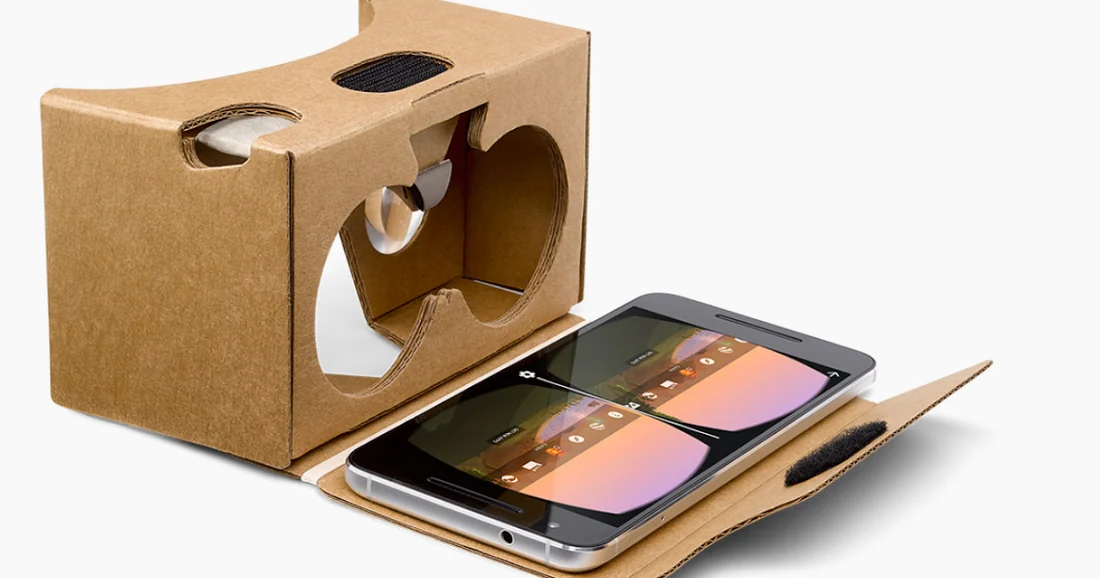
A phone and two lenses, documented as an open design
Google's own developer account, published on 10 December 2014, describes a team turning "a smartphone, and some cardboard, into a virtual reality (VR) viewer earlier this year" — a deliberately vague phrase that is the most precise dating this publication can attribute to a company source. By that December the same post reports "over half a million" viewers already distributed, alongside new Android and Unity SDKs and, notably, open-sourced viewer specifications so any manufacturer could build a compatible enclosure. That last point separates Cardboard from a single product: it was a published design, not a device Google alone sold.
What creates the image
There is no separate display in a Cardboard viewer. The phone's own screen, held a fixed distance from the eyes, is split into two half-frame images and viewed through a pair of lenses mounted in the enclosure. Google's current manufacturer specification calls for biconvex lenses at a "45mm focal distance," chosen because that shape "prevent[s] distortion around the edges," and it fixes a minimum enclosure size — "8.75in (22cm) by 22in (56cm)" of material — so that phone, lenses and screen sit at a workable distance. Stereoscopic rendering in the open-source SDK draws the left and right frames with the parallax offset a viewer's eyes expect; a magnetic or capacitive switch on the enclosure supplies the only input. Viewing conditions are unforgiving: the phone must be centred and steady behind the lenses, ambient light must not wash out the screen, and the whole experience depends on whichever handset the viewer owns rather than on calibrated optics.
What the record does and does not establish
Because the enclosure was an open specification rather than a single manufactured product, no one document describes "the" Cardboard experience; quality varied with phone, lens batch and build quality, and the sources here describe the reference design and SDK, not a tested unit. The GitHub repository confirms the specification is open but directs manufacturers elsewhere for the underlying optical files, so this publication cannot independently verify every dimension a particular viewer used. What the record does establish is intent: a phone-plus-lenses system designed to be distributed cheaply and widely, aimed at reach over image quality.
Questions to bring to a demo
- Which phone model and screen size is the viewer calibrated for, and does a different phone change the focus or framing?
- What happens to image sharpness and edge distortion away from the centre of the lens?
- Is the input limited to a single button, and how does that constrain what an experience can ask a viewer to do?
Cardboard's real innovation was not the optics, which were simple by design, but the decision to publish them. That is why a plain lens, rather than any wavefront trick, could put a stereoscopic image in front of a mass audience of phone owners.
Sources & reading trail
Google's own account that the viewer began as an experiment 'earlier this year' and had reached over half a million distributed units with new SDKs and an open-sourced viewer specification.
Source published: 10 December 2014 · Retrieved: 16 September 2026
Current open specification for third-party viewer manufacture, giving the 45mm biconvex lens requirement and minimum cardboard sheet size.
Source published: Not established · Retrieved: 16 September 2026
States that the Cardboard viewer specification is open source and documents the SDK's motion tracking and stereoscopic rendering functions.
Source published: Not established · Retrieved: 16 September 2026
Primary documents establish the record; the mechanism reading and the demo questions are Presence Atlas editorial analysis. This retrospective draft does not imply the site published on the event date.
Continue reading
- A Kickstarter campaign restarted consumer virtual reality
- Two flat drawings taught Wheatstone how depth is seen
- A headset must be built to fit a range of eyes
- Browse the complete the archive
Sources & reading trail
- Cardboard: seriously fun
Source published: December 10, 2014 · Retrieved: September 16, 2026 - Cardboard for manufacturers
Retrieved: September 16, 2026 - googlevr/cardboard
Retrieved: September 16, 2026
The documents above establish the record. The reading and the questions are this publication’s editorial analysis, written after the fact.
Published September 18, 2026, not on the date of the event described.