
Latency jitter provokes cybersickness more than steady delay
A peer-reviewed review finds irregular timing, not just longer delay, drives VR discomfort.
- First source published
- July 1, 1993
- Site publication
- September 18, 2026
What a peer-reviewed review actually reports
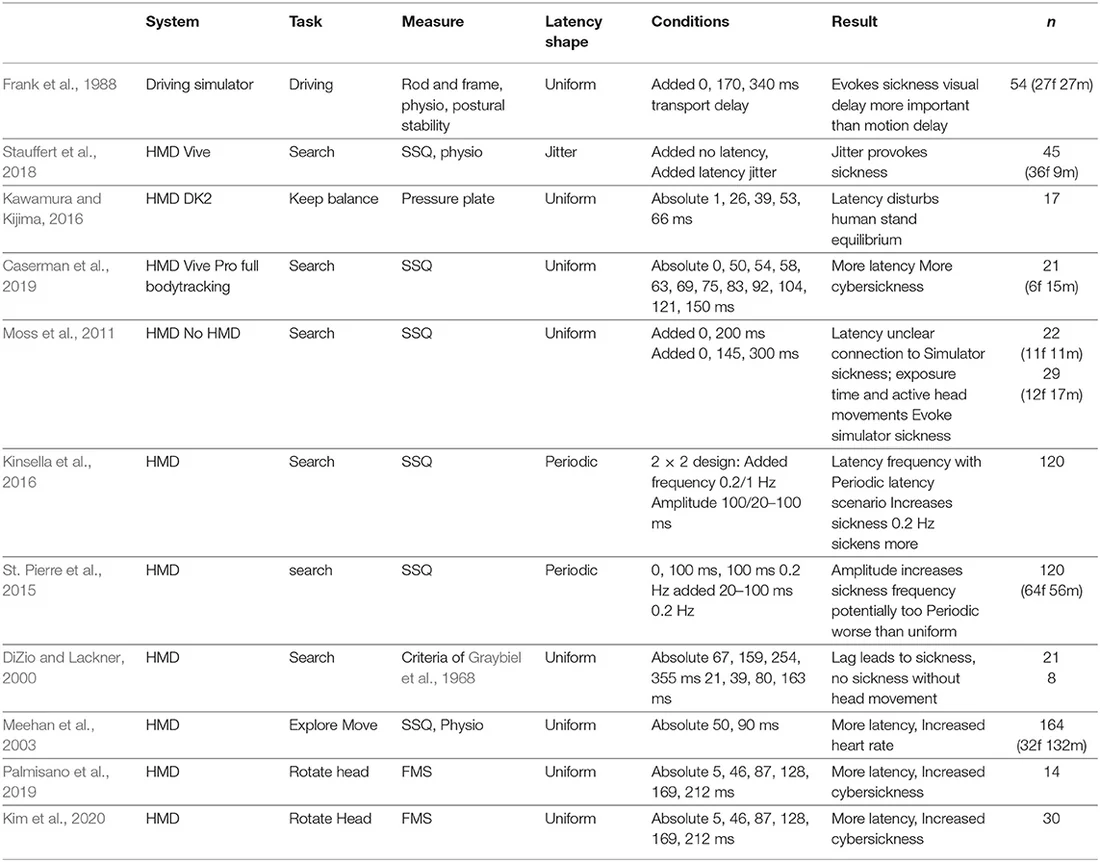
Motion-to-photon latency is the delay between a tracked movement and the corresponding change reaching the screen. A 2020 open-access review by Jan-Philipp Stauffert, Florian Niebling and Marc Erich Latoschik states plainly that 'high MTP latency can cause a loss of performance in interactive graphics applications and, even worse, can provoke cybersickness in Virtual Reality applications'. The review's central finding is not simply that more delay is worse: it reports that latency 'can exhibit intricate timing patterns with various spiking and periodic behaviour', and that these irregular patterns, latency jitter, provoke sickness on top of whatever the average delay is doing. The review also states that periodic latency variation at certain frequencies worsens symptoms more than others, and that head movement amplifies latency-induced discomfort.
Why jitter, not just delay, is the harder problem to fix
A steady, constant lag is something a system, and to some extent a user, can adapt to: the mapping between movement and image stays predictable even if delayed. A jittering lag breaks that predictability itself, so the visual system cannot form a stable expectation of when the image will catch up. That distinction matters for demo comparisons: a system quoted as having low average latency has not thereby shown low jitter, and the review's account implies a smooth-looking demo run on a lightly loaded machine can hide jitter that appears under real production load, background processes, or network variation in a networked telepresence system.
How the underlying studies measure this, and where the evidence sits
The review synthesises a body of controlled experiments, including a named 2018 study by the same authors measuring simulator sickness under latency jitter during a search task, confirmed here at the bibliographic level; this review could not open the full IEEE-published text of that specific study, so its detailed results are not quoted directly. What is common across this research programme, and confirmed by the review, is standardised post-exposure symptom scoring rather than an informal report, tracing back to instruments such as the 1993 Simulator Sickness Questionnaire, so that a 'more sickness' claim means a measured score change under controlled conditions, not a subjective impression from one session.
Questions to bring to a demo
- Has jitter, not just average latency, been measured, and under what real load conditions?
- Was sickness assessed with a standardised instrument, before and after, or only asked about informally?
- Does the demo's network or processing load match what a real installation will run under, including simultaneous users?
A demo that feels comfortable on a quiet, dedicated machine is not evidence that the same system will feel comfortable once it is carrying real load, real network conditions, or a longer session, because the literature this review could open ties discomfort specifically to timing irregularity, not to a single quoted latency number.
Sources & reading trail
Open-access peer-reviewed review stating that high motion-to-photon latency, and specifically irregular latency jitter, provoke cybersickness, with head movement amplifying the effect.
Source published: 26 November 2020 · Retrieved: 16 September 2026
Publisher (Crossref) bibliographic record confirming a specific named empirical study, by the same research group, measuring simulator sickness under latency jitter in a search task; full text was not accessible to this review.
Source published: 1 March 2018 · Retrieved: 16 September 2026
The standardised symptom instrument, established via its own publisher citation record, that latency/cybersickness studies use to quantify and compare sickness severity across conditions.
Source published: 1 July 1993 · Retrieved: 16 September 2026
Primary documents establish the record; the mechanism reading and the demo questions are Presence Atlas editorial analysis. This retrospective draft does not imply the site published on the event date.
Continue reading
- A 2008 study measured fatigue from a stereo display conflict
- The Simulator Sickness Questionnaire replaced ad hoc reports
- A light-field booth carried Google's Starline calls
- Browse the complete the archive
Sources & reading trail
- Latency and Cybersickness: Impact, Causes, and Measures. A Review
Source published: November 26, 2020 · Retrieved: September 16, 2026 - Effects of Latency Jitter on Simulator Sickness in a Search Task
Source published: March 1, 2018 · Retrieved: September 16, 2026 - Simulator Sickness Questionnaire: An Enhanced Method for Quantifying Simulator Sickness
Source published: July 1, 1993 · Retrieved: September 16, 2026
The documents above establish the record. The reading and the questions are this publication’s editorial analysis, written after the fact.
Published September 18, 2026, not on the date of the event described.