
Object Capture turns iPhone photos into ready 3D models
Apple's WWDC 2021 session and developer documentation specify photo counts, detail tiers and USDZ output.
- Site publication
- September 18, 2026
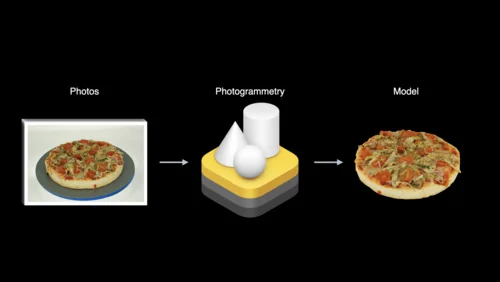
A photogrammetry pipeline built into the operating system
At WWDC 2021, Apple engineers Michael Patrick Johnson and Dave McKinnon presented a session introducing Object Capture, a photogrammetry API built into RealityKit. The session states that input photographs can come from every angle around an object, captured on an iPhone, iPad, DSLR, or drone, and recommends 20 to 200 close-up images depending on how complex the object is. Devices with a LiDAR Scanner can additionally embed depth data with each photo, which the session says is used for automatic scale and gravity recovery, meaning the model comes out at the correct real-world size and orientation without a person setting either by hand. This record reflects the session and current developer documentation as retrieved on 16 September 2026, rather than a single dated announcement, since Apple has continued to update the API in subsequent operating-system releases.
The mechanism and its detail tiers
Apple's PhotogrammetrySession documentation describes a class that "manages the creation of a 3D model from a set of images," taking either a folder of photographs or a custom sequence of samples that can include depth maps and segmentation masks. Processing happens on a Mac, using Intel or Apple silicon hardware, and returns a result containing the reconstructed 3D object alongside a sparse point cloud and the camera poses the algorithm estimated for each input photo. The WWDC session lists five configurable detail levels: Preview for fast interactive checks, Reduced for web and mobile augmented reality, Medium as a balance for single scans viewed in Apple's AR Quick Look, Full with baked material maps for games and film, and Raw for maximum-resolution custom post-production. The primary output format is USDZ, chosen because it opens directly in AR Quick Look on Apple devices without a separate viewer app.
What is documented and what remains a vendor choice
The detail-tier system is a real, documented trade-off between file size and geometric fidelity, not a marketing simplification: each tier changes triangle count and which material channels get baked in. What is not documented is how well the reconstruction performs on genuinely difficult subjects; reflective, transparent, or finely detailed surfaces are common photogrammetry failure cases in the wider literature, and neither the session nor the API reference makes accuracy claims for those cases. A display showing an Object Capture model is therefore only as good as the tier chosen and the photograph set behind it, and that judgement is not one the documentation makes for the viewer.
Questions to bring to a demo
- Which detail level produced the model on display, and does the file size match what that tier implies?
- Were the source photos supplemented with LiDAR depth data, and does that show up in a straighter, better-scaled result?
- Is the object type shown, for example glass, fur or fine mesh, one that the session's own examples covered?
Object Capture standardises the pipeline from photographs to a USDZ model with graded detail levels; it says nothing about the specific object in front of a camera, which is where photogrammetry quality is actually decided.
Sources & reading trail
States the photo-count guidance, LiDAR-assisted scale/gravity recovery, five detail-level tiers, and USDZ output.
Source published: Not established · Retrieved: 16 September 2026
Documents the API's inputs, output result types (3D object, point cloud, poses), and platform requirements.
Source published: Not established · Retrieved: 16 September 2026
Primary documents establish the record; the mechanism reading and the demo questions are Presence Atlas editorial analysis. This retrospective draft does not imply the site published on the event date.
Continue reading
- An iPhone LiDAR scanner brought depth to everyday scans
- Depthkit turns depth cameras into playable volumetric video
- The Smithsonian's own digitization office outlines its 3D programme
- Browse the complete the archive
Sources & reading trail
- Create 3D Models with Object Capture
Retrieved: September 16, 2026 - PhotogrammetrySession
Retrieved: September 16, 2026
The documents above establish the record. The reading and the questions are this publication’s editorial analysis, written after the fact.
Published September 18, 2026, not on the date of the event described.