
An iPhone LiDAR scanner brought depth to everyday scans
Apple's 2020 announcements and ARKit documentation specify a five-metre depth sensor feeding real-time mesh reconstruction.
- Historical event
- October 13, 2020
- First source published
- March 18, 2020
- Site publication
- September 18, 2026
Depth scanning moves from tablet to pocket
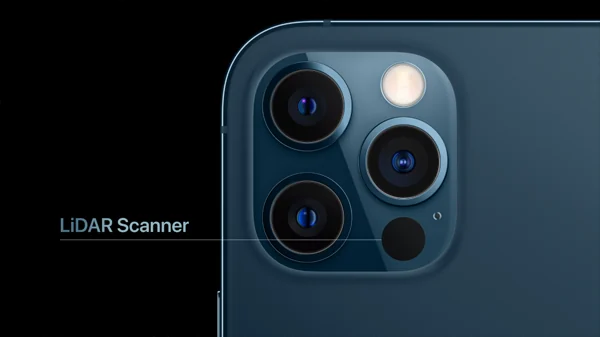
Apple first brought a LiDAR Scanner to a mainstream device with the iPad Pro, announced on 18 March 2020; the press release states the sensor "measures the distance to surrounding objects up to 5 meters away" and "operates at the photon level at nano-second speeds," working indoors and outdoors. Seven months later, on 13 October 2020, Apple carried the same sensor class into a phone: the iPhone 12 Pro announcement describes a LiDAR Scanner that measures "light distance" using "pixel depth information of a scene," and credits it with a sixfold improvement to autofocus speed in low light alongside a new Night mode portrait feature. Both releases frame the sensor primarily around augmented reality and photography, not around 3D scanning as an end in itself.
What the sensor feeds into, mechanically
Apple's ARKit documentation shows what that raw depth signal becomes for a developer. The ARMeshGeometry reference describes a live scene mesh built from vertices, faces formed from every three connected vertices, and outward-facing normals, with each face additionally carrying a surface classification such as wall, floor or table where ARKit can determine one. This is a fundamentally different kind of output from the multi-photograph photogrammetry pipelines used elsewhere in this production chain: LiDAR-based mesh reconstruction updates continuously, in real time, directly from the sensor's own measurements, rather than being computed afterwards from a batch of still photographs. That makes it well suited to what the iPad and iPhone releases actually emphasise, placing virtual objects convincingly and letting real objects occlude them correctly as a person moves the device, and poorly suited, on the documentation's own terms, to producing the kind of fine surface detail a full photogrammetry detail tier is built for.
A documentation gap worth noting
One detail is worth flagging precisely because it is easy to assume rather than read: the ARMeshGeometry reference itself states only iOS 13.4 and iPadOS 13.4 as minimum requirements and does not, in the retrieved text, explicitly state that LiDAR hardware is required to obtain mesh data. In practice, dense real-time scene meshing of this kind depends on the sensor Apple introduced in these same two 2020 announcements, and the class's practical availability tracks LiDAR-equipped hardware; but that link is an inference from the surrounding product history, not a sentence the API reference itself asserts, and it is the kind of gap a specification review should catch rather than assume.
Questions to bring to a demo
- Is the displayed scan raw LiDAR mesh data, or has it been refined afterwards with photogrammetry or manual retouching?
- Does the device and OS version shown actually carry the LiDAR Scanner, or is the mesh being simulated in software?
- What is the scan being used for, real-time placement and occlusion, or a finished asset, since the sensor suits the first far better than the second?
The LiDAR Scanner's documented contribution is a live, coarse, classified mesh of a room, not a finished 3D asset; what a display or AR session does with that stream is a separate, and separately documented, step.
Sources & reading trail
Dates the first LiDAR Scanner announcement and states its 5-metre range and nanosecond-speed operation.
Source published: 18 March 2020 · Retrieved: 16 September 2026
Dates the LiDAR Scanner's arrival on iPhone and states its low-light autofocus and Night mode portrait benefits.
Source published: 13 October 2020 · Retrieved: 16 September 2026
Specifies the live scene-mesh output (vertices, faces, normals, per-face surface classification) built from depth data.
Source published: Not established · Retrieved: 16 September 2026
Primary documents establish the record; the mechanism reading and the demo questions are Presence Atlas editorial analysis. This retrospective draft does not imply the site published on the event date.
Continue reading
- Object Capture turns iPhone photos into ready 3D models
- Kinect put a depth camera in millions of living rooms
- Apple Vision Pro shows the world through cameras, not glass
- Browse the complete the archive
Sources & reading trail
- Apple Unveils New iPad Pro With LiDAR Scanner and Trackpad Support in iPadOS
Source published: March 18, 2020 · Retrieved: September 16, 2026 - Apple Introduces iPhone 12 Pro and iPhone 12 Pro Max With 5G
Source published: October 13, 2020 · Retrieved: September 16, 2026 - ARMeshGeometry
Retrieved: September 16, 2026
The documents above establish the record. The reading and the questions are this publication’s editorial analysis, written after the fact.
Published September 18, 2026, not on the date of the event described.