
MIT's 1989 Mark I display computed a moving hologram
A 1990 SPIE citation record and a later IEEE account describe Mark I, the MIT acousto-optic display behind the first computed moving hologram.
- Historical event
- January 1, 1990
- First source published
- May 1, 1990
- Site publication
- September 18, 2026
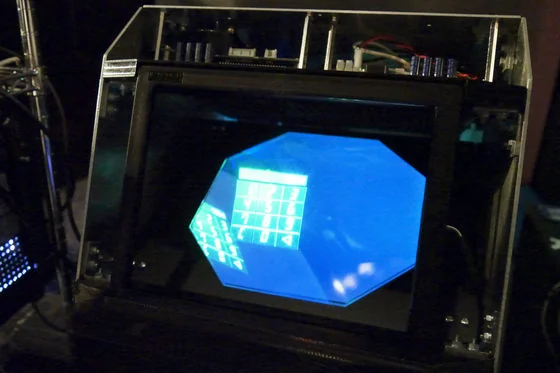
A 1989 display, described in a 1990 conference paper
A Crossref bibliographic record confirms the paper 'Electronic display system for computational holography,' by Pierre St-Hilaire, Stephen A. Benton, Mark E. Lucente, Mary Lou Jepsen, J. Kollin, Hiroshi Yoshikawa and John S. Underkoffler, published in SPIE Proceedings, Practical Holography IV, volume 1212, pages 174-182, presented at the OE/LASE '90 conference in Los Angeles between 14 and 19 January 1990. A later peer-reviewed account by one of the group's own colleagues, V. Michael Bove Jr.'s 2012 Display Holography's Digital Second Act in Proceedings of the IEEE, states plainly that the first reported electronic holographic display, 'Mark I,' developed by Benton and colleagues at the MIT Media Lab in 1989, employed an acousto-optic modulator.
Sound waves standing in for a photographic plate
An acousto-optic modulator turns an electrical signal into a travelling acoustic wave inside a transparent crystal, tellurium dioxide in this case; the acoustic wave compresses and rarefies the material fast enough to diffract passing light, much as a diffraction grating would. Feeding a computed hologram's fringe pattern into that acoustic signal lets the crystal stand in for a developed photographic plate, replayed electronically rather than chemically. Bove's account notes that such devices are inherently one-dimensional and so suited to horizontal-parallax-only displays rather than full-parallax ones, and that the diffraction pattern itself travels at the speed of sound, which the display must compensate for to hold a stationary image.
What the sources establish, and what they leave open
Both opened sources confirm authorship, venue and the acousto-optic mechanism; neither gives the physical screen size, brightness or frame rate of the 1989 Mark I unit, so this draft does not state a figure for any of them. The Bove paper is a review written by a colleague, not the 1990 conference paper itself, so its description of Mark I should be read as a documented secondary characterisation of a primary source this draft could not open directly, since the SPIE Digital Library's own pages did not return readable text during research.
- Is a 'holographic video' claim built on horizontal parallax only, or does it also carry vertical parallax?
- What physical image size and viewing distance was the display designed for?
- Is the light source, and its coherence, adequate for the claimed diffraction efficiency at that scale?
Mark I matters less for its picture than for the substitution at its core: an acoustic wave in a crystal, updated electrically, doing the job a static photographic emulsion once did. That substitution, and its horizontal-only limitation, still shapes what an electronically driven hologram can show.
Sources & reading trail
Bibliographic record confirming authorship, venue (SPIE Practical Holography IV, vol. 1212, pp. 174-182) and the January 1990 OE/LASE conference presentation.
Source published: 1 May 1990 · Retrieved: 16 September 2026
Peer-reviewed account naming 'Mark I' as the first reported electronic holographic display, built by Benton's group in 1989 using an acousto-optic modulator, and explaining its horizontal-parallax-only limitation.
Source published: 1 April 2012 · Retrieved: 16 September 2026
Primary documents establish the record; the mechanism reading and the demo questions are Presence Atlas editorial analysis. This retrospective draft does not imply the site published on the event date.
Continue reading
- A 1967 hologram was calculated, not recorded from light
- This headset display is the one that is actually holographic
- Browse the complete the archive
Sources & reading trail
- Electronic display system for computational holography (Crossref record)
Source published: May 1, 1990 · Retrieved: September 16, 2026 - Display Holography's Digital Second Act
Source published: April 1, 2012 · Retrieved: September 16, 2026
The documents above establish the record. The reading and the questions are this publication’s editorial analysis, written after the fact.
Published September 18, 2026, not on the date of the event described.