
This headset display is the one that is actually holographic
A 2017 paper used phase-only holography for per-pixel focus and built-in vision correction in a headset.
- Historical event
- July 20, 2017
- First source published
- July 20, 2017
- Site publication
- September 18, 2026
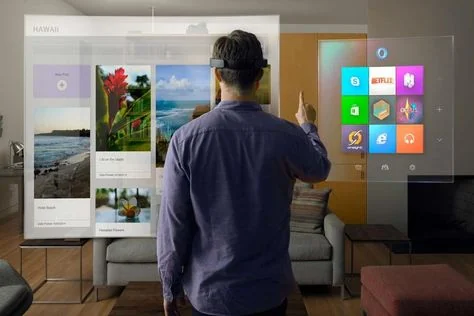
What the paper demonstrated
"Holographic Near-Eye Displays for Virtual and Augmented Reality," by Andrew Maimone, Andreas Georgiou and Joel Kollin of Microsoft Research, was published in ACM Transactions on Graphics on 20 July 2017. This is the one entry in this batch where the word 'hologram' applies without qualification: the paper's bibliographic record describes a display using "phase-only holographic projection," applying "Fresnel holography and double phase amplitude encoding" to reconstruct a wavefront rather than project a fixed image through a lens or waveguide. A second bibliographic registry independently confirms the title, authors and venue.
What creates the image, and why it is different
Every other headset in this batch relays a rendered image, made elsewhere, through a lens, waveguide or panel; this display instead computes the actual interference pattern that would produce the desired wavefront, and shows that pattern on a phase-modulating panel so light diffracts into the intended image as it leaves the device. The record states the method achieves "full color, high contrast and low noise holograms with high resolution and true per-pixel focal control" — meaning each point in the image can carry its own simulated depth, addressing the vergence-accommodation conflict directly rather than working around it with a lens array. The same computation, the record states, allows "optical correction models for aberrations and vision defects," so a viewer's prescription could in principle be corrected in software rather than with glasses. The authors report GPU-accelerated computation running "at ≥90 Hz" and describe resulting eyeglasses-like form factors with an "80° field of view."
What the record does and does not establish
This is a research paper describing a working prototype and its computational method, not a shipped or independently tested product; the 80-degree figure and the real-time frame rate are the authors' own reported results, and the sources opened for this piece do not include an independent replication. Computing a full wavefront in real time is a substantially harder problem than displaying a pre-rendered image, which is precisely why, years after publication, no consumer headset in this batch uses this method — every shipping device instead uses waveguides, passthrough cameras or a lens array.
Questions to bring to a demo
- Is the displayed image actually computed as a hologram, or is 'holographic' being used as a name for a waveguide or projection product?
- What resolution and brightness cost comes with generating a full wavefront compared with a conventional panel?
- Does per-pixel focus actually remove eye strain in extended use, or only in a short demonstration?
The distinction is worth holding onto precisely because the word has been used so loosely elsewhere in this batch: this is the rare headset display for which 'holographic' is a description of the optics, not a marketing choice.
Sources & reading trail
Bibliographic record giving the paper's title, authors, date and abstract describing phase-only holographic projection with per-pixel focal control and an 80-degree field of view.
Source published: 20 July 2017 · Retrieved: 16 September 2026
Independent bibliographic registry confirming title, authors and venue for the same paper.
Source published: 20 July 2017 · Retrieved: 16 September 2026
Primary documents establish the record; the mechanism reading and the demo questions are Presence Atlas editorial analysis. This retrospective draft does not imply the site published on the event date.
Continue reading
- A lens array let a headset show where the eye should focus
- A 1967 hologram was calculated, not recorded from light
- A 2008 study measured fatigue from a stereo display conflict
- Browse the complete the archive
Sources & reading trail
- Holographic near-eye displays for virtual and augmented reality
Source published: July 20, 2017 · Retrieved: September 16, 2026 - Holographic near-eye displays for virtual and augmented reality
Source published: July 20, 2017 · Retrieved: September 16, 2026
The documents above establish the record. The reading and the questions are this publication’s editorial analysis, written after the fact.
Published September 18, 2026, not on the date of the event described.