
A 1967 hologram was calculated, not recorded from light
Lohmann and Paris computed a hologram's interference pattern with a plotter instead of photographing real interfering light.
- Historical event
- October 1, 1967
- First source published
- October 1, 1967
- Site publication
- September 18, 2026
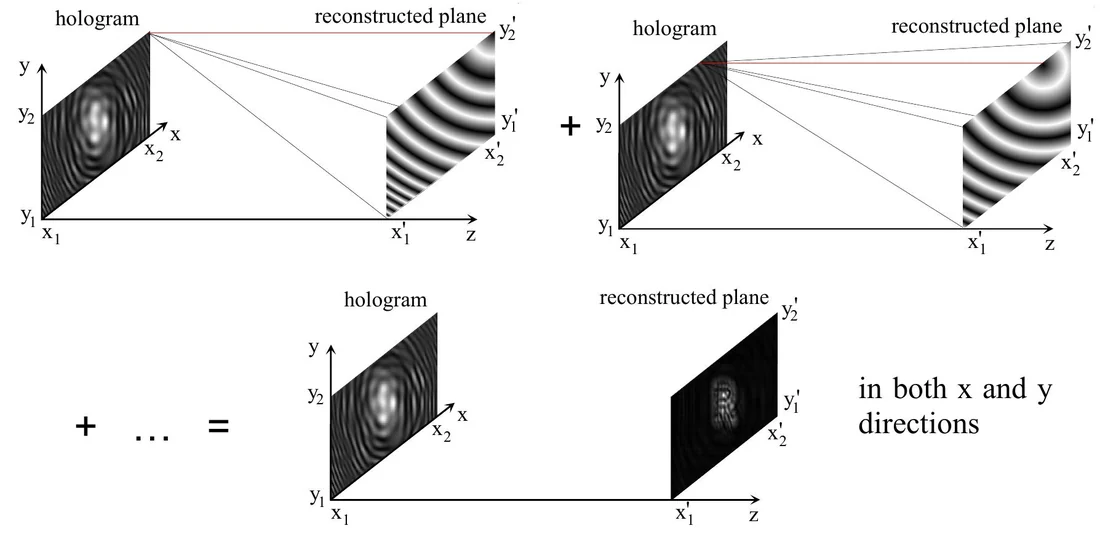
An interference pattern computed rather than exposed
Every hologram before 1967 was made the same way: real light from a real object interfered with a reference beam, and that pattern was recorded directly onto a photographic emulsion, the method Dennis Gabor proposed in 1948 as a way past the resolution limits of electron microscopes. In October 1967, Adolf Lohmann and D. Paris published Binary Fraunhofer Holograms, Generated by Computer in Applied Optics, describing a hologram whose interference pattern was calculated mathematically for an object that need never have existed physically, then output by a computer-controlled plotter rather than exposed by real light.
What creates the image, and how it was actually made
The paper's own description is specific: the holograms 'consist of many transparent dots on an opaque background', with each dot's position, rather than any variation in density, encoding the phase information a conventional hologram carries in continuous grey tones. This is the 'detour phase' technique: light takes a slightly different path length depending on where within a small cell a transparent aperture sits, which is mathematically equivalent to shifting the phase of the wave passing through it. A plotter drew the resulting pattern of dots at full size; it was then photographically reduced to the scale of a conventional hologram, and illuminating the reduced pattern with coherent light reconstructed a genuine three-dimensional wavefront, the same way a conventionally recorded hologram does. The paper reports that these binary holograms proved 'as efficient as conventional thin-emulsion holograms while being easier to reproduce photographically'.
What this establishes, and what it does not
What is documented here is a proof of principle: a hologram can be specified entirely by calculation and does not require light to have ever actually interacted with the object it depicts. That is the necessary precondition for every holographic display fed by a computer rather than a camera, from later computer-generated holography research through to any modern claim of a digital hologram. What the 1967 paper does not establish is real-time computation or display; the method involved an offline plotter run followed by photographic reduction, not anything resembling an updating image. Conflating 'computer-generated' with 'live' or 'video-rate' is a separate, much later engineering achievement this record does not cover.
Questions to bring to a demo
- Is the holographic pattern computed from a model, or captured from an existing object and light source?
- Is the display genuinely reconstructing a wavefront, or projecting a computed image that merely looks three-dimensional?
- If computed, is the pattern generated and displayed in real time, or precomputed and static like the 1967 plotter output?
Lohmann and Paris proved a hologram could be pure arithmetic rather than a recording of real light. Decades of computer-generated holography research since has mostly been about making that arithmetic run fast enough to display, not about the basic principle itself.
Sources & reading trail
Establishes that the hologram's pattern was computed and plotted as transparent dots on an opaque background, encoding phase by dot position (the detour-phase method), then photographically reduced and illuminated to reconstruct the image.
Source published: 1 October 1967 · Retrieved: 16 September 2026
Establishes Gabor's original 1948 proposal, motivated by electron-microscope resolution limits, as the optically recorded predecessor the 1967 computed method departed from.
Source published: Not established · Retrieved: 16 September 2026
Primary documents establish the record; the mechanism reading and the demo questions are Presence Atlas editorial analysis. This retrospective draft does not imply the site published on the event date.
Continue reading
- Gabor's 1948 paper proposed holography to fix microscopes
- Off-axis beams turned Gabor's idea into viewable holograms
- MIT's 1989 Mark I display computed a moving hologram
- Browse the complete the archive
Sources & reading trail
- Binary Fraunhofer Holograms, Generated by Computer
Source published: October 1, 1967 · Retrieved: September 16, 2026 - A New Microscopic Principle
Retrieved: September 16, 2026
The documents above establish the record. The reading and the questions are this publication’s editorial analysis, written after the fact.
Published September 18, 2026, not on the date of the event described.