
Gabor's 1948 paper proposed holography to fix microscopes
Nature's 1948 paper and the Nobel record show holography began as a fix for electron-microscope resolution, years before lasers existed.
- Historical event
- May 15, 1948
- First source published
- May 15, 1948
- Site publication
- September 18, 2026
A two-page fix for a microscope problem
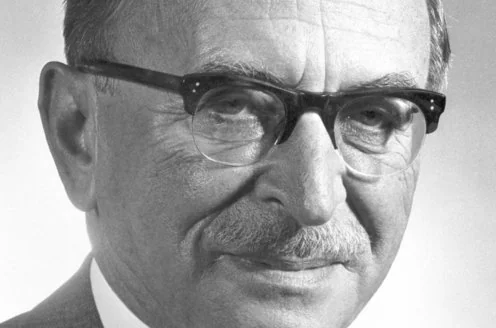
Dennis Gabor's paper 'A New Microscopic Principle' appeared in Nature on 15 May 1948, while he worked at the British Thomson-Houston Company. The paper's subject is not photography or display at all: it opens from the observation that the spherical aberration of electron lenses sets a limit to the resolving power of electron microscopes at about 5 angstrom, and proposes recording the complete light wave scattered by a specimen, not just its intensity, so the image could later be corrected computationally. The idea that would earn Gabor the 1971 Nobel Prize in Physics, for his invention and development of the holographic method, began as instrumentation, not spectacle.
Recording a wave, not a picture
An ordinary photograph keeps only the brightness pattern of light and discards its phase, the information about exactly when each light wave arrives relative to its neighbours. Gabor's proposal was to let the object's scattered light interfere with a separate reference wave, so the resulting fringe pattern on a photographic plate encodes brightness and phase together. Illuminating that developed plate again, with a similar reference wave, reconstructs the original wavefront, including its sense of depth. Gabor's Nobel lecture, delivered on 11 December 1971 under the title 'Holography, 1948-1971,' is his own retrospective on the fourteen years the idea spent unusable for lack of a sufficiently coherent light source.
What 1948 could not yet demonstrate
No laser existed in 1948; Gabor's early experiments used filtered mercury-arc light, only weakly coherent, and produced faint, doubled images rather than clean three-dimensional reconstructions. The Nature paper itself is aimed at electron microscopy, not at viewable light images of everyday objects, so nothing in it describes a display, a viewing angle or an audience. The practical, laser-lit transmission holograms most people now associate with the word came later, from other researchers building directly on this proposal. Treating this 1948 paper as if it already described a viewable hologram overstates what it claims.
- Does a given 'holographic' product actually reconstruct a wavefront, or is it a projection, a reflection or a multiview trick borrowing the name?
- What light source is doing the recording, and is it coherent enough for the claimed image quality?
- How much of a demonstrated result depends on inventions Gabor's 1948 paper could not have anticipated?
Gabor's own framing is worth keeping in view: he was solving a resolution problem in electron optics, and the wavefront-recording principle only later found its now-famous use in visible light. The distance between that proposal and a modern viewable hologram is fourteen years and several other people's work, not a straight line.
Sources & reading trail
Original Nature publication establishing Gabor's proposal to record the whole light wave to fix electron-microscope resolution.
Source published: 15 May 1948 · Retrieved: 16 September 2026
Official prize record giving the exact citation wording for the 1971 award and a summary of the interference-based method.
Source published: Not established · Retrieved: 16 September 2026
Confirms the lecture's title, 'Holography, 1948-1971,' and its 11 December 1971 delivery date.
Source published: Not established · Retrieved: 16 September 2026
Primary documents establish the record; the mechanism reading and the demo questions are Presence Atlas editorial analysis. This retrospective draft does not imply the site published on the event date.
Continue reading
- The 1971 Nobel citation credits Gabor, not a finished field
- Off-axis beams turned Gabor's idea into viewable holograms
- A 1967 hologram was calculated, not recorded from light
- Browse the complete the archive
Sources & reading trail
- A New Microscopic Principle
Source published: May 15, 1948 · Retrieved: September 16, 2026 - Dennis Gabor – Facts (NobelPrize.org)
Retrieved: September 16, 2026 - Dennis Gabor – Nobel Lecture (NobelPrize.org)
Retrieved: September 16, 2026
The documents above establish the record. The reading and the questions are this publication’s editorial analysis, written after the fact.
Published September 18, 2026, not on the date of the event described.