
The 1971 Nobel citation credits Gabor, not a finished field
The prize summary and Gabor's own lecture show what holography was credited for in 1971, and which problems he still listed as unsolved.
- Historical event
- December 11, 1971
- Site publication
- September 18, 2026
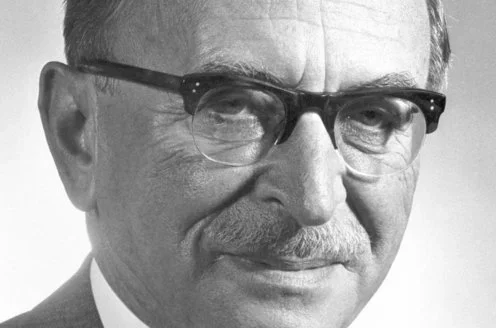
One sentence of citation, one lecture of caveats
The Nobel Prize in Physics 1971 was awarded to Dennis Gabor for his invention and development of the holographic method, a citation repeated on his facts page. That page's own short account of the work describes recording an object's light along with a reference beam that did not fall on the object, then illuminating the developed film with the reference beam alone so that the light is bent so that a reproduction with depth is produced, the same interference principle as his 1948 Nature paper. Gabor delivered his Nobel lecture, titled 'Holography, 1948-1971,' on 11 December 1971, framing his own contribution as an idea whose realisation depended on inventions that came after his 1948 proposal.
What the citation is, and is not, evidence of
A prize citation records that a committee judged the holographic method significant enough to honour; it is not, by itself, evidence about any particular product, display or demonstration made since. The facts page's description is a simplified summary written decades later for a general audience, not a restatement of Gabor's original claims, and this draft treats the two as distinct: the 1948 paper proposed recording a whole wavefront to fix electron-microscope resolution, while the prize was awarded in 1971 once laser-based holography had made the method practical for ordinary objects.
An inventor's own list of what remained unsolved
The research for this draft did not extend to the lecture's full text, since the Nobel Foundation's own PDF of it renders as an image rather than searchable text; the lecture's title and delivery date are confirmed directly from the Nobel site, but its detailed contents are not quoted here. What is documented is the shape of the story the prize record tells: a mechanism proposed in 1948, honoured in 1971, with the citation itself silent on lasers, on later inventors such as Leith and Upatnieks, and on any specific application. Treating the 1971 prize as certifying a finished, general-purpose display technology reads more into one sentence of citation than the sentence contains.
- Does a claim invoking 'the Nobel Prize for holography' name the actual 1971 citation wording, or paraphrase it into something broader?
- Which later inventions does a given holographic product depend on that the 1971 citation does not mention?
- Is a demonstration reconstructing a real wavefront, the specific mechanism the prize honoured, or something else marketed under the same word?
Gabor's own title for his lecture, spanning 1948 to 1971, is the more honest frame than the single citation sentence: a proposal, then twenty-three years of other people's work before it became a demonstrable method worth a prize.
Sources & reading trail
States the exact 1971 Physics Prize citation wording for Dennis Gabor.
Source published: Not established · Retrieved: 16 September 2026
Gives the prize motivation and a summary description of the interference-based recording and reconstruction method.
Source published: Not established · Retrieved: 16 September 2026
Confirms the lecture's title, 'Holography, 1948-1971,' and its 11 December 1971 delivery date.
Source published: Not established · Retrieved: 16 September 2026
Primary documents establish the record; the mechanism reading and the demo questions are Presence Atlas editorial analysis. This retrospective draft does not imply the site published on the event date.
Continue reading
- Gabor's 1948 paper proposed holography to fix microscopes
- Off-axis beams turned Gabor's idea into viewable holograms
- Browse the complete the archive
Sources & reading trail
- The Nobel Prize in Physics 1971 (Summary)
Retrieved: September 16, 2026 - Dennis Gabor – Facts (NobelPrize.org)
Retrieved: September 16, 2026 - Dennis Gabor – Nobel Lecture (NobelPrize.org)
Retrieved: September 16, 2026
The documents above establish the record. The reading and the questions are this publication’s editorial analysis, written after the fact.
Published September 18, 2026, not on the date of the event described.