
A dual backlight layer lets one screen switch out of 3D
Leia Inc's own patents describe a backlight toggling between diffuse 2D light and directional 3D beams.
- First source published
- June 6, 2019
- Site publication
- September 18, 2026
What the record documents
Leia Inc, the company behind switchable-3D tablets marketed under the Lume Pad name, still identifies itself as 'Leia Inc.' on its current web presence, now operating under the product name Immersity; its current site, retrieved 16 September 2026, describes an offering of 'Switchable-Display Hardware' that OEMs can license, alongside a separate spatial-AI software product. The company's original tablet product pages could not be reached for this entry - the web address once used for them now redirects to a page that itself returns an error - so this record is built from the company's own patent filings rather than from tablet-specific marketing copy or a confirmed retail launch date.
What creates the switch
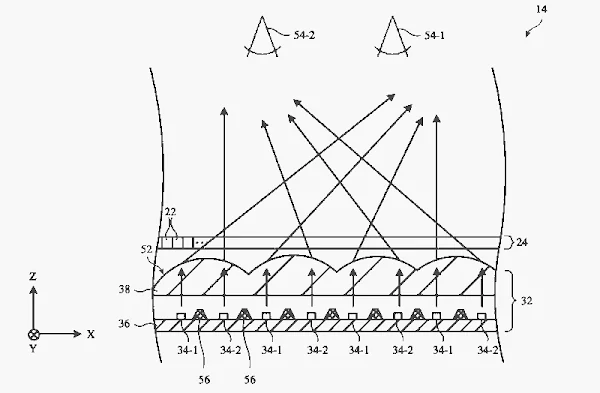
The underlying optical idea, per a patent with a priority date of 30 July 2013 naming inventor David Fattal, is a 'multibeam diffraction grating' built into a light guide behind the display panel: fine, precisely varied grating lines steer light from a single source into 'a plurality of light beams...directed away from the...grating...in different principal angular directions', up to nine distinct directions in the example given. That is what makes autostereoscopic 3D possible without glasses - each eye intercepts a different beam, and therefore a different rendered view. A separate patent with a 2015 priority date, also naming Fattal, describes stacking two backlight layers: a conventional diffuse layer for ordinary 2D use, and the directional grating layer for 3D, with 'a light-blocking layer between them' preventing interference, and switching handled by the system selecting 'which layer operates based on content requirements'.
What the patents do not claim
Notably, the 2015-priority switching patent describes no eye or face tracking and no automatic content detection; mode-switching in that document is software- or user-driven rather than sensor-driven. Any camera-based face tracking associated with the company's consumer tablets, if used, is not established by the two patents read for this entry, and this record does not assert it. Content built for the 3D mode still needs authoring or conversion into a stereo or multi-view format specifically for this backlight; a photo shown in 2D mode uses the diffuse layer exactly as an ordinary screen would.
Questions to bring to a demo
- Is switching between 2D and 3D modes manual, automatic, or tied to specific detected content?
- Does the demonstrated unit use face or eye tracking at all, given the core patents describe none?
- How much native 3D or converted stereo content actually exists for the format shown?
The company's continued description of itself as Leia Inc, years after its consumer tablets left the spotlight, suggests the underlying backlight patents outlived the specific products built on them.
Sources & reading trail
Describes the foundational multibeam diffraction-grating backlight, with a priority date of 30 July 2013, that steers light into distinct directional views.
Source published: 6 June 2019 · Retrieved: 16 September 2026
Describes the dual-backlight-layer mechanism, priority-dated 30 March 2015, that switches a panel between diffuse 2D light and directional 3D beams.
Source published: 20 October 2020 · Retrieved: 16 September 2026
Shows the company still identifies as Leia Inc and currently licenses 'Switchable-Display Hardware' to OEMs.
Source published: Not established · Retrieved: 16 September 2026
Primary documents establish the record; the mechanism reading and the demo questions are Presence Atlas editorial analysis. This retrospective draft does not imply the site published on the event date.
Continue reading
- A barrier or a lens decides which pixels reach which eye
- Sony's spatial display renders views for one tracked viewer
- Stereo depth has a comfort zone, and it narrows up close
- Browse the complete the archive
Sources & reading trail
- Multibeam diffraction grating-based backlighting
Source published: June 6, 2019 · Retrieved: September 16, 2026 - 2D/3D mode-switchable electronic display with dual layer backlight
Source published: October 20, 2020 · Retrieved: September 16, 2026 - Immersive Experiences on Any Device
Retrieved: September 16, 2026
The documents above establish the record. The reading and the questions are this publication’s editorial analysis, written after the fact.
Published September 18, 2026, not on the date of the event described.