
Sony's spatial display renders views for one tracked viewer
Sony's own documentation states the display supports one viewer, eye-tracked within 30 to 75 centimetres.
- Historical event
- October 31, 2020
- Site publication
- September 18, 2026
What the record documents
Sony's developer platform for the Spatial Reality Display keeps a dated history of its own software. Its release notes record 'SDK 1.0.0 (2020/10/31)' as the 'initial release', the earliest date this entry can confirm from Sony's own documentation. That marks the software platform's first release rather than a marketing unveiling, and it is treated here as exactly that narrower fact. The device itself, sold under the model name ELF-SR1, is built to show content rendered on an attached PC using Unity or Unreal Engine, per the same developer site, current as retrieved on 16 September 2026 rather than tied to one dated announcement.
What creates the image
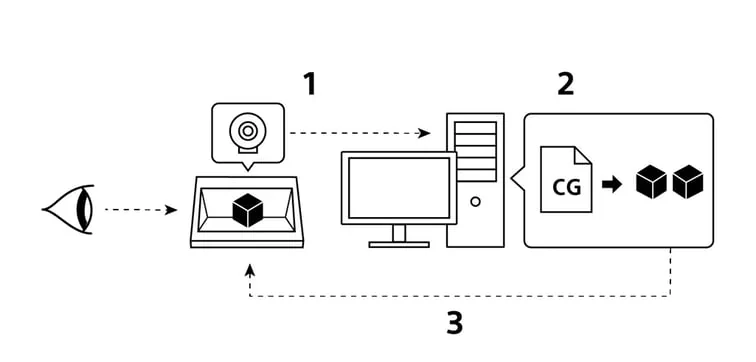
The display does not show a fixed stereo pair. Sony's technical description states that 'high-speed vision sensors and eye-recognition technology' built into the unit 'detects the position of each of the left and right eyes in real-time, not only horizontally and vertically, but also in depth', and that the attached PC then generates 'light source video...from 3DCG data' matched to that exact eye position. A layer of 'micro-optical lenses' fixed across the panel then 'delivers stereoscopic images to the left and right eyes'. The system recalculates a fresh stereo pair for wherever the tracked eyes currently are, rather than broadcasting one fixed set of views the way an untracked lenticular panel does; the company's own white paper describes the PC as able to 'render literally hundreds of views, each precisely calculated for the user's exact position' as the head moves.
The single-viewer limit
That white paper, headed 'White Paper(ELF-SR1 only)', states plainly that the display supports 'one' user, within a stated working range of '12–30 inches (30 cm–75 cm)' from the screen. This is the direct trade for tracked precision: a system built around one pair of tracked eyes has no defined behaviour for a second viewer, who would either see an image calculated for someone else's eye position or nothing coherent, a point the documentation reviewed here does not itself describe. Outside the stated distance band, tracking accuracy is not specified in the pages consulted.
Questions to bring to a demo
- What happens to the image, precisely, for a second person standing beside the tracked viewer?
- How does tracking behave at the edges of the 30–75 cm range rather than in the middle of it?
- Does the eye-tracking sensor fail visibly, or degrade gradually, under different ambient lighting?
Sony's own documentation is unusually specific about the viewer limit, which is worth noting: many spatial displays leave that number for a buyer to discover in person, whereas this platform states it as a specification.
Sources & reading trail
Describes the eye-recognition sensor and micro-optical lens layer that together generate the stereoscopic image.
Source published: Not established · Retrieved: 16 September 2026
States the display supports one viewer within a 12-to-30-inch working distance and renders hundreds of position-matched views.
Source published: Not established · Retrieved: 16 September 2026
Dates the developer SDK's initial release to 31 October 2020, the earliest confirmed date in Sony's own documentation.
Source published: Not established · Retrieved: 16 September 2026
Primary documents establish the record; the mechanism reading and the demo questions are Presence Atlas editorial analysis. This retrospective draft does not imply the site published on the event date.
Continue reading
- Sony's display renders two views for one tracked viewer
- Tracking one head turned a flat screen into a window
- Stereo depth has a comfort zone, and it narrows up close
- Browse the complete the archive
Sources & reading trail
- About the Spatial Reality Display
Retrieved: September 16, 2026 - White Paper(ELF-SR1 only)
Retrieved: September 16, 2026 - Release note
Retrieved: September 16, 2026
The documents above establish the record. The reading and the questions are this publication’s editorial analysis, written after the fact.
Published September 18, 2026, not on the date of the event described.