
A patent rotated a screen to fill a dome with light
A 2003 patent for a spinning projection screen inside a dome set the template modern swept-volume volumetric displays still use.
- Historical event
- April 29, 2003
- First source published
- April 29, 2003
- Site publication
- September 18, 2026
What the patent documents, dated to the day
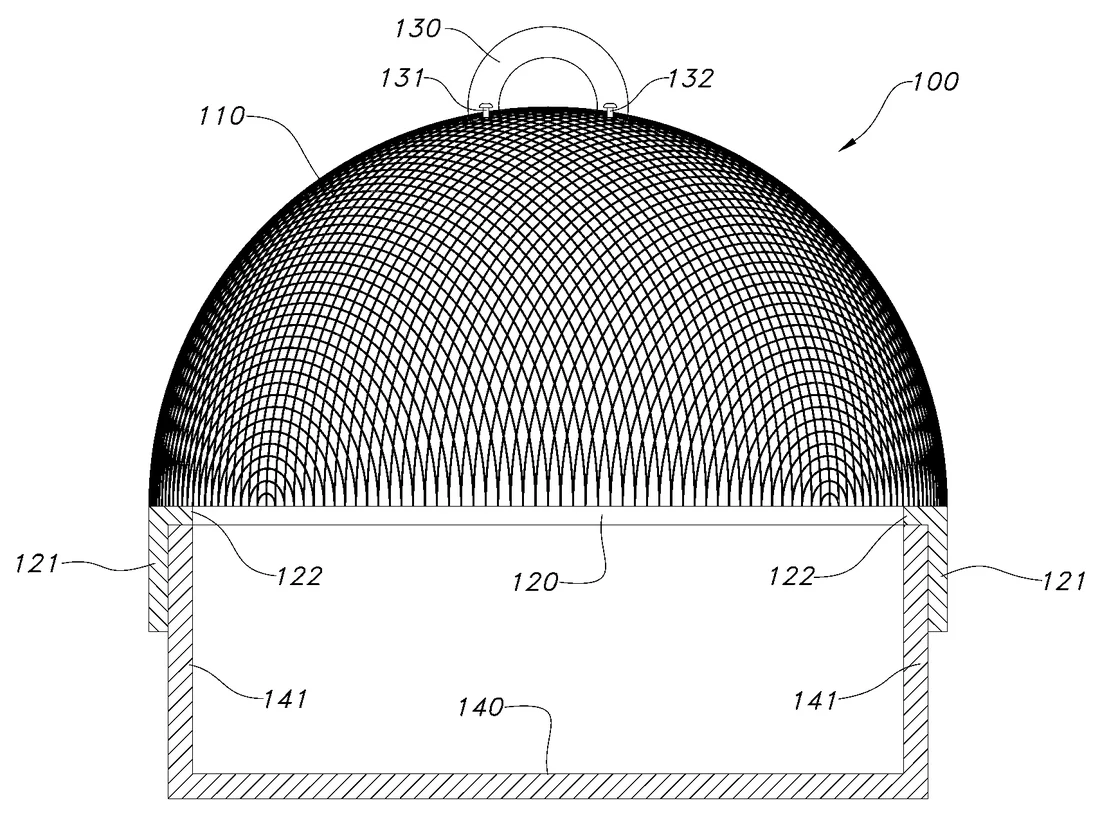
On 29 April 2003, the US Patent and Trademark Office granted US Patent 6,554,430, 'Volumetric three-dimensional display system', to Actuality Systems, the company Gregg Favalora co-founded. The patent describes a specific, concrete mechanism, not an abstract concept: a circular projection screen spinning inside a transparent dome, with the image-generating optics kept stationary below the platform, outside the viewer's line of sight, so only the rotating screen itself is visible through the dome.
What creates the image, and the viewing conditions it needs
A stationary projector updates the image on the spinning screen continuously; the patent states the system projects updated two-dimensional image slices onto the screen 'at least 4,000 times per second'. The patent's own explanation of why this looks solid rather than a blur is direct: 'persistence of the human visual system integrates these two-dimensional image slices into a three-dimensional volume-filling image'. Because the screen genuinely sweeps through the whole enclosed volume and the image is redrawn at every angle as it spins, the resulting volumetric image can be viewed from any position around the dome, by multiple viewers simultaneously, with no glasses, headset or head tracking required. This is a real, physically distinct point in space emitting light, unlike a projected illusion reflected off a flat surface.
What later documentation confirms and what it does not
Two years after the patent granted, Favalora's own 2005 survey in IEEE Computer situates this exact product, marketed as Perspecta, within the wider field of volumetric displays, alongside competing static-volume approaches. A current manufacturer, Voxon, describes its own product on its website, as retrieved 16 September 2026, in near-identical mechanical terms: 'swept-volume LED technology: a high-speed surface sweeps a 2D image through 3D space so fast that persistence of vision builds a true, walk-around voxel cloud'. What none of these documents establishes is true mutual occlusion between objects within the volume; a rotating-screen display, like the static-volume alternative, draws each slice independently, so one voxel does not automatically block light from a voxel behind it the way a solid object would. That constraint belongs to the swept-volume class generally, not to any single implementation.
Questions to bring to a demo
- What is the actual screen rotation speed and image update rate, and how does that limit achievable voxel resolution?
- Does a foreground object in the volume visibly and correctly block objects positioned behind it?
- Is the enclosure a sealed, transparent dome, and does the moving screen restrict where viewers can safely stand?
The 2003 patent's spinning-screen mechanism, verified in its own claims and echoed almost exactly in a current manufacturer's own description two decades later, set the durable template for swept-volume volumetric displays: sweep a surface fast enough, and persistence of vision does the rest of the work.
Sources & reading trail
Claims and describes the mechanism: a semicircular projection screen rotating inside a transparent dome, updated by a stationary projector at least 4,000 times per second, integrated by persistence of vision into a volume-filling image.
Source published: 29 April 2003 · Retrieved: 16 September 2026
Confirms this patent's commercial product, Perspecta, as one of the volumetric displays the survey covers in a dedicated section, situating it within the wider field two years after the patent granted.
Source published: 1 August 2005 · Retrieved: 16 September 2026
Confirms a current product built on the same principle, describing swept-volume LED technology in which a high-speed surface sweeps a 2D image through space so persistence of vision builds a walk-around voxel cloud, as retrieved 16 September 2026.
Source published: Not established · Retrieved: 16 September 2026
Primary documents establish the record; the mechanism reading and the demo questions are Presence Atlas editorial analysis. This retrospective draft does not imply the site published on the event date.
Continue reading
- A 2005 survey split true 3D displays into two working classes
- A swept LED screen paints a volume you can walk around
- A spinning LED blade draws a flat image that looks solid
- Browse the complete the archive
Sources & reading trail
- Volumetric three-dimensional display system (US Patent 6,554,430 B2)
Source published: April 29, 2003 · Retrieved: September 16, 2026 - Volumetric 3D displays and application infrastructure
Source published: August 1, 2005 · Retrieved: September 16, 2026 - Voxon / Voxel3D swept-volume display (manufacturer product page)
Retrieved: September 16, 2026
The documents above establish the record. The reading and the questions are this publication’s editorial analysis, written after the fact.
Published September 18, 2026, not on the date of the event described.