
Photopolymer film now records holograms without wet chemistry
Bayfol and Litiholo documentation shows self-developing photopolymer has replaced silver halide for volume holograms and AR optics.
- Site publication
- September 18, 2026
What the manufacturer documentation states, as retrieved
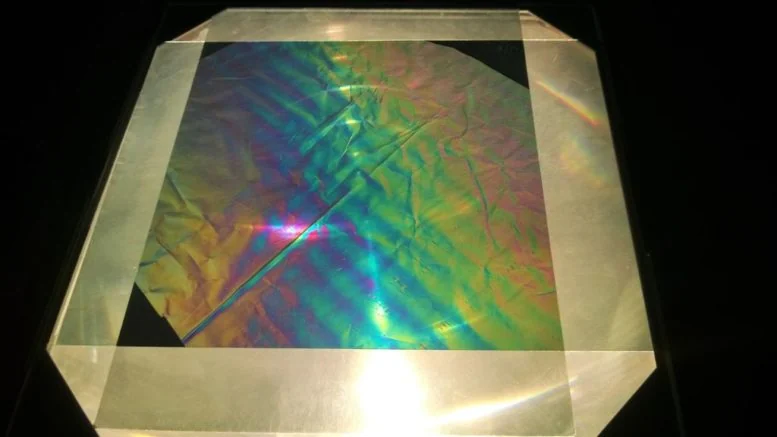
Covestro describes its Bayfol HX film as "a three layer stack of a substrate, the light-sensitive photopolymer and a protective cover film," which is "self-developing — no wet or thermal post-treatment required," recordable within specific bands depending on grade, up to a full "440–850 nm" range across the product line, and compatible with roll-to-roll manufacturing. At the consumer end, Litiholo's own site describes film that "develops as you expose it, and can be viewed immediately," sold for use with a laser or the company's own hologram printer to record people, CAD designs or 3D art. Both companies are describing the same underlying chemistry at very different scales.
What makes it self-developing
Classic silver-halide holography exposes a photographic emulsion that then needs wet chemical development — developer, then bleach or fix — before the recorded interference pattern becomes a working diffraction grating. Photopolymer instead undergoes its defining reaction during the exposure itself: light from the interference pattern drives monomers to diffuse and polymerise unevenly across the material, fixing a refractive-index pattern directly, with no darkroom step afterwards. That is the mechanism behind both products' marketing language, and it is why the same chemistry suits an industrial roll-to-roll line producing Bayfol HX and a benchtop hobbyist kit from Litiholo without either needing a wet lab.
What the documentation does not establish
Covestro states Bayfol's applications as its own claims — augmented reality glasses, automotive transparent displays, anti-counterfeit features, laser eye protection — without independent performance figures for diffraction efficiency, shelf life, or humidity sensitivity on the page opened for this entry. Litiholo's page centres on price and ease of use rather than optical specification. Neither document states the resolvable fringe density or dynamic range that actually determines whether a given photopolymer can hold a wide-angle or full-colour hologram, so "photopolymer film" spans everything from a low-cost hobby product to an industrial volume holographic optical element substrate, and the material name alone does not indicate which end of that range a specific vendor is supplying.
- What diffraction efficiency and angular or spectral bandwidth does this specific photopolymer grade achieve?
- How does the recorded hologram's stability change with humidity, ultraviolet exposure, or years on display?
- Is a given material sold for a single fine-art exposure or as a mass-replicated waveguide component?
The self-developing mechanism is well documented by both manufacturers; the performance figures that separate a hobby film from an industrial optical component are not stated on the pages this entry could open.
Sources & reading trail
States the film's layer construction, self-developing exposure process, recordable wavelength ranges and stated applications.
Source published: Not established · Retrieved: 16 September 2026
Describes a consumer-grade self-developing photopolymer film that can be viewed immediately after exposure.
Source published: Not established · Retrieved: 16 September 2026
Primary documents establish the record; the mechanism reading and the demo questions are Presence Atlas editorial analysis. This retrospective draft does not imply the site published on the event date.
Continue reading
- Off-axis beams turned Gabor's idea into viewable holograms
- Waveguide combiners are the window into see-through headsets
- Browse the complete the archive
Sources & reading trail
- Bayfol® HX photopolymer film (Covestro)
Retrieved: September 16, 2026 - LitiHolo — home
Retrieved: September 16, 2026
The documents above establish the record. The reading and the questions are this publication’s editorial analysis, written after the fact.
Published September 18, 2026, not on the date of the event described.