
A multiplex hologram is built from strips of movie film
A 1969 paper and a 1980 patent document the technique; a specific 1974 artwork could not be verified.
- First source published
- August 1, 1969
- Site publication
- September 18, 2026
What the documented record actually shows
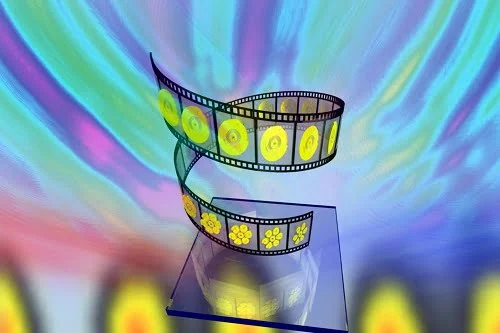
The earliest technique this review could verify from an opened primary source is D. J. DeBitetto's paper in Applied Optics, published in August 1969, titled 'Holographic Panoramic Stereograms Synthesized from White Light Recordings'. A separate United States patent filed in 1976 and granted in 1980, for a 'system for synthesizing strip-multiplexed holograms', describes the specific method in more detail: cinema film of a rotating subject is projected frame by frame, each frame is optically compressed into a narrow vertical strip, and the holographic plate is shifted sideways between exposures so a sequence of adjacent strips, one per film frame, is recorded side by side. This review could not independently verify a primary record specifically naming a 1974 artwork made this way; what is documented is the underlying technique and its patent, not that particular claim, and this entry is written to the evidence that could be opened.
Why walking past it makes it move
Each narrow strip on the finished plate reconstructs one film frame, visible only from the narrow range of angles that strip was recorded from. Because the strips are arranged in the same sequence the film frames were shot in, a viewer walking sideways along the plate passes from one strip's viewing zone into the next, and sees the corresponding film frames in sequence, reconstructing the original motion as apparent motion parallax. The patent states the result can be bent into a cylinder and lit from a single point source, so a viewer walking around the outside sees the recorded action play out in a loop. Unlike a laser-transmission hologram viewed from a fixed position, this technique's entire effect depends on the viewer moving.
Where the museum record helps, and where it stops
The Science Museum Group's collection holds physical multiplex holograms made by Martin Richardson at the Royal College of Art in 1984 using this family of technique, confirming it was practised as a craft beyond the originating patent, in a UK teaching and studio context rather than only a US patent filing. The collection record gives maker, date and material for those specific objects; it does not extend the technique's documented history back to 1974 on its own, and this review has not found a primary record that does.
Questions to bring to a demo
- Is the moving image reconstructed optically from recorded strips, or is it a modern display simulating the same walk-by parallax electronically?
- How many discrete viewing strips make up the recorded motion, and how coarse is the resulting parallax?
- What light source and viewing geometry does the piece require, and how does that limit where it can be displayed?
The multiplex stereogram matters as a precursor to today's light-field and multi-view displays because it solved motion parallax optically, decades before any of that could be done electronically. The precise date attached to any specific historic artwork made this way is a separate, narrower claim from the technique itself, and this entry keeps the two apart.
Sources & reading trail
Optica publisher record establishing the earliest verified technique for synthesising a panoramic holographic stereogram from a sequence of conventional white-light film recordings.
Source published: 1 August 1969 · Retrieved: 16 September 2026
Patents the specific method, anamorphic strip recording from sequential movie-film frames laterally shifted across a photographic plate, used to synthesise an animated, motion-parallax multiplex hologram.
Source published: 10 June 1980 · Retrieved: 16 September 2026
UK national collection record documenting physical multiplex hologram artefacts (Martin Richardson, Royal College of Art, 1984) made using this strip-multiplex technique.
Source published: Not established · Retrieved: 16 September 2026
Primary documents establish the record; the mechanism reading and the demo questions are Presence Atlas editorial analysis. This retrospective draft does not imply the site published on the event date.
Continue reading
- Ives patented a slotted screen that split a photo per eye
- A UK museum catalogues 901 hologram-related items online
- Browse the complete the archive
Sources & reading trail
- Holographic Panoramic Stereograms Synthesized from White Light Recordings
Source published: August 1, 1969 · Retrieved: September 16, 2026 - System for synthesizing strip-multiplexed holograms (US4206965A)
Source published: June 10, 1980 · Retrieved: September 16, 2026 - Science Museum Group Collection — multiplex hologram search results
Retrieved: September 16, 2026
The documents above establish the record. The reading and the questions are this publication’s editorial analysis, written after the fact.
Published September 18, 2026, not on the date of the event described.