
One collector's hologram archive began with unsold gallery stock
Jonathan Ross's own site traces his collection to a 1978 gallery, SEE 3 (HOLOGRAMS) LTD, and names what it now catalogues.
- Site publication
- September 18, 2026
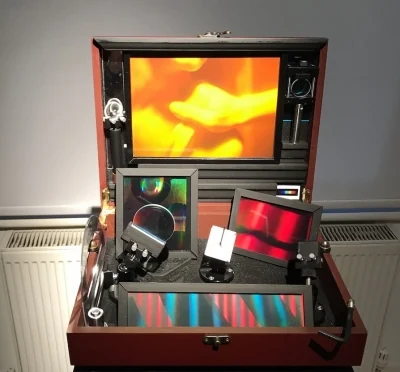
What the collector's own site documents, as retrieved
The collection's background page states that Jonathan Ross began gathering holographic material in 1978, after co-founding a production company, SEE 3 (HOLOGRAMS) LTD, and a gallery, The Hologram Place, in Europe; unsold gallery inventory became the seed of his personal collection. The same page states the site's own purpose plainly: "to document all my exhibitions, to give a taste of what is in my collection, and to introduce it to a still wider audience by means of the internet." It adds that the website itself was "launched in 2005 and redesigned in 2013," and moved to "a cloud-based, green web, hosting service" in March 2025 — small, dated facts about the record's own upkeep rather than about any single hologram in it.
What the site's structure documents
The collection's home page sorts its holdings into named sections that map onto distinct formats: Lenticulars, a ridged-lens parallax format that is not itself a hologram but is catalogued alongside them; named artist collaborations, such as one credited to Berkhout and Nicholson; holograms reproduced in books, magazines and comics; and "The Cabinet," described on the site as "a collection of holographic curiosities." A private collector's own taxonomy is useful evidence in its own right: it shows how someone working inside the trade groups the medium day to day, which is a different, more practitioner-level lens than a national museum's formal object-record schema applies to the same material.
What is not established here
This is a single collector's personal website rather than a peer-reviewed catalogue. Object-level facts for individual holograms — a precise maker, date and technique for each named piece — sit on further linked pages this entry did not open in full, so it can confirm the collection's founding story and category structure without confirming an exact item count or a complete artist list. The site's own history of repeated redesigns, most recently a 2025 hosting move, is also a caution: some linked pages returned only placeholder or templated text during this research, a limitation of an independently maintained archive rather than one with an institution's sustained technical upkeep behind it.
- Does a specific hologram's own linked page give a maker, date and technique, or only a caption?
- How does this collector's category scheme compare with a national museum's formal cataloguing of the same medium?
- What happens to public access to the archive if its current, independent maintenance stops?
The founding story and the site's own category structure are documented in the collector's own words; the depth and consistency of the underlying object records vary page to page in a way an institutional catalogue generally does not.
Sources & reading trail
States the collection's 1978 origin via SEE 3 (HOLOGRAMS) LTD and The Hologram Place gallery, and the website's own launch and redesign history.
Source published: Not established · Retrieved: 16 September 2026
Shows the site's own category structure for the collection, including lenticulars, artist collaborations, print holograms and a curated cabinet.
Source published: Not established · Retrieved: 16 September 2026
Primary documents establish the record; the mechanism reading and the demo questions are Presence Atlas editorial analysis. This retrospective draft does not imply the site published on the event date.
Continue reading
- A UK museum catalogues 901 hologram-related items online
- Browse the complete the archive
Sources & reading trail
- Background (Jonathan Ross Hologram Collection)
Retrieved: September 16, 2026 - Jonathan Ross Holography Collection — home
Retrieved: September 16, 2026
The documents above establish the record. The reading and the questions are this publication’s editorial analysis, written after the fact.
Published September 18, 2026, not on the date of the event described.