
A patented 2001 screen design lets a room share one 3D view
Holografika's patent and site describe modules and a screen giving unlimited viewers real motion parallax.
- Historical event
- May 18, 2001
- First source published
- February 14, 2006
- Site publication
- September 18, 2026
What the record documents
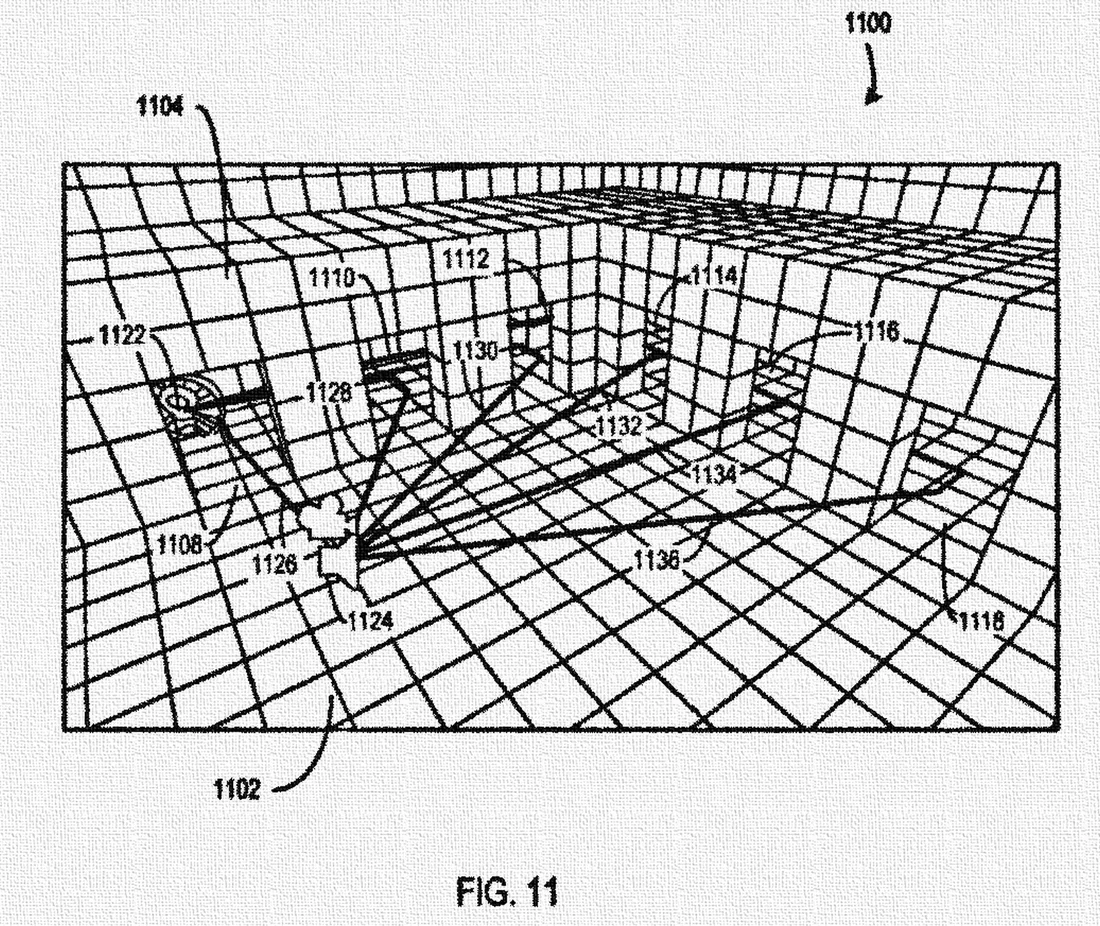
A patent titled 'Method and apparatus for displaying 3d images', filed by inventor Tibor Balogh on 18 May 2001 and granted in 2006, describes the core mechanical idea behind what Holografika later marketed as the HoloVizio system: many identical optical projection modules arranged in rows, each built from a microdisplay, collimating optics and a lens acting as a deflecting element, all aimed at a single specialised screen. The patent's priority date of 19 May 2000 places the underlying idea a year earlier still. Holografika's own company site, current as retrieved on 16 September 2026 rather than dated to a specific announcement, states that HoloVizio 'is not a stereoscopic or multi-view system' and, just as explicitly, 'is not a purely holographic system' either - an unusually direct piece of vendor self-classification worth taking at face value.
What creates continuous parallax
Rather than a lenticular sheet splitting a handful of discrete views, the patent describes a 'directionally selective transmitting and/or reflecting screen' fed simultaneously by dozens of projection modules, each contributing light rays travelling in a specific direction. The company's technology page describes this in its own vocabulary as 'voxels of the holographic screen' that 'emit light beams of different intensity and colour to the various directions' - every point on the screen is, in effect, broadcasting a slightly different picture down every angle at once, rather than one picture the same way to everyone. The practical result, per the company's own description, is that an 'unlimited number of viewers can watch simultaneously the same 3D image', each 'from his or her own perspective', with no glasses, head tracking or headgear required.
What the evidence does not establish
Neither the patent nor the current company pages state how many physical projection modules a given screen size requires, what that hardware costs to build or maintain, or how wide the resulting shared viewing zone is in metres or degrees. A design built from dozens of precisely aligned projectors behind one screen is, by its own description, an optically complex and module-intensive way to produce continuous horizontal parallax - the tradeoff for shared, glasses-free, wide-angle viewing is evidently a great deal of projection hardware, though the sources reviewed here do not quantify exactly how much.
Questions to bring to a demo
- How many projection modules does a given screen size use, and how does that scale with screen width?
- What happens at the physical edge of the screen's viewing zone, rather than at the centre of the room?
- How does image brightness compare with a conventional single-projector display of the same size?
The company's refusal to call its own system either 'multi-view' or 'purely holographic' is a useful discipline: the patent describes a real, dated, genuinely different way of building parallax, distinct from both categories this site treats carefully elsewhere.
Sources & reading trail
Describes the multi-projection-module and directional-screen mechanism, filed 18 May 2001 with a priority date of 19 May 2000.
Source published: 14 February 2006 · Retrieved: 16 September 2026
States that HoloVizio is neither a stereoscopic/multi-view system nor a purely holographic one, and that an unlimited number of viewers can watch simultaneously.
Source published: Not established · Retrieved: 16 September 2026
Describes the screen's voxels emitting light of different intensity and colour in different directions.
Source published: Not established · Retrieved: 16 September 2026
Primary documents establish the record; the mechanism reading and the demo questions are Presence Atlas editorial analysis. This retrospective draft does not imply the site published on the event date.
Continue reading
- A light field is a claim about how many rays you capture
- A barrier or a lens decides which pixels reach which eye
- A 2005 survey split true 3D displays into two working classes
- Browse the complete the archive
Sources & reading trail
- Method and apparatus for displaying 3d images
Source published: February 14, 2006 · Retrieved: September 16, 2026 - Holografika
Retrieved: September 16, 2026 - Technology principles
Retrieved: September 16, 2026
The documents above establish the record. The reading and the questions are this publication’s editorial analysis, written after the fact.
Published September 18, 2026, not on the date of the event described.