
Digital Domain's own filings never called Tupac's return a hologram
SEC filings describe a 'virtual' Tupac Shakur performance without naming the projection mechanism the press called a hologram.
- Historical event
- April 14, 2012
- First source published
- May 16, 2012
- Site publication
- September 18, 2026
What the company's own filings say happened
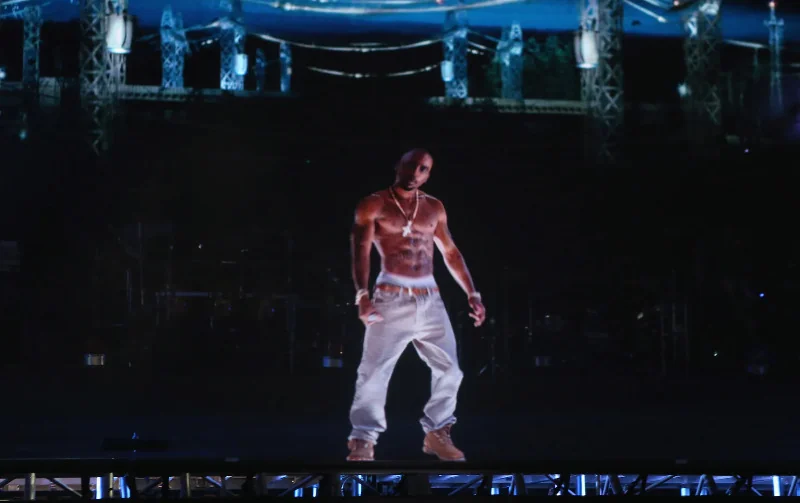
Digital Domain Media Group's 16 May 2012 earnings release, filed as an exhibit to an 8-K, states that a virtual Tupac Shakur joined his friends Dr. Dre and Snoop Dogg onstage at the Coachella Music Festival on 14 April 2012, framing it as the launch of the company's Virtual Performer business. A follow-up 23 May 2012 filing repeats the claim, describing Digital Domain as the company behind the Tupac Shakur virtual performance and noting a wave of inbound requests for similar productions. Both are regulatory disclosures written to describe a business opportunity to investors, not technical documents, and neither names a display method.
A reflection, not a reconstructed image
Neither filing uses the word hologram, projection, foil or screen. That silence is informative: a company happy to call the event a commercial breakthrough was not willing to put a specific technical claim into a document it must stand behind. The word hologram was supplied by press coverage. A CBS News report on the wider industry states that the projection technology for that stunt is now owned by a company called Hologram USA, and quotes that company's chief executive describing how this class of system works: the projectors bounce an image off a cinema screen nestled to the floor, reflected up at a 45-degree angle. That is the Pepper's ghost principle, a flat reflected image correct only within a limited viewing cone, carried out at concert scale, not a volumetric or wavefront-reconstructed hologram.
What the record does not settle
Because Digital Domain's own filings are silent on mechanism, this account cannot say from company documents alone exactly whose foil, screen or rigging stood on the Coachella stage that night. What the record does establish is that ownership and control of this general technique became contested: the same CBS report notes the technology's ownership passed to Hologram USA, a company that went on to litigate patent claims against rival producers using similar reflection rigs. The dispute was over a delivery mechanism, not over any claim to have achieved true holography.
- Does a producer's press material ever name the actual optical technique, or only the outcome?
- Who currently owns the rights to the specific rig used, and could that affect future revivals?
- Would the illusion read differently from a seat outside the front-of-house viewing cone?
The lesson here is less about Tupac Shakur than about disclosure: a public company will describe a technological achievement in a securities filing while leaving the technology itself undescribed, and it falls to trade press, patent records and later litigation to fill the gap the company chose not to.
Sources & reading trail
Company's own earnings release stating a virtual Tupac Shakur performed at Coachella on 14 April 2012, without naming a display mechanism.
Source published: 16 May 2012 · Retrieved: 16 September 2026
Follow-up filing describing Digital Domain as the company behind the Tupac Shakur virtual performance.
Source published: 23 May 2012 · Retrieved: 16 September 2026
Secondary journalism identifying Hologram USA as current owner of the Coachella projection technology and quoting its own explanation of the 45-degree reflection mechanism.
Source published: 28 January 2018 · Retrieved: 16 September 2026
Primary documents establish the record; the mechanism reading and the demo questions are Presence Atlas editorial analysis. This retrospective draft does not imply the site published on the event date.
Continue reading
- Rival firms sued over the patents behind a foil illusion
- Pulse Evolution's own SEC filing names Pepper's ghost, not a hologram
- A tensioned foil scaled Pepper's ghost to concert-size stages
- Browse the complete the archive
Sources & reading trail
- Digital Domain Media Group, Inc. 8-K Exhibit 99.1 (16 May 2012)
Source published: May 16, 2012 · Retrieved: September 16, 2026 - Digital Domain Media Group, Inc. 8-K Exhibit 99.1 (23 May 2012)
Source published: May 23, 2012 · Retrieved: September 16, 2026 - Bringing musical stars back via hologram (CBS News)
Source published: January 28, 2018 · Retrieved: September 16, 2026
The documents above establish the record. The reading and the questions are this publication’s editorial analysis, written after the fact.
Published September 18, 2026, not on the date of the event described.