
RealD's silver screen fixed 3D cinema's ghosting problem
RealD's SEC filings date cinema 3D's single-projector polarisation system to November 2005 and later flag its own declining demand.
- Historical event
- November 1, 2005
- First source published
- June 10, 2011
- Site publication
- September 18, 2026
What RealD's own filings document
RealD Inc.'s annual report for the fiscal year ended March 2011 states that its cinema 3D system was first commercially deployed in November 2005, when Walt Disney released Chicken Little on roughly 100 RealD-enabled screens. By the filing date, the company reported about 15,000 screens across 61 countries. Growth continued: a later 10-K covering the year to March 2013 put deployment at approximately 22,700 screens in 68 countries, representing roughly half of an estimated 46,000 3D-enabled screens worldwide at the end of 2012, with domestic RealD-enabled screens carrying about 80 per cent of domestic 3D box office.
One projector, a spinning polarisation switch, a silver screen
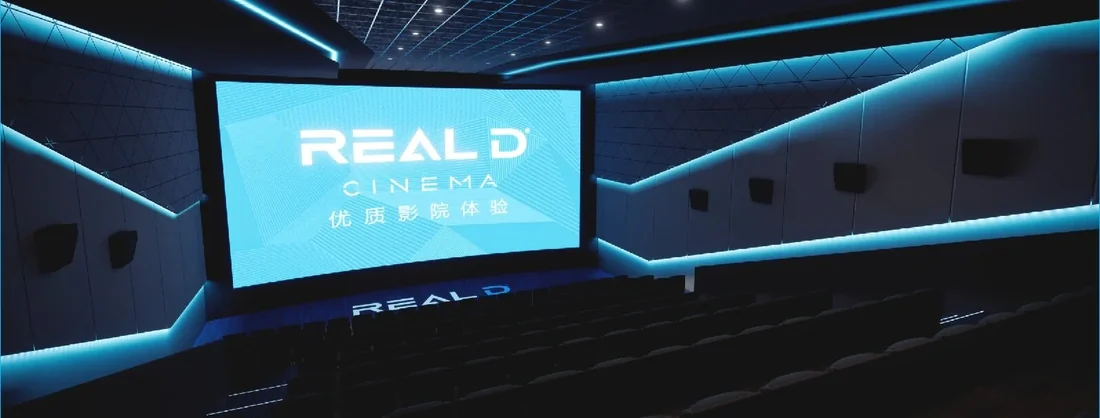
RealD's own description of the mechanism, given in the 2011 filing, is a single digital projector alternating left- and right-eye frames at high speed through a polarisation-switching device mounted in front of the lens, which the company calls its cinema system. The image lands on a silver-coloured screen chosen to preserve polarisation on reflection, and viewers wear disposable circularly polarised glasses rather than the active shutter glasses or dual-projector rigs common before it. Circular polarisation keeps left and right images separated even if a viewer tilts their head, unlike linear polarisation, which the filing credits with reducing the ghosting and eye strain associated with earlier dual-projector 3D. A single-projector design also meant exhibitors converting to digital projection could add 3D with one extra device and a screen change, not a second projector and an alignment problem.
The same filings record the downturn beginning
The 2013 filing does not only report growth; it states, as a risk factor, that domestic consumer preference was already trending toward 2D over 3D, that there was no guarantee studios would keep producing 3D titles, and that competitors including IMAX were gaining share. It also records a revenue decline in fiscal 2013 against fiscal 2012. Read together, the two filings frame a lifecycle: a specific technical fix for dual-projector 3D's problems, rapid screen deployment tied to major releases, and then a company acknowledging in its own risk disclosures that audience appetite and studio supply, not the display technology, had become the binding constraint.
- How many screens in a given market are still equipped with functioning RealD hardware today, and is it still serviced?
- Does a current 3D release's box office share match the historical RealD-enabled figures these filings reported, or has the format's share fallen further?
- Is a venue's silver screen still in good enough condition to preserve polarisation, or has it degraded since installation?
A polarisation-switching projector and a silver screen solved a specific technical problem well enough to reach tens of thousands of screens; the same company's later filings show that solving the display problem did not guarantee a lasting supply of reasons to put the glasses on.
Sources & reading trail
States RealD's system was first deployed in November 2005 on Chicken Little, and describes the single-projector circular-polarisation mechanism and silver-screen requirement.
Source published: 10 June 2011 · Retrieved: 16 September 2026
Reports approximately 22,700 RealD-enabled screens across 68 countries by March 2013, and states risk factors around declining consumer preference for 3D.
Source published: 6 June 2013 · Retrieved: 16 September 2026
Primary documents establish the record; the mechanism reading and the demo questions are Presence Atlas editorial analysis. This retrospective draft does not imply the site published on the event date.
Continue reading
- Stereo depth has a comfort zone, and it narrows up close
- Browse the complete the archive
Sources & reading trail
- RealD Inc. Annual Report (Form 10-K) for the fiscal year ended March 25, 2011
Source published: June 10, 2011 · Retrieved: September 16, 2026 - RealD Inc. Annual Report (Form 10-K) for the fiscal year ended March 31, 2013
Source published: June 6, 2013 · Retrieved: September 16, 2026
The documents above establish the record. The reading and the questions are this publication’s editorial analysis, written after the fact.
Published September 18, 2026, not on the date of the event described.