
BASE Hologram named its own projector, not a hologram principle
BASE Entertainment's 2018 launch announcement names Epson projection technology for its Roy Orbison and Maria Callas tours.
- Historical event
- January 11, 2018
- First source published
- January 11, 2018
- Site publication
- September 18, 2026
What the 2018 launch announcement documents
On 11 January 2018, BASE Entertainment announced a new division, BASE Hologram, in a release preserved on the company's own press room page. Founder and CEO Brian Becker is quoted calling it a field with vast potential that many have pioneered but never on this large a scale. The release named two debut productions: a Roy Orbison show launching in the UK with the Royal Philharmonic Orchestra in April 2018, and a Maria Callas production opening in Tokyo in May 2018, with a North American Orbison run to follow that September. It also states that the families of these performers have entrusted the company with their legacies, framing the productions as licensed by each estate. The materials reviewed here document only these two initial shows; any later additions to the company's slate are not covered by this entry.
The one piece of hardware the company did name
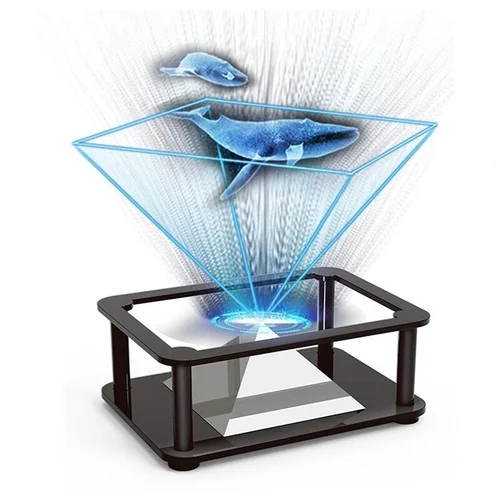
Unusually, the launch release specifies a projector brand: Epson's Pro L-Series laser projection technology, used to deliver bright, vivid images for what the release itself calls a larger-than-life hologram. That is a vendor's own promotional language, and it applies the word hologram to a projected image, not a reconstructed wavefront. A CBS News report on the wider hologram-touring business describes how this class of system works in practice, quoting a rival firm's chief executive: the projectors bounce an image off a cinema screen nestled to the floor, reflected up at a 45-degree angle. That is the reflection principle documented in stage-projection patents such as US7883212B2, not a wavefront hologram. The same report quotes BASE's own Marty Tudor describing how the Callas performance was built: a body double performed on camera for twelve weeks, after which effects artists superimposed a computer-generated face onto that footage.
What is documented, and what is asserted
BASE's own announcement documents the estates' licensing arrangement, the projector brand, and the production timeline. It does not document the screen material, its angle, or the venue-by-venue viewing conditions audiences actually sat within. The 45-degree reflection description comes from a competitor's executive discussing the category generally, not from BASE's own technical literature about this specific rig, and should be read as informative but not a confirmed specification of BASE's own equipment.
- Does hologram in a producer's press release mean anything more precise than a large projected image?
- What did the estate actually license: a likeness, a specific performance, or both?
- How is a body double's performance blended with archival vocals, and where does that process introduce interpretation?
The launch announcement is candid about the business arrangement and about one supplier's name, and silent on the optics that make the illusion work. That pattern, precise about commerce and vague about mechanism, recurs across this entire category of touring show.
Sources & reading trail
Company's own launch announcement for BASE Hologram naming Epson projection technology, debut productions and estate-licensing language.
Source published: 11 January 2018 · Retrieved: 16 September 2026
Patent documentation of the general reflective-screen mechanism family this category of show belongs to.
Source published: 8 February 2011 · Retrieved: 16 September 2026
Secondary journalism quoting BASE's own Marty Tudor on body-double capture and a rival executive's description of the 45-degree reflection technique.
Source published: 28 January 2018 · Retrieved: 16 September 2026
Primary documents establish the record; the mechanism reading and the demo questions are Presence Atlas editorial analysis. This retrospective draft does not imply the site published on the event date.
Continue reading
- A tensioned foil scaled Pepper's ghost to concert-size stages
- Rival firms sued over the patents behind a foil illusion
- Pulse Evolution's own SEC filing names Pepper's ghost, not a hologram
- Browse the complete the archive
Sources & reading trail
- BASE Entertainment Press Room
Source published: January 11, 2018 · Retrieved: September 16, 2026 - Projection apparatus and method for pepper's ghost illusion (US7883212B2)
Source published: February 8, 2011 · Retrieved: September 16, 2026 - Bringing musical stars back via hologram (CBS News)
Source published: January 28, 2018 · Retrieved: September 16, 2026
The documents above establish the record. The reading and the questions are this publication’s editorial analysis, written after the fact.
Published September 18, 2026, not on the date of the event described.